Real slate is gorgeous, cold, brittle, and expensive to install — four facts that explain why stone-look laminate keeps gaining ground. Slate-look laminate, sold in the US mostly as stone-visual tile laminate and known in overseas catalogs as slate effect laminate flooring, reproduces the cleft texture and layered grays of quarried slate on a warm, click-together fiberboard plank. The best current products fool visitors from a standing height, install over a weekend, and cost a third of the real thing. The worst look like a photograph of a rock, because that is literally what they are. Knowing which specs separate the two is the whole game.
What Slate-Look Laminate Actually Is
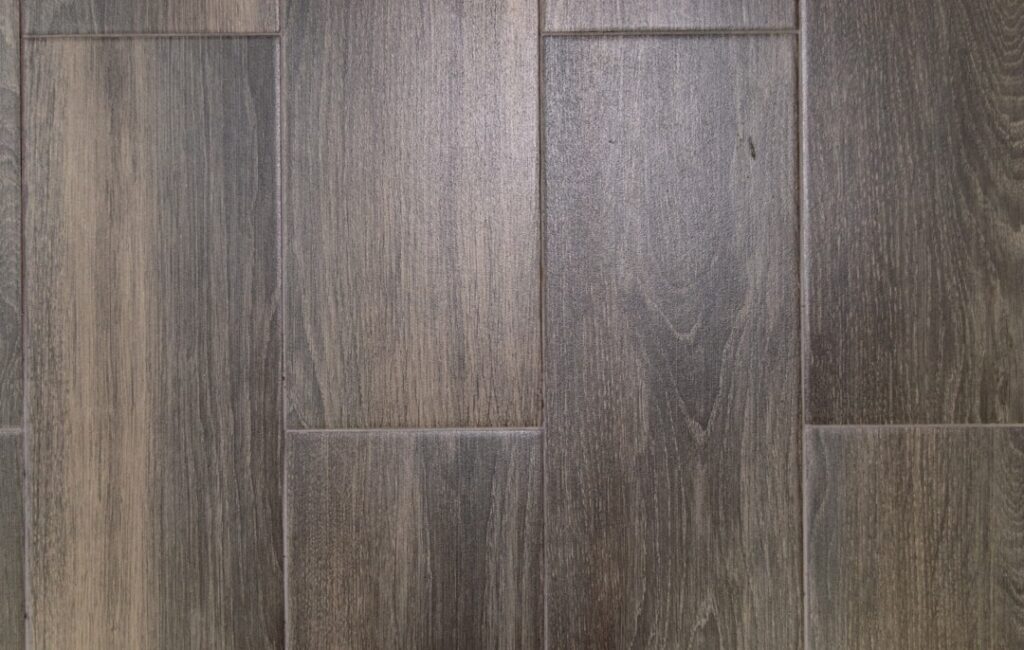
Construction is identical to wood-look laminate: a high-density fiberboard (HDF) core, a photographic décor layer, and a melamine wear layer fused under heat and pressure. Instead of oak grain, the décor layer carries high-resolution scans of genuine slate — charcoal, graphite, rust-veined, and multi-tone gray variations. Formats range from standard planks to large 12-by-24-inch and 16-by-32-inch tile-format pieces designed to read as individual stones.
Two manufacturing details determine realism. Embossed-in-register (EIR) texturing aligns the surface relief with the printed image, so the ridges you feel match the cleft lines you see. And pattern repeat frequency controls how often the same “stone” reappears across the floor; premium lines print many unique faces per décor, while budget product repeats every few planks and gives the illusion away in a large room.
How It Compares to Real Slate
Genuine slate runs $4 to $10 per square foot for the tile plus another $8 to $15 for professional installation over a properly prepared substrate — the stone demands a rigid, crack-isolated setting bed, and installers charge accordingly. Laminate versions cost $1.50 to $4 per square foot in material and click together over foam underlayment with no mortar, no grout, and no sealing schedule. Real slate also spalls, sheds layers underfoot, and needs periodic resealing in wet areas; laminate needs a broom and a barely damp mop.
Stone keeps real advantages. Slate is fully waterproof, lasts a century, works with radiant heat beautifully, and adds a material authenticity a photograph cannot match at close inspection. It is also cold and unforgiving — dropped glasses shatter, and standing at a kitchen counter on stone for an hour tells your knees about it. Laminate is warmer, quieter with the right underlayment, and far more comfortable, but it is a 15-to-25-year floor, not a forever one.
Slate-Look Laminate vs. Porcelain Slate-Look Tile
Porcelain tile printed with slate visuals is the middle path many buyers weigh. Porcelain wins on water: it is fully waterproof and belongs in showers and mudroom wet zones where laminate never will. Tile pricing lands between the other options, roughly $3 to $7 per square foot material plus $6 to $12 installed.
Laminate answers with comfort, speed, and DIY-friendliness. A competent homeowner floats 400 square feet of click-lock tile-format laminate in a weekend with a saw, spacers, and a tapping block — no thinset cure times, no grout haze, no tile saw rental. Underfoot, laminate flexes slightly and holds room temperature, while porcelain matches stone for coldness. For living rooms, dining rooms, and hallways where the slate look matters more than submersion-proof performance, laminate is the pragmatic pick.
Texture and Finish Options Worth Seeking Out
Not all slate visuals are equal, and showroom lighting hides the differences. Prioritize these features when comparing samples:
- Embossed-in-register cleft texture: The surface relief must follow the print. Generic stipple texture over a slate image looks wrong at any angle with window light.
- Matte or low-satin finish: Real slate has almost no sheen. Glossy “wet look” finishes read as plastic immediately.
- Beveled or grout-line edges: Tile-format pieces with a shallow, darker bevel mimic grout joints and sell the stone illusion; square unbeveled edges make the floor read as a printed sheet.
- Multiple unique faces: Ask the retailer how many distinct décors the line prints. Lay out six loose planks in daylight and hunt for repeats before buying.
Durability Specs to Demand
Treat the AC abrasion rating as non-negotiable. AC3 handles ordinary residential traffic; AC4 is worth the modest upcharge for entryways, kitchens, and homes with dogs, since stone visuals typically go in the hardest-working rooms of the house. Thickness matters for feel and forgiveness — 8mm is the sensible floor, and 10mm to 12mm planks sound and feel noticeably more like stone underfoot while bridging small subfloor dips.
Water resistance deserves close reading. Modern water-resistant laminate lines carry surface-spill warranties of 24 to 72 hours, which makes slate-look laminate viable in kitchens and half baths. Standard HDF-core product without those claims swells at the seams from repeated wet mopping alone. Whatever the carton promises, the weak point is always the click joint, so check whether the edges are wax-sealed and whether the warranty covers subfloor-side moisture (it almost never does — use a vapor barrier on concrete).
Best Rooms and Layout Tips
Slate visuals thrive where people expect stone: entryways, hallways, kitchens, dining spaces, powder rooms, and finished basements over a proper vapor retarder. The dark, variegated surface hides tracked-in dirt better than pale oak visuals, which is a genuine everyday advantage at a busy back door. Full bathrooms with tubs and laundry rooms remain better served by porcelain or vinyl unless you choose a strongly water-rated line.
Layout sells the illusion. Run tile-format pieces in an offset brick or ashlar pattern rather than stacking joints, and stagger cartons as you work so shade variation distributes naturally. Darker floors show dust and footprints more than mid-tone ones, so households with black-lab-level shedding may prefer a mixed gray décor over deep charcoal. Buy 10 percent overage, and 15 percent for diagonal layouts.
What It Costs Installed
Material pricing clusters in three tiers: $1.50 to $2.50 per square foot for basic 8mm planks with generic texture, $2.50 to $4 for EIR-textured, water-resistant 10mm to 12mm product, and $4 to $5.50 for premium tile-format lines with grout-look bevels. Underlayment adds $0.30 to $0.60 per square foot unless pre-attached, and transitions, quarter-round, and stair nosing typically add $150 to $400 per project.
Professional installation runs $2 to $5 per square foot for a straightforward floating floor, so a 300-square-foot kitchen-and-hall project lands between $1,400 and $2,900 all-in — versus $4,000 to $7,000 for the same footprint in genuine slate. Confident DIYers can cut the installed cost nearly in half, which is the single biggest lever in the whole budget.
Buying Checklist
Bring this list to the showroom and the decision mostly makes itself:
- AC3 minimum, AC4 for entries and kitchens.
- 10mm or thicker with embossed-in-register texture and a matte finish.
- Stated surface-water warranty if the floor is going anywhere near a sink.
- Tile format with beveled grout-look edges for the most convincing stone read.
- Enough cartons from matching lot numbers, plus 10 to 15 percent overage.
- Take a sample home and view it in your own daylight before committing.
Choose on texture and print quality rather than price alone, and slate effect laminate flooring delivers the drama of a stone floor with none of the cold toes, cracked tiles, or sealing chores — a trade most households make happily.
Prefer to explore on your own?
See how new flooring looks in your actual room in seconds — free, no signup.
Try the free Floor Studio →