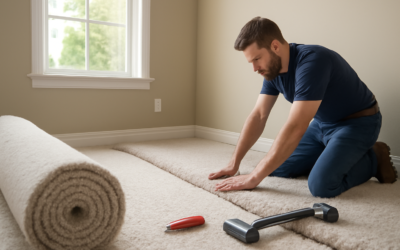
Most people think a cramped bedroom or tiny home office needs a tiny rug to match. That instinct usually backfires. Choosing the right small room carpet is less about scale and more about light, color, and how the eye travels across a floor. Get it right and a 9-by-10-foot space can read as calm and roomy. Get it wrong and the same room feels choppy and closed in. After fitting carpet in hundreds of compact rooms, I can tell you the difference comes down to a handful of decisions you make before a single square foot gets installed.
Why Carpet Works in Small Rooms
Hard flooring bounces sound and shows every transition seam, which visually breaks up a small floor. Carpet does the opposite. It absorbs noise, softens footsteps, and creates one continuous surface that the eye reads as a single plane. That unbroken expanse is exactly what makes a tight room feel larger than its square footage suggests.
There is also the comfort factor. Small rooms are often bedrooms, nurseries, reading nooks, and home offices, the spaces where you want warmth underfoot. A quality carpet with a good pad adds an insulating layer that can cut a chilly slab or drafty subfloor by several degrees in winter. For a room you actually sit and relax in, that matters more than in a busy hallway.
Choosing the Right Color
Color is your single most powerful tool in a small space. Light, cool tones such as pale gray, soft greige, and warm ivory reflect more of the available light and visually push the walls outward. If your room gets limited natural light, lean lighter rather than darker. A medium-toned beige is the forgiving middle ground that hides traffic better than a true white while still keeping things open.
That does not mean dark carpet is off limits. A deep charcoal or navy can make a small den feel cozy and intentional, especially when the walls are kept light to create contrast. The rule I give clients is simple: pick one element to go dark, either the floor or the walls, but rarely both in a room under 120 square feet.
Matching Carpet to Wall Color
- Light walls, light carpet: maximum sense of openness, best for the smallest rooms
- Light walls, mid-tone carpet: grounds the space without shrinking it, the most versatile combo
- Dark walls, light carpet: dramatic and modern, the floor keeps it from feeling like a cave
Pile Height and Texture
Plush, high-pile carpet feels luxurious but can overwhelm a small room and crush quickly under furniture legs. For compact spaces I usually recommend a low to medium pile in the range of 0.25 to 0.5 inches. It is easier to vacuum, resists matting, and reads as crisp rather than shaggy. A textured saxony or a tight-loop Berber both work well because they hide footprints and seams.
If you crave softness underfoot, a frieze with a twisted fiber gives you that cushion without the maintenance headaches of a true shag. Whatever you choose, keep the texture relatively fine. Bold, chunky loops create visual busyness that fights against the calm you are trying to build in a small footprint.
Patterns and Direction
A common myth is that patterns make small rooms look smaller. It depends entirely on the pattern. Subtle tone-on-tone designs, fine pin-dots, and small geometric weaves add interest without clutter. What you want to avoid are large, high-contrast motifs that chop the floor into competing zones.
Direction is a quiet trick the pros use. Running a subtle linear pattern or even just the carpet’s nap toward the longest wall draws the eye down the length of the room and stretches it visually. In a narrow space, orient any directional element along the longer dimension to counteract the bowling-alley effect.
Carpet vs. Area Rug in a Small Room
You have two real options: wall-to-wall carpet or a large area rug over existing flooring. Wall-to-wall maximizes the seamless look and adds the most warmth, but it commits the room to carpet. A large rug gives flexibility and lets you swap styles later. If you go the rug route, size up. A rug that floats in the center with bare floor framing it on all sides actually makes a room feel smaller. Aim to slide the front legs of your furniture onto the rug so it anchors the whole layout.
- Wall-to-wall: seamless, warmest, best resale neutrality, harder to change
- Large area rug: flexible, defines a zone, easier to update with trends
Padding and Subfloor
Do not skimp on the pad just because the room is small. The square footage is low, so the cost difference between a budget pad and a premium 8-pound rebond is often only $30 to $60 for the whole room. A better pad extends carpet life, improves the feel underfoot, and adds sound dampening, which is a real benefit in bedrooms and offices. For most residential rooms, a 7- to 8-pound density pad at 7/16-inch thickness hits the sweet spot.
Before installation, check that the subfloor is clean, dry, and flat. Small rooms make minor humps and dips more noticeable because there is less area for your eye to forgive them. A quick pass with a level and some floor patch saves you from staring at a lump every time you walk in.
Estimating Cost
Because small rooms use so little material, this is one project where you can splurge on quality without breaking the budget. A typical 10-by-10-foot room is roughly 100 square feet, or about 11 square yards. Mid-grade residential carpet runs $2 to $5 per square foot for materials, with installation and pad adding another $1 to $2 per square foot. That puts a complete small-room job in the rough range of $300 to $800 installed, depending on the fiber and region.
One money-saving tip: ask your retailer about remnant rolls. Stores frequently carry end-of-roll pieces large enough to cover a small bedroom or closet at a steep discount, sometimes 40 to 60 percent off the per-yard price. For a compact space, a remnant is often the smartest buy on the floor.
Maintenance for Lasting Looks
Small rooms concentrate foot traffic, so a tight maintenance routine keeps your carpet looking new longer. Vacuum once or twice a week, more in a high-use office. Treat spills immediately by blotting, never rubbing, and keep a small bottle of carpet spot cleaner on hand. Every 12 to 18 months, a professional hot-water extraction refreshes the fibers and lifts ground-in soil that home vacuums miss.
Place a small mat at the door if the room opens to an entry or kitchen, and use furniture coasters under heavy legs to prevent permanent dents. These tiny habits cost almost nothing and add years to your investment.
Final Thoughts
The best small room carpet choice blends a light-to-mid color, a low-to-medium pile, and a subtle texture that keeps the floor reading as one clean surface. Spend your savings on a better pad, orient any pattern along the long wall, and keep contrast gentle. Done right, the floor becomes the quiet foundation that makes a small room feel bigger, warmer, and far more inviting than its square footage would suggest.