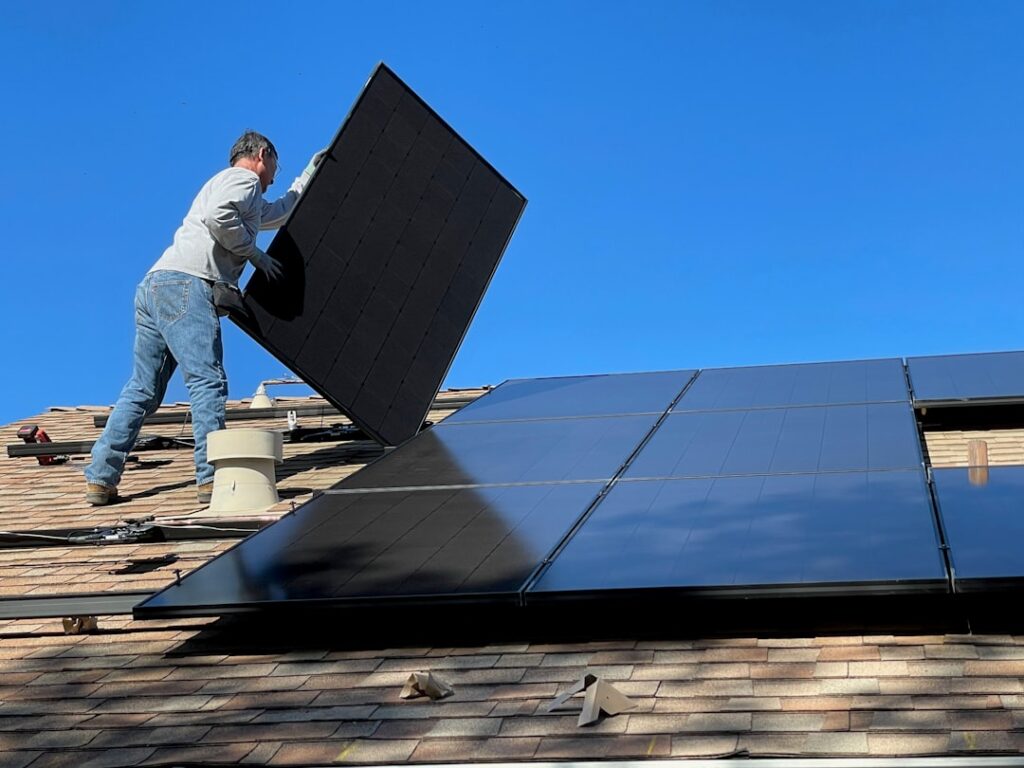
The average American home spends about $1,900 a year on electricity, and roughly two-thirds of that could come off a sunny roof. A solar roof — whether that means integrated solar shingles or conventional panels — is one of the few home upgrades with a calculable payback, but the numbers swing wildly depending on which product you choose. Solar shingles can cost more than double what rack-mounted panels do for the same output. This guide sorts the real options, the honest costs, and the situations where each one actually pencils out.
Two Very Different Products Called “Solar Roof”
Conventional rack-mounted panels bolt to your existing roof through flashed mounts. They are cheap per watt, efficient (22 to 23 percent for premium modules from REC, Qcells, or Panasonic), and any of the thousands of installers in the US can service them. Building-integrated photovoltaics (BIPV) — solar shingles or tiles — replace the roofing material itself, so the roof and the power plant are one product. The look is dramatically cleaner: no racks, no visible modules, just a slightly glossier roof plane.
That aesthetic costs real money. Solar shingles run 15 to 18 percent efficient at best, generate less power per square foot, and lock you into a small pool of certified installers. If your existing roof has 15-plus years of life left, tearing it off to install BIPV destroys the economics before you start.
The Main Solar Shingle Players
Three products dominate the integrated market:
- Tesla Solar Roof: Tempered glass tiles that mix active solar tiles with matching inactive ones covering the whole roof. Expect $60,000 to $120,000 for a full replacement on a typical 2,000 to 2,500 square foot roof, depending on complexity — Tesla prices steep roofs and multiple hips and valleys aggressively. Comes with a 25-year tile, power, and weatherization warranty.
- GAF Energy Timberline Solar: Nailable solar shingles installed by regular GAF roofing crews alongside standard Timberline HDZ architectural shingles. Because it goes on with the reroof and uses roofer labor, it typically lands 10 to 25 percent cheaper than Tesla for similar output. Each shingle produces about 45 watts.
- CertainTeed Solstice and Luma: Lower-profile shingle and tile systems, less common but a fit where the installer network reaches.
A useful benchmark: rack-mounted panels cost roughly $2.50 to $3.50 per watt installed before incentives. Solar shingles run $4.50 to $8.00 per watt — and Tesla quotes have exceeded that on complex roofs.
What a Solar Roof Costs, All-In
For a home needing an 8 kW system (typical for a 2,000 square foot house using 900 kWh a month):
- Panels on an existing sound roof: $20,000 to $28,000 before incentives
- New asphalt roof plus panels: $32,000 to $45,000
- GAF Timberline Solar reroof: $45,000 to $65,000
- Tesla Solar Roof: $60,000 to $120,000
Federal incentives have historically covered a large share — the residential clean energy credit paid 30 percent of system cost, and many states stack rebates, property-tax exemptions, or performance payments on top. Incentive programs change; verify current federal and state terms before signing anything, because a 30 percent swing decides marginal projects. Note that on a BIPV roof, only the solar-generating portion of the cost typically qualifies for energy credits, not the whole roof.
Payback Math That Holds Up
Run the calculation with your own utility rate, not a salesman’s average. An 8 kW system in a decent solar market produces 10,000 to 12,000 kWh per year. At $0.16 per kWh — near the national average — that is $1,600 to $1,900 in offset power annually, assuming your utility credits exports at or near retail (net metering). A $22,000 panel system netting to roughly $15,000 after a 30 percent credit pays back in 8 to 10 years, then produces nearly free power for the remaining 15-plus years of its warranty. That is a solid, defensible return.
The same math on a $90,000 Tesla roof stretches payback past 25 years on energy savings alone. Integrated solar buyers are really paying for two things: a new premium roof they needed anyway, and the appearance. Judged as “a slate-look roof that also erases the power bill,” it can be rational. Judged purely as an investment, panels win every time. States that have moved to reduced export rates — California’s NEM 3.0 cut export credits roughly 75 percent — shift the math toward adding a battery ($10,000 to $16,000 installed) so you consume your own power at night instead of selling it cheap.
Is Your Roof Even a Candidate?
Orientation and shade matter more than the hardware. South-facing planes are ideal; east and west surfaces produce about 15 to 20 percent less. North faces are generally not worth covering above 35 degrees latitude. A roof needs to be shade-free from roughly 9 a.m. to 3 p.m. — one mature oak throwing afternoon shadow can cut production 30 percent, though panel-level microinverters (Enphase IQ8) limit the damage to only the shaded modules. Pitch between 15 and 40 degrees is the sweet spot. And age is the gating question: installers will not mount panels on shingles with under 10 years of life, because removing and reinstalling a system later costs $3,000 to $9,000.
Roof Type Compatibility
Asphalt shingles are the easy case — standard flashed lag mounts, no drama. Standing-seam metal is actually the best solar roof substrate: S-5! clamps grip the seams with zero penetrations, and the 50-year metal outlives two generations of panels. Concrete and clay tile cost $0.50 to $0.75 more per watt because installers must swap tiles for hooks or flashed replacements, and amateur crews crack tiles constantly. Flat roofs use ballasted racks tilted 10 degrees. Wood shake is effectively a no — most installers refuse it for fire and mounting reasons, which makes a reroof-plus-solar package the sensible path.
Maintenance and What Breaks
Panels themselves are boring in the best way — no moving parts, degradation around 0.4 percent per year, and rain handles most cleaning except in dusty or pollen-heavy regions, where an annual rinse recovers a few percent of output. The components that actually fail are electronics: string inverters last 10 to 15 years and cost $2,000 to $4,000 to replace (budget for one swap over the system life), while microinverters carry 25-year warranties and fail individually rather than all at once. Monitor production monthly through the app; a silent 20 percent drop usually means a tripped breaker, a failed optimizer, or new shading, and catching it in March instead of December is worth real money. Solar shingles add a wrinkle — a failed tile means a roofing-plus-electrical service call from a certified crew, which is why the installer’s longevity matters as much as the warranty paper.
Questions to Ask Before You Sign
Get three quotes and compare price per watt, not monthly payment. Confirm the installer is NABCEP-certified and pulls their own permits. Ask who holds the workmanship warranty (10 years should be the floor) and whether the roof penetration warranty is in writing. If the pitch involves a lease or power-purchase agreement, read the escalator clause — a 2.9 percent annual increase compounds into paying more than utility rates by year 15, and a leased system complicates a home sale. Ownership, whether cash or a straightforward loan, keeps the incentives and the value with you.
The Bottom Line
If your roof is healthy and you want the fastest payback, rack-mounted panels are the answer — 8 to 11 years to break even in most states, quicker where power is expensive. If your roof is due for replacement anyway, price a GAF Timberline Solar reroof against a conventional roof-plus-panels package; the gap has narrowed enough to make it a fair fight. Choose a Tesla-style full solar roof only when appearance is a top-three priority and the budget absorbs a premium roof. In every case, the cheapest kilowatt-hour is still the one you do not use — air sealing and attic insulation return money faster than any solar product, so fix the envelope first and size the system smaller.