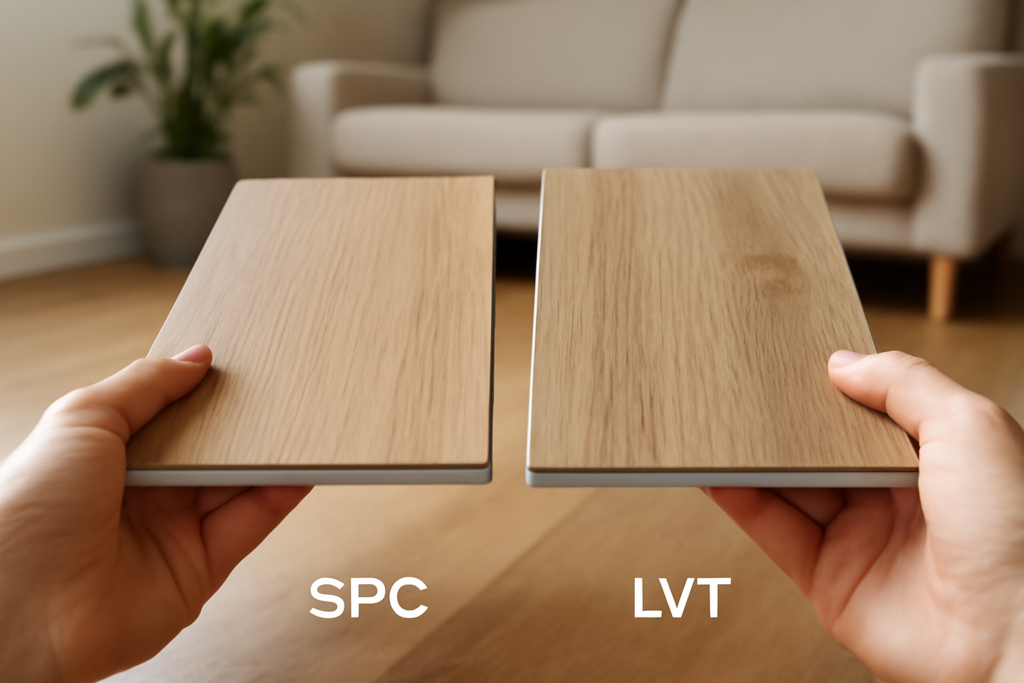
Stand in a flooring showroom and two planks can look absolutely identical — same oak grain, same beveled edge, same waterproof claim — yet one costs twice as much and behaves completely differently underfoot. Understanding SPC and LVT vinyl flooring is the key to not overpaying or, worse, buying the wrong floor for the room. The confusion is understandable because SPC is technically a type of LVT, but in everyday retail terms the two names describe products with very different cores, feel, and ideal uses. Here is what separates them and how to choose.
The Terminology, Untangled
LVT stands for luxury vinyl tile, an umbrella term for high-quality vinyl planks and tiles built from multiple layers with a printed design film and a protective wear layer. Traditional LVT has a flexible PVC core. SPC stands for stone plastic composite, sometimes called stone polymer composite, and it is a rigid-core evolution of LVT.
So when a store separates “LVT” from “SPC,” they usually mean flexible glue-down or loose-lay luxury vinyl on one side and rigid click-lock stone-core planks on the other. Keep that framing in mind and the comparison gets clear.
What’s Inside Each Core
The core layer is where the two truly diverge, and it drives almost every performance difference.
SPC Core
SPC uses a dense composite of limestone powder (calcium carbonate), PVC, and stabilizers pressed into a rigid, stone-hard board. It does not flex when you hold a plank horizontally. That rigidity makes it dimensionally stable, dent resistant, and able to bridge minor subfloor imperfections.
LVT Core
Flexible LVT uses a plasticized PVC core that bends in your hands. It is thinner and softer, which makes it conform to the subfloor — for better and worse. It feels a little warmer and quieter but shows every bump beneath it.
Durability and Dent Resistance
This is SPC’s home turf. Because the stone-composite core is so hard, SPC shrugs off heavy furniture legs, dropped pots, and pet claws better than flexible LVT. If you have a busy kitchen, big dogs, or roll a heavy office chair around, SPC’s rigidity resists the point-load dents that can pock softer vinyl.
Flexible LVT is still tough on the surface thanks to its wear layer, but its softer core can telegraph subfloor debris and take dents from concentrated weight. For pure impact durability, SPC wins.
Comfort and Sound
Softer is not always worse. Flexible LVT feels a touch more forgiving underfoot and can be quieter, which some homeowners prefer in bedrooms and living rooms. SPC is harder and, without a good attached pad, can sound and feel more like tile. Many SPC products now ship with an attached IXPE or cork underlayment that closes much of that comfort gap and cuts hollow footstep noise.
If underfoot softness and warmth top your list, LVT has a slight edge. If you do not mind a firmer feel — or you add a quality pad — SPC is perfectly comfortable.
Installation Differences
How each goes down often decides the project.
- SPC is almost always click-lock and floats over the subfloor. No glue, fast DIY installs, and it tolerates a less-than-perfect subfloor because the rigid planks bridge small dips.
- Flexible LVT is commonly glue-down or loose-lay. Glue-down bonds solidly and feels dead flat, but demands a flawless, fully prepped subfloor and more labor.
Because SPC clicks together with no adhesive, it is the friendlier weekend project. Glue-down LVT rewards you with a rock-solid floor but asks for meticulous prep and patience.
Temperature Stability
Here is a practical difference people learn the hard way. Flexible LVT expands and contracts more with temperature swings, so in a sunroom or a space with big heat changes it can gap or lift at the seams. SPC’s stone core is far more dimensionally stable, holding its shape through heat and cold. For rooms with strong sun exposure or inconsistent climate control, SPC is the safer pick.
Waterproofing
Both are waterproof at the plank level — neither core absorbs water. The difference is at the seams. Click-lock SPC floats, so standing water can eventually reach the subfloor through the joints if a flood sits for hours. Glue-down LVT is sealed to the subfloor, which some consider marginally better for wet zones. In practice both handle kitchens, baths, and laundry rooms well for everyday spills. Just don’t treat either as a substitute for a proper sealed wet room.
Cost Comparison
Pricing overlaps but trends differ. Budget SPC runs about $1.50 to $3 per square foot, with premium lines up to $5. Flexible LVT ranges from roughly $2 to $6 per square foot depending on wear layer and brand, and high-end glue-down commercial LVT can go higher. Factor in installation: SPC’s DIY click install saves labor, while glue-down LVT often means paying an installer, which can add $2 to $5 per square foot.
Which Should You Choose?
Match the product to the room and your priorities:
- Choose SPC for kitchens, entryways, basements, high-traffic areas, homes with pets, rooms with temperature swings, and any DIY floating install over an imperfect subfloor.
- Choose flexible LVT for bedrooms and living rooms where softness and quiet matter, for large open spans best served by glue-down stability, and when you want the most realistic, hand-scraped high-end visuals.
Whatever you pick, prioritize the wear layer thickness — 20 mil or more for busy households — because that clear top layer, not the core, is what protects the look over time.
Thickness and Wear Layer Explained
Two numbers confuse buyers more than any others, so it is worth separating them. Overall thickness is the total height of the plank, measured in millimeters — SPC typically runs 4 to 7 mm, flexible LVT around 2 to 5 mm. The wear layer is the clear protective film on top, measured in mils (thousandths of an inch), and it has nothing to do with overall thickness.
A thick plank with a thin wear layer will scratch quickly; a thinner plank with a 20-mil wear layer will outlast it. When you compare SPC and LVT products, line up the wear-layer numbers first — that is what actually protects the printed design. For a family home, target 20 mil or more regardless of which core you choose.
Longevity and Warranties
Both floor types are built to last well over a decade in a home. SPC’s rigid core resists the dents and dimensional changes that shorten a floor’s life, and quality SPC often carries residential warranties of 20 to 25 years or even lifetime. Flexible LVT warranties are strong too, especially glue-down commercial-grade products, but the softer core makes them slightly more vulnerable to point-load damage over time. Read the fine print: warranties usually require proper subfloor prep, correct underlayment, and the recommended cleaning routine to stay valid.
The Bottom Line
SPC and LVT vinyl flooring share the same waterproof, wood-look DNA, but the rigid stone core of SPC delivers superior dent resistance, temperature stability, and easy click installation, while flexible LVT offers a softer, quieter feel and glue-down solidity. For most homeowners tackling a durable, DIY-friendly waterproof floor, SPC is the practical winner. Choose LVT when comfort, high-end visuals, or a fully bonded floor matter more than rigidity. Know which core you are buying and you will get exactly the floor the room needs.
Prefer to explore on your own?
See how new flooring looks in your actual room in seconds — free, no signup.
Try the free Floor Studio →