Walk the vinyl aisle at any flooring store in 2026 and most of the planks you pick up will be stone-based, not the flexible vinyl of a decade ago. SPC rigid core flooring — stone plastic composite — has become the default luxury vinyl construction because its dense limestone-and-PVC core shrugs off dents, hides nothing under a topcoat of realistic printed visuals, and installs over imperfect slabs that would telegraph through softer products. It is not perfect: SPC is colder and harder underfoot than its WPC cousin, and the quality spread between bargain and premium lines is wide. Here is what actually matters when you buy it.
What Is Inside an SPC Plank?
SPC stands for stone plastic composite (sometimes stone polymer composite). The core is roughly 60 to 70 percent calcium carbonate — powdered limestone — blended with PVC and stabilizers, then extruded into a dense, rigid board. A typical plank stacks five layers: an attached underlayment pad (usually 1mm to 1.5mm of IXPE or EVA foam), the SPC core, a printed vinyl design layer, a clear wear layer, and a UV-cured urethane finish on top.
Density is the defining trait. SPC cores run around 1,900 to 2,100 kg/m³ — roughly twice as dense as a WPC core. That density is why a refrigerator foot or a chair leg that would crater a soft vinyl leaves barely a mark on quality SPC. It is also why the planks are thin for their strength: most SPC runs 4mm to 6.5mm total thickness, while WPC needs 6.5mm to 8mm or more to achieve similar rigidity.
The Real Advantages
- Dent and impact resistance: the compressed stone core resists point loads from furniture, appliances, and dropped pans better than any other vinyl construction.
- 100 percent waterproof structure: the core will not swell, warp, or delaminate from standing water, making it legitimate for kitchens, baths, and basements.
- Dimensional stability: SPC expands and contracts far less with temperature swings than flexible vinyl, so it tolerates sunrooms and homes left unconditioned better — most manufacturers rate it for roughly 0°F to 140°F in the space.
- Forgiving over imperfect subfloors: the rigid core bridges minor slab dips and old tile grout lines that flexible glue-down vinyl would telegraph.
- Floating click installation: no adhesive, installable over concrete, plywood, or existing hard flooring in a weekend.
Price is friendly too. Entry SPC starts around $2 per square foot at box stores, solid mid-range product runs $3 to $4.50, and premium lines with 20-mil or 22-mil wear layers and painted bevels top out around $5 to $7 per square foot before installation.
The Honest Downsides
SPC’s density cuts both ways. The floor feels harder underfoot than WPC, laminate over a good pad, or engineered wood — closer to standing on tile than on wood. If you cook for hours at a stretch, your knees will notice, and dropped glassware is more likely to shatter. The stone core also conducts heat away from bare feet, so SPC reads cold in winter, particularly over an uninsulated basement slab. A quality attached pad helps; so does radiant heat, which most SPC lines permit up to a surface temperature of about 85°F (check the specific warranty).
Two more caveats. Thin 4mm bargain planks with skimpy click profiles can be fussy to lock and prone to edge chipping during installation. And while the core is waterproof, water still finds seams — a flooded room can push moisture through to the subfloor, so “waterproof” protects the floor itself, not necessarily what is underneath it. Sound is worth mentioning as well: without a decent attached pad, SPC can sound clicky and hollow in upstairs rooms.
SPC vs WPC: Which Rigid Core Do You Want?
WPC (wood plastic composite) uses a foamed polymer core — lighter, thicker, and cushioned. The practical differences come down to feel versus toughness:
- Comfort and warmth: WPC wins clearly. Its foamed core gives underfoot and insulates better.
- Dent resistance: SPC wins. Heavy furniture can compress a WPC core over time.
- Temperature stability: SPC handles sunroom heat gain and vacation-home temperature swings better.
- Subfloor forgiveness: both bridge minor flaws, but thicker WPC feels more solid over slightly hollow spots.
- Price: comparable at mid-range; WPC skews slightly higher, often $4 to $7 per square foot.
The rule of thumb most installers use: SPC for kitchens, entries, basements, rentals, and anywhere abuse is likely; WPC for bedrooms, living rooms, and upper floors where comfort and quiet matter more than maximum durability.
Specs That Separate Good SPC from Cheap SPC
Ignore the marketing names and read the spec sheet. Four numbers tell you most of what you need:
- Wear layer thickness: 12 mil minimum for a quiet household, 20 mil for kids, dogs, and rental units, 22-28 mil for commercial-grade abuse. This number predicts how long the floor looks good more than any other.
- Total thickness: 5mm to 6.5mm planks feel more solid and click together more reliably than 4mm bargain product.
- Attached pad: look for 1mm to 1.5mm IXPE, which outperforms basic EVA foam for sound and moisture tolerance.
- Certifications: FloorScore certification for indoor air quality, and ASSURE CERTIFIED on better rigid-core lines.
Reputable widely available lines include Shaw Paragon, COREtec Pro (an SPC line, unlike the brand’s original WPC), MSI Cyrus and XL Prescott, Mohawk SolidTech, and box-store labels like Lifeproof (Home Depot) and NuCore Performance (Floor & Decor). Painted or micro-beveled edges and EIR (embossed-in-register) texture are the visual upgrades that make mid-priced SPC pass for wood at standing height.
Installation Notes From the Field
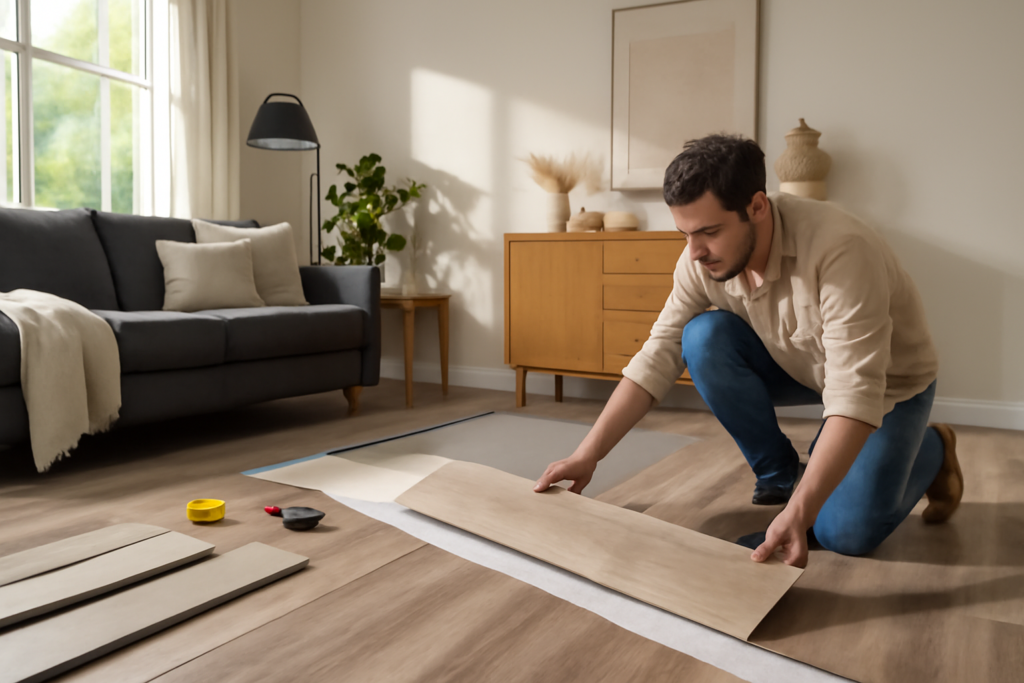
SPC floats, so the subfloor rules are about flatness more than material: most manufacturers want the substrate flat within 3/16 inch over 10 feet. Grind high spots and fill lows with patch compound — a rigid plank rocking on a hump will eventually stress the click joint. Leave a 1/4-inch expansion gap at walls, undercut door jambs, and keep runs under the manufacturer’s maximum (often 50 to 60 feet) before adding a transition.
Cutting is easy: score deeply with a utility knife and snap, or use a jigsaw for notches. Acclimation requirements are milder than wood — typically 24 to 48 hours with cartons laid flat in the room. One field tip: tap planks together with a rubber mallet and tapping block rather than pulling up on the joint to force engagement, because levering a rigid click profile is the fastest way to snap a tongue. Expect a competent DIYer to lay 200 to 300 square feet a day; pros charge roughly $1.50 to $3 per square foot for labor.
Where SPC Makes the Most Sense
Choose SPC rigid core flooring when the room works hard: kitchens with rolling islands and dropped cast iron, mudrooms, basements with occasional moisture, laundry rooms, and rental properties where you want one durable floor throughout. It is also the practical pick over old ceramic tile you do not want to demo, since the rigid core spans thin grout lines cleanly. Skip it where comfort rules — a nursery or a bedroom over a cold garage — or where you want real wood’s resale cachet in a formal living space. Match the wear layer to your household, insist on a proper attached pad, and a mid-priced SPC floor should look presentable for 15 to 25 years with nothing more than sweeping and a damp mop.
Prefer to explore on your own?
See how new flooring looks in your actual room in seconds — free, no signup.
Try the free Floor Studio →