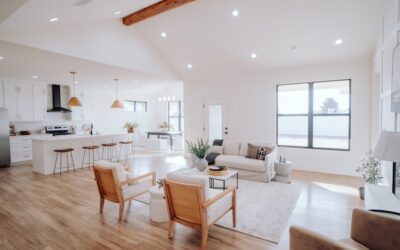
Long before wide plank became the Instagram favorite, American homes were almost universally covered in narrow hardwood boards measuring 2 1/4 inches wide. That classic look is called strip flooring, and it still defines a huge share of prewar houses, bungalows, and traditional builds across the country. Strip boards pack more seams per room than plank, which creates a busier visual rhythm, better stability in humid climates, and a lower material cost when you stick to standard grades. This guide walks through species, thicknesses, installation, real pricing, and the specific scenarios where strip still beats wider options.
What Counts as Strip Flooring
The industry draws the line at 3 inches. Any solid or engineered hardwood board narrower than 3 inches wide qualifies as strip; anything 3 inches or wider is considered plank. The most common strip widths are 1 1/2, 2 1/4, and 2 3/4 inches. Thicknesses run 3/4 inch for solid nail-down, 3/8 inch for thin solid over concrete-friendly subfloors, and 1/2 inch for most engineered products.
Board lengths vary by grade. Select and better grades average 3 to 7 feet with occasional longer pieces. Utility grades ship with shorter 14-inch offcuts mixed in, which is fine for closets and pantries but creates a choppier look in open rooms.
Common Species and Their Quirks
Red and White Oak
Roughly 80 percent of strip flooring installed in the US is oak. Red oak hits a Janka hardness of 1290, handles site finishing beautifully, and stains to almost any tone. White oak runs slightly harder at 1360 and resists moisture better, which matters in kitchens and half-baths. Expect $4 to $7 per square foot for unfinished #1 common oak strips.
Maple
Hard maple hits 1450 Janka and has a tight, nearly uniform grain. It shows scratches faster than oak because of that clean grain, but it takes a clear satin finish wonderfully. Maple runs $5 to $8 per square foot.
Hickory and Pecan
Hickory is the hardest domestic strip option at 1820 Janka. Color variation between heartwood and sapwood is dramatic; some homeowners love the rustic look, others cannot stand it. Budget $6 to $9 per square foot.
Heart Pine and Reclaimed Fir
Reclaimed strip boards pulled from old warehouses run $9 to $18 per square foot before install. Softer than oak at 870 Janka for heart pine, but the patina and tight growth rings are irreplaceable in a historic renovation.
Installation Methods by Subfloor
Solid 3/4 inch strip nails directly to wood subfloor with 2 inch cleats driven at 8 to 10 inch intervals by a pneumatic flooring nailer. On slab, thin 3/8 inch solid can go down with full-spread urethane adhesive like Bostik Best or Sika T-55. Engineered strip floats over foam underlayment or glues down.
Acclimation matters more with strip than with wider formats because you have more seams to absorb humidity swings. Leave boxes in the installation room for 5 to 7 days and check moisture content with a pin meter. Target is within 2 percentage points of the subfloor reading.
Pros of Strip Over Plank
- Better dimensional stability. Narrow boards expand and contract less in absolute inches, so gapping and cupping are less noticeable.
- Lower material cost per square foot. Mills get more yield from the same log cutting strips than planks, and that savings passes through.
- Easier to match a historic home. If your 1940s colonial originally had 2 1/4 inch oak, installing 5 inch plank in an addition will look wrong forever.
- Faster repairs. When a strip gets damaged, you pop out one short board instead of surgically cutting out a 6 foot plank.
Cons Worth Weighing
- More labor to install. A 200 square foot room has roughly twice as many boards as the same room in 5 inch plank, which means twice the nailing and racking time.
- Busier look in large open spaces. Strip flooring can feel visually chaotic in a great room with 14 foot ceilings; wide plank reads calmer.
- Higher finish consumption. More seams mean more edges for stain and sealer to soak into during site finish, bumping material costs by 15 to 20 percent.
- Squeaks multiply with age. Every board joint is a potential squeak; neglected subfloors will complain loudly after a decade.
Installed Cost Ranges
Budget for $8 to $14 per square foot installed for standard 2 1/4 inch prefinished oak, including underlayment and labor. Site-finished jobs in select grade white oak with a custom stain run $12 to $18 per square foot. Reclaimed heart pine with hand-scraping, staining, and three coats of oil-based polyurethane lands between $18 and $28 per square foot. Removal of existing floor adds $1 to $3 per square foot depending on material and adhesive.
Stairs, borders, and medallions get priced separately. Expect $75 to $150 per stair tread and $25 to $60 per linear foot for perimeter borders.
Buying Tips From the Job Site
- Order 10 percent overage for straight runs and 15 percent for rooms with multiple cuts, angles, or diagonal installs.
- Inspect bundles before the truck leaves. Reject any box with visible moisture staining or warped boards at the top layer.
- Buy all bundles from the same mill run. Batch numbers on the side of the carton should match; different runs can shift color by a full shade.
- For site-finished projects, dry-lay a 4 foot by 4 foot section first and shuffle boards to balance color before nailing anything permanent.
- Keep at least one unopened box after the job finishes. Future repairs, refinish samples, and transitions all need donor material.
Maintenance Across Decades
A properly installed strip floor should last 80 to 100 years with periodic refinishing. Expect to screen-and-recoat every 7 to 10 years and do a full sand every 25 to 30 years. A 3/4 inch solid board can tolerate four to six full sandings over its life; engineered strip with a 3 mm wear layer handles two.
Day to day, sweep or vacuum with a bare-floor setting, damp-mop with a pH-neutral cleaner, and keep humidity between 35 and 55 percent year-round. Felt pads under furniture and walk-off mats at exterior doors cut scratch complaints by more than half.
Bottom Line
Strip flooring remains the most honest hardwood choice for period homes, tight budgets, and climates that swing hard between winter dry heat and summer humidity. It costs less per square foot in material, outlasts almost any other floor category when maintained, and holds resale value especially well in traditional neighborhoods. If you love the wide plank look, fine; if you want a floor that quietly disappears into the architecture and lasts a century, narrow oak strips are still the default for good reason.
Prefer to explore on your own?
See how new flooring looks in your actual room in seconds — free, no signup.
Try the free Floor Studio →