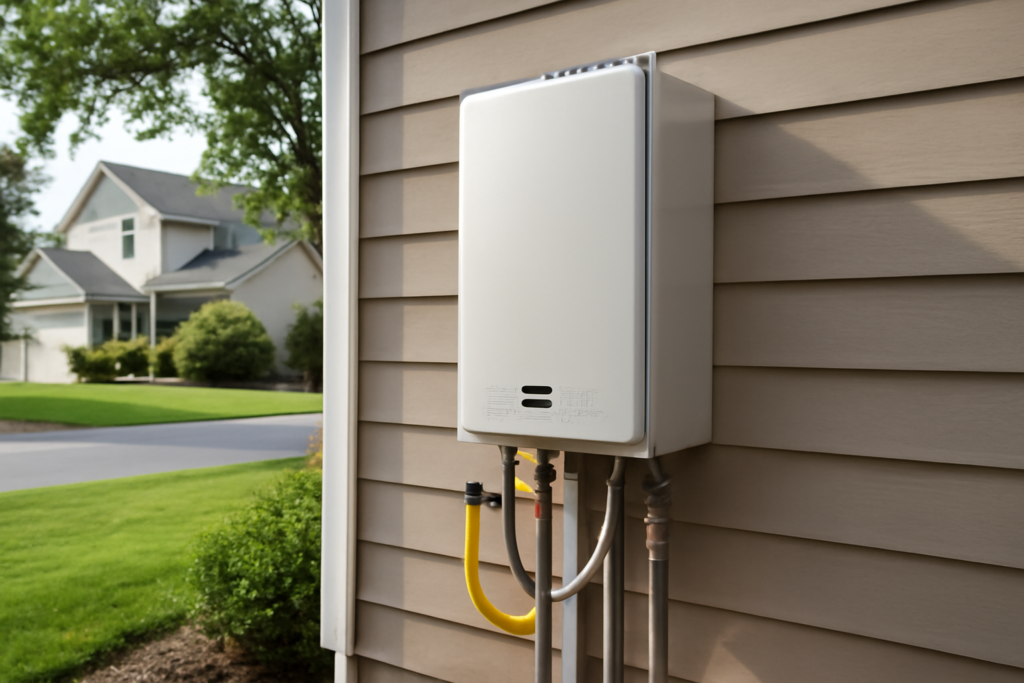
If you’ve shopped for RV or cabin hot water, you’ve almost certainly run into the name. The Suburban tankless water heater is best known in the recreational vehicle world, where Suburban has supplied water heaters to manufacturers for decades, but the same on-demand technology increasingly appeals to homeowners with tiny homes, workshops, and off-grid setups. Understanding what Suburban offers, how their tankless units differ from a traditional tank, and what it takes to install one helps you decide whether endless hot water makes sense for your space.
- Who Suburban Is and What They Make
- How Tankless Beats a Traditional Tank
- Understanding Flow Rate and Sizing
- Fuel and Power Requirements
- Installation Considerations
- Winterizing and Freeze Protection
- Maintenance for Long Life
- Troubleshooting Common Problems
- Understanding Minimum Flow Rates
- Gas Pressure and Ventilation Details
- Is a Suburban Tankless Right for You?
Who Suburban Is and What They Make
Suburban Manufacturing has built water heaters, furnaces, and cooking appliances for the RV and mobile market for over 70 years. Their tank-style RV water heaters are a fixture in travel trailers, but the company also produces on-demand tankless units designed for the tight spaces and propane fuel common in mobile living.
The flagship on-demand model heats water instantly using an LP gas burner and a compact heat exchanger, eliminating the small 6- or 10-gallon tank that limits how long you can shower in a typical RV. For homeowners, this same design suits any small propane-fueled application where a full-size residential unit would be overkill.
How Tankless Beats a Traditional Tank
A conventional water heater keeps 6 to 50 gallons hot around the clock, burning fuel even when no one needs hot water. A tankless unit fires only when you open a hot tap, heating water as it flows through the heat exchanger. The differences add up fast.
- Endless hot water — you’re not limited to a tank’s capacity, so back-to-back showers stay hot
- No standby loss — the burner isn’t cycling to keep a tank warm between uses
- Space savings — the compact unit frees storage that a tank would occupy
- Lighter weight — a real advantage in RVs and mobile installations
The trade-off is flow rate. A tankless unit delivers a steady but limited number of gallons per minute, so running two showers plus a dishwasher can outpace a small unit’s capacity.
Understanding Flow Rate and Sizing
Tankless sizing revolves around gallons per minute and temperature rise. A compact Suburban on-demand unit is designed for point-of-use and small-dwelling loads rather than a full four-bathroom house.
For an RV, tiny home, or cabin, a single shower drawing 1.5 to 2.0 GPM is well within reach. Trying to run a shower and a kitchen sink simultaneously in cold weather, where the incoming water is colder and demands more heating, may exceed a small unit’s capacity. Match the unit’s rated flow to your realistic peak demand, and remember that colder inlet water always reduces the effective flow at a comfortable temperature.
Fuel and Power Requirements
Suburban’s on-demand units run on liquid propane, the standard fuel in RVs, cabins, and many rural properties. The burner needs a reliable LP supply and correct gas pressure to modulate properly, so a properly sized regulator is essential.
Even a gas-fired tankless unit needs 12-volt DC power to run its ignition, controls, and fan. In an RV this comes from the coach battery; in a fixed installation you’ll need a suitable low-voltage supply. Because there’s combustion involved, the unit also requires proper venting to the outside, which is a non-negotiable safety requirement in any enclosed space.
Installation Considerations
Installing a tankless unit is more involved than swapping a tank, and it’s a job many homeowners hand to a professional. The core steps include mounting the unit, connecting the LP gas line, running the water lines, wiring the 12-volt control power, and installing the exterior vent.
- Choose a location with access to gas, water, power, and an exterior wall for venting
- Mount the unit securely, following the clearances in the manual
- Connect and pressure-test the propane line for leaks before firing
- Plumb the cold inlet and hot outlet, adding shutoff valves for future service
- Wire the low-voltage control power and confirm ignition
A leak test on the gas connection is mandatory. Any smell of propane means you stop, shut off the supply, and address the connection before proceeding.
Winterizing and Freeze Protection
One reality of RV and cabin water heaters is freeze risk. A tankless unit’s small heat exchanger holds little water but can still crack if it freezes, so winterizing is critical in cold climates.
Before the first hard freeze, drain the unit completely and run RV antifreeze through the lines, or bypass and blow out the system with compressed air. Some installations add a small heat source or heat tape in the compartment for occasional cold snaps. Skipping winterization is the fastest way to destroy an otherwise reliable unit.
Maintenance for Long Life
Tankless units reward a little annual care. The heat exchanger accumulates mineral scale over time, especially in hard-water areas, which restricts flow and reduces efficiency. Flushing the unit once a year with a descaling solution keeps it running like new.
Also inspect the burner and vent for debris, spiders, and mud daubers, which love to nest in gas appliance components and can block combustion. Check the inlet water filter screen periodically and clean it of sediment. These simple tasks keep a well-installed unit delivering hot water reliably for many years.
Troubleshooting Common Problems
Like any gas appliance, a tankless unit occasionally acts up, and most issues have simple causes. If the burner won’t ignite, the first suspects are low propane pressure, an empty tank, or insufficient 12-volt power to the control board, so check the battery and gas supply before anything else.
Water that runs lukewarm or fluctuates in temperature usually points to low flow, a partially clogged inlet filter, or mineral scale in the heat exchanger restricting performance. Air in the gas line after a tank refill can also cause sputtering ignition that clears after a few cycles. If the unit shuts down mid-shower, the flow may have dropped below the minimum needed to keep the burner lit, a common issue when a low-flow fixture or a nearly closed valve reduces demand too far.
Understanding Minimum Flow Rates
A quirk of tankless technology that catches new owners off guard is the minimum activation flow. The unit needs a certain gallons-per-minute threshold before its flow sensor triggers the burner, often around 0.5 GPM. Open a hot tap only a trickle, and the heater may never fire, leaving you with cold water.
This matters most with low-flow faucets and water-saving showerheads common in RVs and tiny homes. If you find the heater won’t kick on at low flow, opening the tap a bit wider solves it, and choosing fixtures with a flow rate comfortably above the unit’s minimum prevents the problem entirely. Understanding this threshold also explains why very brief hand-washing sometimes doesn’t get hot, the flow simply never reaches the trigger point long enough.
Gas Pressure and Ventilation Details
Two installation details separate a trouble-free unit from a frustrating one: proper gas pressure and correct venting. Propane appliances need the regulator set to the manufacturer’s specified pressure, and a regulator that’s undersized or set wrong causes weak, unstable flames and nuisance shutdowns.
Venting is equally critical and non-negotiable for safety. The unit must exhaust combustion gases directly outside through the specified vent, never into an enclosed compartment, because incomplete combustion produces carbon monoxide. Keep the vent terminal clear of obstructions and away from windows or intakes, and install a carbon monoxide detector in any living space near the heater. These details protect both the unit’s performance and your family’s safety, and they’re worth verifying with a professional if you have any doubt about your installation.
Is a Suburban Tankless Right for You?
For a full-size home with several bathrooms, a residential tankless or a whole-home gas unit will serve you better than an RV-oriented product. But for an RV, tiny home, cabin, workshop, or any small propane-fueled space, a Suburban tankless water heater delivers endless hot water, saves space, and eliminates the standby waste of a small tank. Size it to your real peak demand, vent it properly, and stay disciplined about winterizing and annual flushing, and it becomes one of the most appreciated upgrades in a compact living space.