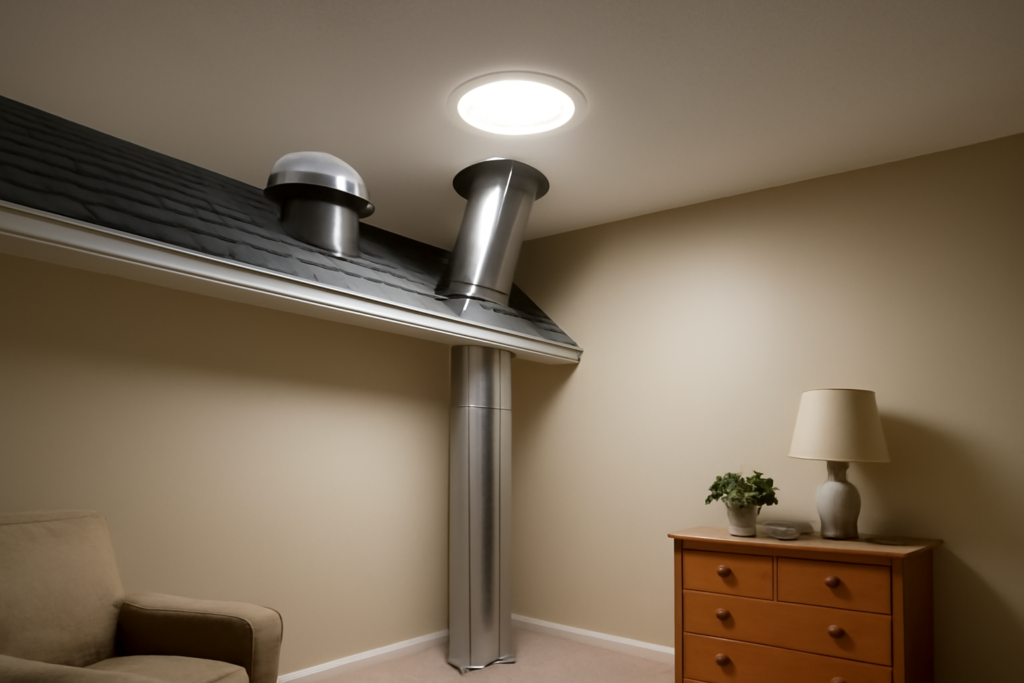
A windowless hallway, a cramped powder room, or a closet you light up every time you walk in can all get free daylight from a fixture the size of a dinner plate. A sun tunnel skylight captures sunlight at the roof and channels it down a reflective tube to a diffuser in the ceiling below. A well-placed unit can throw the equivalent of a 60- to 100-watt bulb of soft, even light into a room with no electricity at all.
These devices go by several names: sun tunnel, solar tube, tubular skylight, or light pipe. They solve a problem traditional skylights cannot, because they fit between rafters and snake around framing to reach rooms a full skylight shaft would never suit. This guide covers how they work, what they cost, and where they shine, plus the roof-penetration realities you should hand to a licensed installer.
How a Sun Tunnel Works
The system has three parts. A clear acrylic dome sits on the roof and gathers daylight from every angle. A highly reflective tube, coated to bounce back more than 98 percent of visible light in premium models, carries that light down through the attic. At the ceiling, a diffuser lens spreads the light evenly across the room so you do not see a hot spot.
Because the tube reflects rather than focuses, the light arrives soft and glare-free, close to natural daylight color. On a bright day a 14-inch tube can light a 200-square-foot room. Output tracks the sun, so you get more light at midday and less at dawn and dusk, and essentially none after dark unless the unit has an integrated LED night kit.
Rigid vs Flexible Tubes
The tube type drives both light output and where the unit can go. Choosing correctly is the single biggest performance decision.
- Rigid reflective tube: A hard, mirror-finish metal pipe that reflects the most light and delivers the brightest result. It needs a fairly straight path from roof to ceiling, though angle adapters allow a bend or two. Best when the attic run is short and mostly vertical.
- Flexible tube: A bendable, accordion-style duct that routes around ductwork, wiring, and framing. It is far more forgiving to install but loses more light at each bend, so it works best on short runs under about 4 feet.
For a run over 4 feet, or any time brightness is the priority, rigid wins. Reserve flexible tubes for tight attics where obstacles make a straight shot impossible. Common tube diameters are 10 inches for small spaces like closets and 14 inches for bathrooms, kitchens, and hallways.
Where Sun Tunnels Work Best
Interior rooms with no exterior wall are the classic candidates: hallways, walk-in closets, laundry rooms, pantries, and small bathrooms. They also suit stairwells and entryways that feel like caves during the day. The ideal home has a simple attic and a roof pitch between 15 and 60 degrees, though low-slope and flat-roof kits exist.
They are less useful where you already have windows, where the attic run would exceed about 20 feet, or where a room needs strong evening light more than daytime brightness. If the ceiling below is a second story with no attic, or the roof is heavily shaded by trees, the payoff shrinks. Match the tube diameter to the room, and do not oversize a closet.
What a Sun Tunnel Skylight Costs
Pricing spans a wide range depending on tube type, diameter, and roof complexity. As a planning guide, expect these figures.
- Unit only: $150 to $500 for a residential kit, with 10-inch flexible units at the low end and 14-inch rigid units with premium coatings at the top.
- Professional installation: $500 to $1,200 installed for a straightforward asphalt-shingle roof.
- Complex roofs: Metal, tile, or slate roofs and long attic runs can push a fully installed job to $1,500 to $2,500.
Add-ons raise the total. A daylight-dimming baffle, an integrated LED night light, or a ventilation model all cost more. Compared with a traditional skylight that often runs $1,500 to $3,000-plus installed with drywall shaft work, a sun tunnel is usually the cheaper way to add daylight.
Installation and Roof Penetration Realities
This is a roof project, and the flashing is what keeps your house dry. The installer cuts a hole through the roof deck, sets a flashed base that integrates with the shingles or tile, and seals the dome so wind-driven rain cannot get under it. A poor flashing job is the number one cause of sun tunnel leaks, and a leak in an attic can rot framing before you ever see a ceiling stain.
Because the work involves cutting the roof, working at height, and sealing a penetration correctly for your specific roofing material, hire a licensed roofer or a factory-certified installer for anything beyond a simple shingle roof. Follow the manufacturer’s instructions to the letter, since flashing kits are material-specific and using the wrong one voids the leak warranty. Confirm local code and permit requirements before you start, as some jurisdictions treat roof penetrations as permitted work.
If you are set on DIY on a simple, low roof, at minimum work with a helper, use fall protection, and never cut a rafter. Reroute the tube around framing rather than removing structure. When the run crosses a truss web or requires cutting anything structural, stop and call a pro.
Sun Tunnel vs Traditional Skylight
Homeowners often weigh a sun tunnel against a conventional skylight, and the two solve related but different problems. A traditional skylight is a framed glass window in the roof, opening to the sky through a drywall shaft. It delivers a lot of light, offers a view of the sky and passing clouds, and some models open for ventilation. It also costs more, often $1,500 to $3,000-plus installed once you account for the light shaft and drywall work, and it introduces more potential for heat gain, heat loss, and leaks.
A sun tunnel trades the view for simplicity and lower cost. Because it uses a small reflective tube instead of a large glass opening, it fits between rafters, routes around obstacles, and rarely needs any shaft framing, which is why it installs faster and cheaper. It also loses far less heat than a big glass skylight. The choice comes down to your goal: if you want a dramatic architectural feature, a sky view, or ventilation, a full skylight fits. If you simply want to erase a dark, windowless room affordably, a sun tunnel usually wins on cost and ease.
Add-Ons Worth Considering
Basic sun tunnels are simple, but several available upgrades extend what they can do. An integrated LED night light kit puts a small electric light inside the diffuser so the fixture provides illumination after dark, turning a daytime-only device into a round-the-clock ceiling light. This requires an electrical connection, so plan for wiring if you want it.
Other options address glare and heat. A daylight-dimming baffle or a remote-controlled shade lets you dial the brightness down in a bedroom or media room. Some kits offer a solar-powered ventilation option that adds a small exhaust function, useful in a bathroom. For hot climates, look at models with a thermal or insulated diffuser to reduce heat transfer. Tube extensions and angle adapters let the unit reach rooms farther from the roof penetration, though remember that each bend and every extra foot of tube costs some brightness. Decide which add-ons you truly need before buying, since they raise both the price and, for the lighted and ventilation options, the installation complexity.
Maintenance and Real-World Performance
Sun tunnels are close to maintenance-free. The acrylic dome may need a rinse every couple of years to clear pollen and grime, and the diffuser can be wiped from inside if bugs or dust collect. There are no moving parts on a basic unit, so failures are rare and usually trace back to flashing rather than the optics.
Location within the room affects how the light feels. A diffuser placed over a hallway or the center of a small room spreads light most evenly, while one tucked into a corner lights that corner but leaves the far side dim. Where the roof and ceiling allow some choice, position the ceiling diffuser toward the part of the room you use most. Remember that output follows the sun, so a south-facing roof capture generally delivers the most consistent daylight across the day in the northern United States.
Set expectations honestly. A sun tunnel skylight delivers genuinely useful daytime light and can cut your reliance on switches during the day, but it is not a substitute for electric lighting after sunset unless you buy a model with a built-in LED. Output also dips on heavily overcast days. For most homeowners lighting a dark interior room, though, the trade is worth it: a modest upfront cost, near-zero operating cost, and years of free daylight.