Pines are the workhorses of the evergreen world: fast to establish, green in every season, and available in everything from towering 80-foot giants to knee-high globes. Choosing among the many types of pine trees for landscaping comes down to matching a variety’s mature size, growth habit, and hardiness to the exact spot you have in mind. Plant a white pine 6 feet from the house and you will regret it in a decade; plant a dwarf mugo pine there instead and it will look perfect for 30 years. This guide breaks down the pines worth planting, sorted by how you intend to use them.
- What to Consider Before You Plant a Pine
- Tall Pines for Privacy and Windbreaks
- Medium Pines for Specimen and Accent Planting
- Scotch (Scots) Pine (Pinus sylvestris)
- Japanese Black Pine (Pinus thunbergii)
- Lacebark Pine (Pinus bungeana)
- Dwarf and Compact Pines for Small Spaces
- Pines for Hot and Southern Climates
- Planting and Spacing Guidelines
- Care and Common Problems
- How to Tell Pines Apart
- Using Pines in Your Landscape Design
What to Consider Before You Plant a Pine
Before falling for a pretty specimen at the nursery, run through a few practical filters. Mature size is the big one, most landscaping mistakes are trees planted too close to structures or power lines. Check the hardiness zone; most pines thrive in USDA zones 3 through 8, but some are pickier. Consider sun (nearly all pines demand full sun), soil drainage (pines hate wet feet), and your purpose: privacy screen, windbreak, specimen tree, or foundation accent. Nail those down and the right species usually chooses itself.
Tall Pines for Privacy and Windbreaks
When you need height and screening fast, these large pines deliver.
Eastern White Pine (Pinus strobus)
Soft blue-green needles in bundles of five and a graceful form make this a favorite. It grows fast, 2 to 3 feet a year, and reaches 50 to 80 feet tall. Hardy in zones 3 to 8. Excellent for large screens and windbreaks, but give it room; it is not a small-yard tree.
Austrian Pine (Pinus nigra)
Tough, dense, and tolerant of urban pollution, road salt, and clay soil. Grows to 40 to 60 feet with stiff dark-green needles. A dependable windbreak pine for difficult sites in zones 4 to 7.
Ponderosa Pine (Pinus ponderosa)
A western native reaching 60 feet or more, with long needles and distinctive orange, puzzle-piece bark on mature trees. Very drought-tolerant once established, ideal for large western and mountain landscapes in zones 3 to 7.
Medium Pines for Specimen and Accent Planting
Not every yard has room for an 80-foot tree. These mid-size pines make striking standalone specimens.
Scotch (Scots) Pine (Pinus sylvestris)
Recognizable by its orange-red upper bark and blue-green twisted needles. Grows to 30 to 60 feet and adapts to poor soils, zones 3 to 7. Long a Christmas-tree staple, it also makes a picturesque landscape specimen with age.
Japanese Black Pine (Pinus thunbergii)
Prized for its irregular, artistic form and salt tolerance, making it a top choice for coastal landscapes and bonsai-style pruning. Typically 20 to 40 feet, zones 5 to 8.
Lacebark Pine (Pinus bungeana)
A slower grower with exfoliating bark that develops a beautiful patchwork of green, gray, and cream. Reaches 30 to 50 feet, zones 4 to 8. A refined choice for a focal-point planting.
Dwarf and Compact Pines for Small Spaces
For foundation beds, rock gardens, and small yards, dwarf pines give you evergreen structure without the eventual overgrowth.
- Dwarf Mugo Pine (Pinus mugo var. pumilio): A dense, mounding shrub-pine, usually 3 to 5 feet tall and wide. Hardy zones 2 to 7, tolerant of tough conditions, and the go-to compact evergreen for foundations and borders.
- Dwarf White Pine ‘Nana’: A slow, rounded form of white pine staying under 6 feet, with the same soft needles on a manageable frame.
- ‘Slowmound’ Mugo Pine: Even more compact and tidy than standard mugo, reaching about 3 feet in many years.
- Japanese Red Pine ‘Low Glow’: A dwarf, wide-spreading pine around 3 to 4 feet tall with attractive reddish bark, great for rock gardens.
- Weeping White Pine ‘Pendula’: A cascading, sculptural specimen whose size depends on how it is staked, dramatic in a small ornamental bed.
Pines for Hot and Southern Climates
Many classic pines dislike southern heat and humidity. If you garden in the warmer zones, look to these.
Loblolly pine (Pinus taeda) and slash pine (Pinus elliottii) are fast-growing southern natives, reaching 60 to 100 feet, well-suited to zones 6 to 9 and common as quick screening in the Southeast. For a smaller southern option, Japanese black pine handles heat and salt gracefully. In the arid Southwest, the Italian stone pine and pinyon pine tolerate drought and alkaline soils where other pines fail.
Planting and Spacing Guidelines
Getting spacing right at planting saves years of grief. As a rule, plant a pine at least as far from a building as half its mature width, more if you want it to look natural rather than crowded. For a privacy screen, space large pines 8 to 12 feet apart for a solid wall within several years, or wider for individual specimens.
- Dig the hole two to three times as wide as the root ball but no deeper, the top of the root ball should sit slightly above grade.
- Backfill with native soil, water deeply, and mulch a 2- to 3-inch ring, keeping mulch off the trunk.
- Water regularly the first two seasons; most pines are drought-tolerant only once established.
Care and Common Problems
Pines are refreshingly low-maintenance once settled in. They rarely need pruning beyond removing dead or damaged branches; if you want denser growth, pinch the new “candles” in spring rather than shearing. Give them full sun and well-drained soil and they largely take care of themselves.
Watch for a few issues. Pine wilt, spread by beetles, can kill Scotch and Austrian pines quickly, and diplodia tip blight affects stressed trees, so keep them healthy and avoid wounding. Bagworms and pine sawfly can defoliate branches; handpick or treat early. Overwatering and poorly drained soil cause more pine deaths than any pest, so err on the dry side.
With so many types of pine trees for landscaping, there is a right pine for nearly every situation, a soaring white pine for a windbreak, a sculptural black pine for a focal point, or a tidy mugo for the foundation. Match the mature size and hardiness to your site, give it sun and drainage, and a pine will anchor your landscape with year-round green for generations.
How to Tell Pines Apart
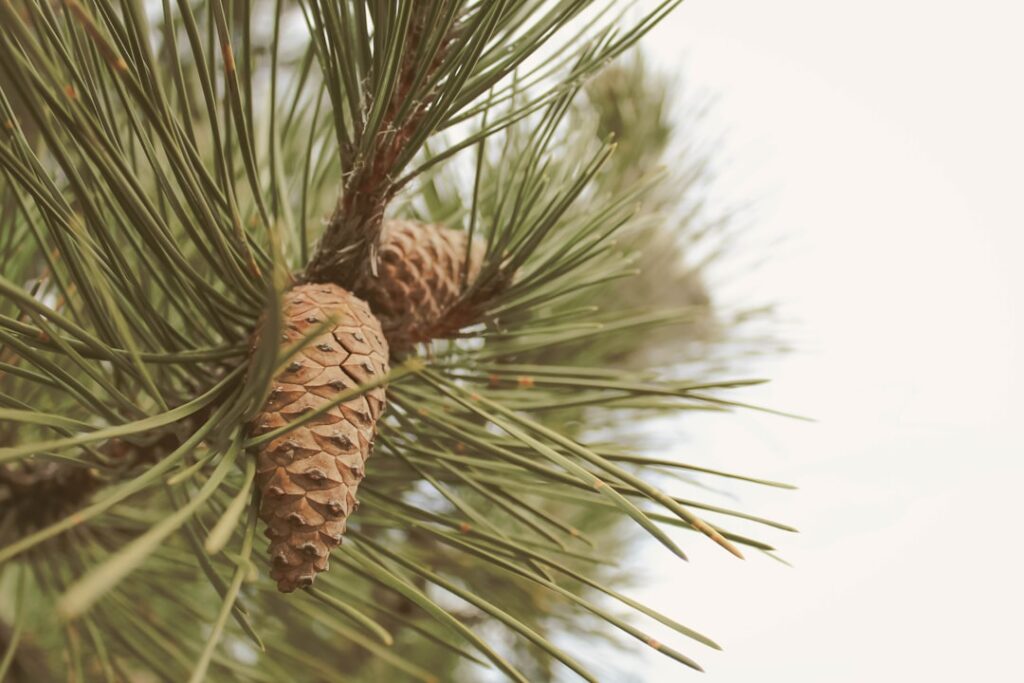
Identifying pines is easier than it looks once you know what to check, and it helps you choose and shop with confidence. Start with the needles. True pines carry their needles in bundles called fascicles, and the number per bundle is a reliable clue: white pine holds five soft needles per bundle, Scotch and red pines hold two, and ponderosa and Austrian pines hold two or three that are long and stiff. Needle length ranges from a couple of inches on mugo pine to more than 8 inches on ponderosa and southern pines.
Bark is the next tell. Scotch pine develops striking orange-red bark on its upper trunk, ponderosa matures to orange plates that smell faintly of vanilla, and lacebark pine peels into a camouflage patchwork. Cones vary too, from the long, slender cones of white pine to the stubby, prickly cones of mugo and Austrian pines. Growth habit rounds out the picture: some pines grow tall and columnar, others spread wide or mound low. Knowing these traits keeps you from buying a future giant for a small foundation bed.
Using Pines in Your Landscape Design
Beyond picking a species, think about how pines function in the overall design. As evergreens, they provide year-round structure and color when deciduous trees are bare, which makes them invaluable for winter interest and for screening you want to work in every season. Plant a row of large pines along a property line for privacy and to buffer wind and road noise; a dense evergreen windbreak on the north or west side of a house can even trim winter heating costs.
Use dwarf and mounding pines to anchor foundation plantings and rock gardens, where their compact form and evergreen texture contrast nicely with flowering shrubs and perennials. A single sculptural specimen like a Japanese black pine or a weeping white pine makes a strong focal point in a front yard or beside an entry. Cluster three pines of varying heights for a natural grove effect, and underplant with shade-tolerant ground covers once the canopy fills in. Because pines drop needles that acidify the soil beneath them, pair them with acid-loving companions like azaleas, rhododendrons, and blueberries for a low-maintenance, cohesive planting.