There’s a reason hotel bathrooms make you stop and stare. Ultra modern bathroom design strips away the fussy details, the ornate vanities, the busy tile, the visible clutter, and replaces them with clean lines, floating fixtures, and a restrained palette that feels calm and expensive. It’s the look homeowners screenshot most and understand least, so let’s break down exactly what makes it work and what it costs to pull off.
I’ve built bathrooms across every style, and the modern ones are deceptively hard. Minimalism shows every mistake because there’s nothing to hide behind. Get the geometry, materials, and lighting right, though, and even a small bathroom reads like a spa.
The Core Principles
Before you pick a single tile, understand the rules that define the style. Modern bathrooms lean on three ideas: reduction, geometry, and continuity. Reduction means fewer objects and hidden storage so surfaces stay clear. Geometry means crisp rectangles, flat planes, and straight sightlines instead of curves and ornament. Continuity means running the same material across large areas so the eye glides without interruption.
Everything below serves those three ideas. If a fixture or finish adds visual noise without a function, it doesn’t belong.
Minimalist Fixtures
Fixtures set the tone, and modern ones are all about clean profiles and hidden mechanics. Swap the traditional two-handle faucet for a single-lever or wall-mounted spout with a matte finish. Wall-mounted toilets, where the tank hides inside the wall and only a sleek bowl and a flush plate show, are the signature move; they free up floor space and make cleaning effortless, though they add roughly $600 to $1,500 over a standard toilet once you account for the in-wall carrier.
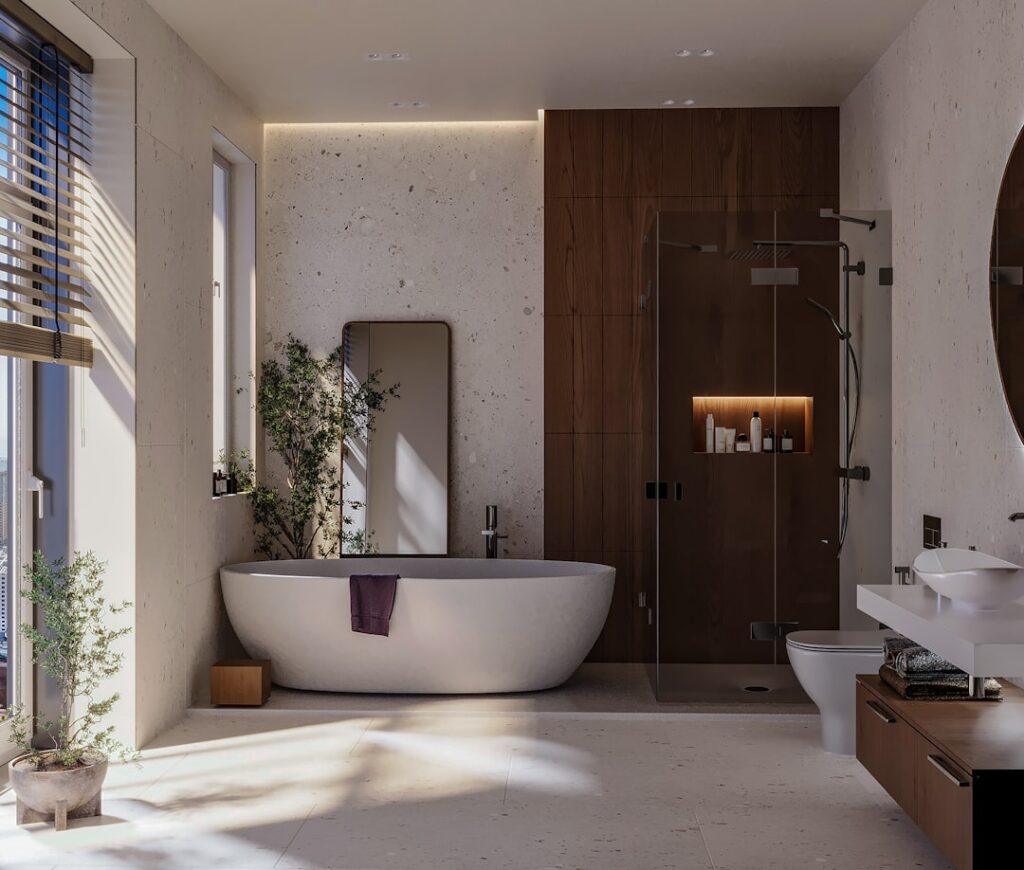
In the shower, think frameless glass, a linear trench drain instead of a center drain, and a flush rainfall head. Popular finishes right now are matte black, brushed brass, and gunmetal, often mixed with a single accent metal used consistently throughout the room.
The Floating Vanity
If you do one thing to modernize a bathroom, float the vanity. Wall-mounting the cabinet so the floor runs unbroken beneath it makes the room feel larger and lighter, and it’s become the defining element of the style. Pair it with an integrated or vessel sink, a wide horizontal mirror, and LED lighting underneath for a subtle glow at night.
Choose a slab-front cabinet with no visible hardware, push-to-open or a discreet finger channel keeps the face perfectly flat. Natural wood grain in walnut or oak warms up an otherwise cool palette, while high-gloss white or charcoal lacquer reads more clinical and sharp. Expect $800 to $3,000 for a quality floating vanity, more for solid-wood or custom sizes.
Large-Format Tile
Nothing says modern like fewer grout lines. Large-format tile, panels running 24-by-48 inches or bigger, minimizes seams so walls and floors read as continuous planes. Porcelain slabs that mimic marble, concrete, or travertine give you that seamless luxury look without natural stone’s maintenance.
A few ways designers deploy it:
- Floor-to-ceiling in the shower for a monolithic wet-room feel.
- Book-matched slabs where two panels mirror each other so the veining flows like an open book.
- Same tile on floor and walls to erase the boundary and expand the space.
Large-format installation is a specialist job, the panels are heavy and demand a dead-flat substrate, so budget more for labor: $12 to $25 per square foot installed, versus $7 to $14 for standard tile.
Lighting and LED Details
Lighting is where modern bathrooms earn their glow. Layer three types: ambient (recessed ceiling cans), task (vertical sconces or a backlit mirror flanking the face for even, shadow-free light), and accent (hidden LED strips). Those concealed strips, under the floating vanity, behind a backlit mirror, or in a niche, are the detail that makes the room feel custom.
Choose LED color temperature carefully. Around 3000K reads warm and flattering, while 4000K feels crisp and gallery-like. Put everything on dimmers, and consider a smart mirror with anti-fog and integrated lighting, a $200 to $600 upgrade that pulls a lot of weight in a minimalist scheme.
Materials and Color Palettes
The palette is deliberately restrained. Modern bathrooms usually pick one of a few directions:
- Monochrome: Whites, greys, and charcoal with black fixtures, crisp and timeless.
- Warm minimal: Greige, sand, and natural oak with brushed-brass accents, softer and more inviting.
- Moody dramatic: Deep charcoal or forest tile with backlighting for a hotel-suite feel.
Materials do the heavy lifting: large porcelain slabs, quartz or sintered-stone counters, tempered glass, matte metal, and a single warm wood element to keep the room from feeling sterile. The discipline is using few materials, but the best possible version of each.
Cost Tiers: What You’ll Actually Spend
Modern bathrooms span a wide budget range depending on fixtures and finishes. Here’s a realistic breakdown for a standard 5-by-8 full bath:
- Budget modern ($8,000 to $15,000): Floating vanity, large-format porcelain on the floor and shower, standard frameless glass, matte-black fixtures, and a backlit mirror. Smart shopping and some DIY demo keep costs down.
- Mid-range ($15,000 to $30,000): Wall-hung toilet, trench drain, book-matched slab walls, custom lighting, and premium fixtures.
- High-end ($30,000 to $60,000-plus): Full sintered-stone slabs, a curbless wet room, heated floors, smart toilet, and integrated automation.
The single biggest cost drivers are moving plumbing, the wall-hung toilet carrier, and slab tile labor. If you keep fixtures in their existing locations, you’ll save thousands.
Storage That Stays Invisible
Minimalism lives or dies on hidden storage, because clear surfaces are the whole point. Every toiletry, towel, and cleaning bottle needs a home behind a flat door or inside a wall. Recessed medicine cabinets that sit flush with the wall, mirror-fronted so they disappear, are a cornerstone of the look. A tiled shower niche, cut into the wall during construction, keeps shampoo and soap off the ledges and out of sight.
Inside the floating vanity, drawer organizers and outlet-equipped compartments keep hair tools charged and hidden. Some homeowners add a tall, narrow “tower” cabinet with push-latch doors for linens, again with no visible hardware to break the plane. The discipline is simple: if something has to live in the bathroom, give it a concealed spot, so the surfaces you actually see stay serene and uncluttered.
Common Mistakes to Avoid
Because minimalism is unforgiving, small errors read loudly. The most common one is treating “modern” as “cold”, an all-white, all-hard room with no warmth or texture ends up feeling like a clinic. The fix is a single warm element: a wood vanity, a stone bench, a plant, or brass fixtures against a monochrome backdrop.
Other pitfalls include over-mixing metal finishes (pick one or two and repeat them), choosing trendy fixtures that will date quickly instead of clean, timeless profiles, and underestimating lighting so the room looks flat. Skimping on the tile substrate is a technical mistake that shows up fast, large-format panels demand a perfectly flat surface, and any lippage between big tiles is instantly visible. Spend where it counts: substrate prep, lighting, and one or two hero materials.
Making It Work in a Small Bathroom
You don’t need a big footprint for this look, minimalism actually favors small spaces. Float the vanity to expose floor, run the same large tile up the walls and across the floor to erase boundaries, install a frameless glass shower to keep sightlines open, and lean on a large mirror and LED accents to bounce light around. A curbless shower with a linear drain makes even a compact bath feel like one continuous, seamless room.
Approach it with discipline and restraint, and ultra modern bathroom design delivers the highest wow-per-square-foot of any style. Nail the floating vanity, the large-format tile, and the layered LED lighting first, keep the palette tight, and the calm, hotel-suite feeling follows.