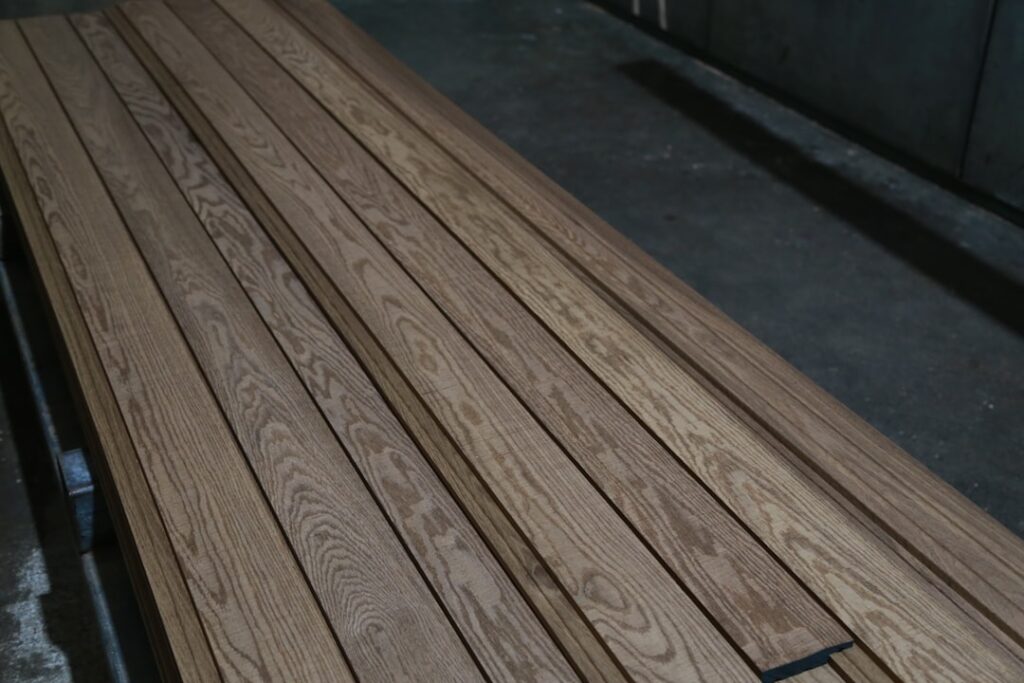
Unfinished hardwood flooring is raw wood — no stain, no polyurethane, no factory-applied coating. It arrives at your home as bare planks that are installed, sanded smooth on-site, stained to your chosen color, and sealed with multiple coats of finish. This process gives you complete control over the final appearance and creates a seamless, smooth surface with no micro-bevels between planks.
The trade-off is time, dust, and odor. Finishing hardwood on-site adds 3 to 7 days to the project timeline, generates significant sanding dust, and produces strong fumes from oil-based finishes. For homeowners who want a custom look and a flawlessly smooth floor, the extra effort is worth it. For those who prioritize speed and convenience, prefinished hardwood may be the better choice.
- What Is Unfinished Hardwood Flooring?
- Cost Comparison
- Pros and Cons of Unfinished Hardwood Flooring
- The Sanding and Finishing Process
- Stain Options
- Unfinished vs Prefinished Hardwood
- When to Choose Unfinished Hardwood
- Frequently Asked Questions
- Is unfinished hardwood flooring cheaper than prefinished?
- How long does it take to finish unfinished hardwood?
- Can you install unfinished hardwood yourself?
- What is the best finish for unfinished hardwood?
- Does unfinished hardwood need to acclimate?
- Can you leave hardwood unfinished?
- How many times can unfinished hardwood be refinished?
This guide covers everything you need to know about unfinished hardwood flooring — what it is, when to choose it, cost comparisons, the sanding and finishing process, stain options, and a detailed comparison to prefinished hardwood.
What Is Unfinished Hardwood Flooring?
Unfinished hardwood flooring is raw, untreated wood that is milled into tongue-and-groove planks but receives no factory staining or sealing. The planks are installed directly onto the subfloor (nailed, stapled, or glued), and then the entire floor is sanded, stained, and finished on-site after installation.
This process has been the standard method of installing hardwood floors for over a century. Prefinished hardwood — planks that come pre-stained and sealed from the factory — is actually the newer approach, having gained mainstream popularity only in the last 30 years. Many flooring professionals still consider site-finished unfinished hardwood to be the superior product because the finish is applied as one continuous surface rather than on individual planks before they are joined together.
Common species available in unfinished form include red oak, white oak, maple, hickory, walnut, ash, and cherry. Virtually any domestic or exotic hardwood species can be ordered unfinished, though availability varies by region and supplier.
Cost Comparison
The cost picture for unfinished hardwood flooring is nuanced. The material itself is cheaper than prefinished, but you must add the cost of on-site sanding, staining, and finishing.
| Cost Component | Unfinished Hardwood | Prefinished Hardwood |
|---|---|---|
| Material (per sq ft) | $3.00 – $8.00 | $4.00 – $12.00 |
| Installation labor | $3.00 – $5.00 | $3.00 – $5.00 |
| Sanding (3 passes) | $1.00 – $2.00 | Not needed |
| Staining | $1.00 – $2.00 | Included in material |
| Finish coats (2-3 coats) | $1.50 – $3.00 | Included in material |
| Total installed | $9.50 – $20.00 | $7.00 – $17.00 |
When you factor in the on-site finishing costs, unfinished hardwood typically costs $2 to $4 more per square foot than prefinished. The material savings ($1 to $4/sqft cheaper) are offset by sanding and finishing labor ($3.50 to $7.00/sqft). On a 1,000-square-foot project, the difference could be $2,000 to $4,000.
However, this comparison assumes professional installation and finishing. DIY-minded homeowners who rent a floor sander and apply stain and finish themselves can reduce costs significantly — though the learning curve for even sanding is steep, and mistakes are expensive to fix.
For more on hardwood pricing, see our hardwood flooring cost guide.
Pros and Cons of Unfinished Hardwood Flooring
| Pros | Cons |
|---|---|
| Custom stain color — unlimited options | Longer installation timeline (3-7 extra days) |
| Seamless finish — no micro-bevels between planks | Significant dust during sanding |
| Lower material cost per square foot | Strong fumes from oil-based finishes (days) |
| Can match existing floors perfectly | Higher total installed cost after finishing |
| Floor is sanded flat — corrects minor subfloor variation | Must vacate the space during finishing |
| Finish bonds to wood directly (no factory coating layer) | More opportunity for application errors |
| Easier to refinish later — no factory finish to sand through | Requires skilled professional for best results |
The Sanding and Finishing Process
After unfinished hardwood flooring is installed, the on-site finishing process typically takes 3 to 7 days depending on room size, number of coats, and drying conditions.
Step 1: Rough Sanding
A drum sander or belt sander makes the first pass with coarse-grit sandpaper (36 to 60 grit). This levels the floor by removing high spots, lippage between planks, and surface roughness. Rough sanding produces the most dust — professional crews use dustless or dust-containment systems that capture 90% to 99% of airborne particles, but some fine dust still escapes.
Step 2: Medium Sanding
A second pass with medium-grit sandpaper (80 grit) smooths out the scratches left by the coarse grit. This pass refines the surface and prepares it for fine sanding.
Step 3: Fine Sanding
A third pass with fine-grit sandpaper (100 to 120 grit) creates the final smooth surface that will accept stain and finish. Edges and corners that the drum sander cannot reach are sanded with an edger (a smaller, hand-held disc sander). After fine sanding, the floor is vacuumed thoroughly and wiped with a tack cloth to remove all dust.
Step 4: Staining (Optional)
If you want a color other than the wood’s natural tone, stain is applied at this stage. The stain is brushed or wiped onto the raw wood, allowed to penetrate for the manufacturer’s recommended time (usually 5 to 15 minutes), and then the excess is wiped off. The floor must dry completely (6 to 24 hours) before the first finish coat. Staining is optional — many homeowners choose a clear finish that showcases the wood’s natural grain and color.
Step 5: Finish Coats
Two to three coats of finish are applied over the stained (or natural) wood. Between coats, the floor is lightly abraded with a screen or fine sandpaper (220 grit) to ensure adhesion. Each coat must dry before the next is applied — drying time ranges from 2 to 8 hours for water-based finishes and 8 to 24 hours for oil-based finishes.
Finish Types
| Finish Type | Appearance | Dry Time Between Coats | Odor | Durability |
|---|---|---|---|---|
| Water-based polyurethane | Clear, does not yellow | 2 – 4 hours | Low | Good |
| Oil-based polyurethane | Warm amber tone, deepens with age | 8 – 24 hours | Strong | Excellent |
| Hardwax oil | Matte, natural look | 6 – 12 hours | Moderate | Good (easy to spot-repair) |
| Conversion varnish (Swedish finish) | Very hard, clear | 3 – 8 hours | Very strong | Excellent |
Water-based polyurethane is the most popular choice for residential floors because it dries quickly, has low odor, and does not yellow over time. Oil-based polyurethane remains popular for its warm amber tone and exceptional durability, but the strong fumes require ventilation and the longer dry time extends the project by 1 to 3 days.
Learn more about finish options in our hardwood refinishing guide.
Stain Options
One of the biggest advantages of unfinished hardwood flooring is complete control over stain color. Unlike prefinished hardwood, where you choose from a manufacturer’s predetermined palette, unfinished wood accepts any stain color you can imagine.
Popular stain categories include:
- Natural / clear — No stain; just clear finish over raw wood. Shows the true grain and color of the species.
- Light stains — Whitewash, pickled, Scandinavian blonde. Create an airy, modern look.
- Medium stains — Golden oak, honey, provincial. Warm, traditional tones.
- Dark stains — Espresso, ebony, Jacobean. Rich, dramatic, and formal.
- Gray stains — Weathered oak, driftwood, classic gray. Modern and trending.
- Custom mixes — Professional finishers can blend stain colors to achieve exactly the shade you want.
Always test stain samples on your actual flooring wood — not a different piece of wood, not a display board. Different species, cuts, and individual boards absorb stain differently. Apply samples in the room where the floor will be installed, because lighting dramatically affects perceived color. Most professionals apply 3 to 5 sample patches on the floor and let you choose before proceeding.
Explore our hardwood floor stain colors guide for visual examples and recommendations.
Unfinished vs Prefinished Hardwood
This is the central question most homeowners face. Here is a detailed comparison.
| Feature | Unfinished Hardwood | Prefinished Hardwood |
|---|---|---|
| Material cost | $3 – $8/sq ft | $4 – $12/sq ft |
| Total installed cost | $9.50 – $20/sq ft | $7 – $17/sq ft |
| Installation time | 5 – 10 days total | 1 – 3 days |
| Stain options | Unlimited — custom | Limited to manufacturer palette |
| Surface smoothness | Seamless — no bevels | Micro-bevels between planks |
| Finish durability | Good to excellent | Excellent (factory UV-cured) |
| Dust during install | Significant | Minimal |
| Odor during install | Strong (oil-based) / Low (water-based) | None |
| Ability to match existing floors | Excellent | Difficult |
| Refinishing ease | Easier — no factory coating layer | Slightly harder — must sand through factory finish |
| Walk-on time after install | 3 – 7 days | Immediately |
Prefinished wins on speed, convenience, lower total cost, and factory finish durability. Unfinished wins on custom color, seamless appearance, ability to match existing floors, and long-term refinishing ease.
For details on prefinished options, see our prefinished hardwood flooring guide.
When to Choose Unfinished Hardwood
Unfinished hardwood is the right choice in several specific scenarios.
Matching existing floors. If you are adding hardwood to an adjacent room and want it to match existing floors perfectly, unfinished is the only reliable option. You can sand both the new and old floors together, apply the same stain, and finish them as one continuous surface. Prefinished planks will never perfectly match an existing floor’s color and sheen.
Custom stain color. If you have a specific stain color in mind — especially a mixed custom color — unfinished is necessary. Prefinished options are limited to each manufacturer’s palette.
Seamless appearance. If you dislike the visible micro-bevels between prefinished planks, unfinished delivers a perfectly flat, gap-free surface after sanding. This is especially noticeable on wide-plank installations.
Historic restoration. Restoring a historic home often requires matching original flooring profiles and finishes. Unfinished hardwood in the correct species and width, finished on-site, provides the most authentic result.
New construction. In new builds where you are not living in the home during finishing, the dust and fumes are less of a disruption. Many builders install unfinished hardwood to give buyers full control over the final color.
Frequently Asked Questions
Is unfinished hardwood flooring cheaper than prefinished?
The raw material is cheaper — typically $1 to $4 less per square foot. However, after adding on-site sanding ($1 to $2/sqft), staining ($1 to $2/sqft), and finishing ($1.50 to $3/sqft), the total installed cost of unfinished hardwood is usually $2 to $4 more per square foot than prefinished. You save on material but spend more on labor.
How long does it take to finish unfinished hardwood?
The sanding and finishing process adds 3 to 7 days to the project timeline. Sanding takes 1 to 2 days, staining takes 1 day plus drying time, and 2 to 3 coats of finish take 1 to 3 days depending on the product and drying conditions. You cannot walk on the floor during this time.
Can you install unfinished hardwood yourself?
Installing the raw planks is a reasonable DIY project for experienced homeowners with nail guns or staple guns. However, the sanding and finishing process is extremely difficult to do well without professional experience. Uneven sanding, drum marks, stain blotching, and finish bubbles are common DIY mistakes that are expensive to fix. Most professionals recommend DIY installation paired with professional sanding and finishing.
What is the best finish for unfinished hardwood?
Water-based polyurethane is the most popular choice for residential floors — it dries quickly, has low odor, and maintains the wood’s natural color without yellowing. Oil-based polyurethane is preferred by homeowners who want a warm amber tone and maximum durability. Hardwax oil is gaining popularity for its natural, matte appearance and easy spot-repairability.
Does unfinished hardwood need to acclimate?
Yes. Unfinished hardwood should acclimate in the installation space for 3 to 7 days before installation. Stack the planks with spacers to allow air circulation on all sides. The wood’s moisture content should reach equilibrium with the room’s humidity level (ideally 6% to 9% moisture content for most regions) before installation begins.
Can you leave hardwood unfinished?
Technically yes, but it is not recommended for floors. Unfinished wood absorbs water, stains easily, splinters, and wears rapidly under foot traffic. Some designers use unfinished wood for rustic accent walls or ceilings, but floors need a protective finish to remain functional and durable.
How many times can unfinished hardwood be refinished?
Solid unfinished hardwood 3/4 inch thick can be refinished 3 to 5 times over its lifespan, depending on how much material each sanding removes. Thinner products (3/8 or 1/2 inch) allow fewer refinishing cycles. Because unfinished hardwood starts without a factory finish layer, the first sanding removes less material, potentially allowing one additional refinishing compared to prefinished.
Ready to explore your options? Compare unfinished to prefinished hardwood, browse stain colors, or read our complete hardwood flooring guide.
Prefer to explore on your own?
See how new flooring looks in your actual room in seconds — free, no signup.
Try the free Floor Studio →