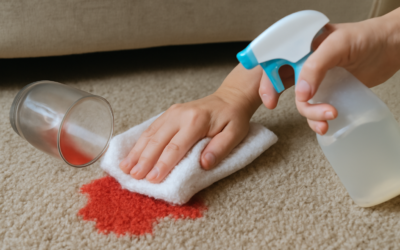
A urine stain is a chemistry problem before it’s a cleaning problem. Fresh urine is mildly acidic and rinses out cleanly with water; dried urine crystallizes into alkaline salts that bond to carpet fibers, soak through mattress padding, and bleach the polyurethane finish on hardwood. The longer it sits, the harder it becomes to remove a urine stain completely — and the ammonia odor that lingers afterward is the calling card of an incomplete cleanup. This guide walks through the right approach for every surface in your home.
Why Urine Stains Are So Hard to Remove
Urine contains urea, uric acid, urochrome (the yellow pigment), creatinine, salts, and bacteria. When it dries, the uric acid crystallizes into salt deposits that water alone cannot dissolve. These crystals reactivate every time humidity rises, which is why old pet accidents seem to “come back” on damp days.
The crystal structure is also what defeats most household cleaners. Soap and water mask the stain temporarily, but the uric acid crystals remain. Only enzyme cleaners or oxidizers actually break the molecular bonds.
Fresh Urine on Carpet: First 30 Minutes
Speed matters more than product choice here. Blot — never scrub — with white paper towels or a clean cotton cloth. Stand on the towel to apply pressure, lifting and replacing until the towel comes up nearly dry. Then:
- Pour cool water over the spot to dilute remaining urine
- Blot again until dry
- Apply an enzyme cleaner like Nature’s Miracle Advanced or Rocco and Roxie Professional Strength, saturating the area down through the carpet pad
- Cover with plastic wrap and let dwell 8 to 24 hours per the bottle directions
- Blot any remaining moisture and let air dry
Skipping the saturation step is the most common mistake. If the urine reached the pad, surface enzyme treatment leaves crystals deep in the cushion.
Old, Set Urine Stains on Carpet
For stains that have dried for days or weeks, you need a more aggressive approach. Mix one cup of white vinegar with one cup of warm water, pour onto the stained area, and let it sit for 10 minutes to break down the alkaline salt crystals. Blot dry. Then sprinkle baking soda over the spot, followed by a solution of 1/4 cup hydrogen peroxide (3%) and one teaspoon dish soap. The bubbling reaction lifts trapped uric acid.
Let dry completely (8 to 12 hours), then vacuum thoroughly. Finish with enzyme cleaner for the bacterial and odor components. Severe cases — typically cat urine — may require professional extraction or carpet pad replacement.
Mattress Urine Stains
Strip the bedding immediately and blot up as much liquid as possible. Memory foam mattresses absorb deeply, so apply pressure from above with a stack of towels for 5 to 10 minutes. Then mix:
- 8 oz hydrogen peroxide (3%)
- 3 tablespoons baking soda
- 2 drops dish soap
Apply the mixture with a spray bottle, let bubble for 30 minutes, blot, and air dry with a fan blowing across the surface for 12 to 24 hours. Avoid using too much liquid — saturated memory foam grows mold inside its core. For deep contamination, professional mattress cleaning runs $80 to $150, but heavily soaked mattresses are often beyond saving.
Hardwood Floor Urine Damage
Urine on polyurethane-finished hardwood is a race against time. Wipe up immediately, then clean with a wood floor cleaner like Bona Hardwood Floor Cleaner. If the urine sat overnight and you see black discoloration, the urine has penetrated the finish and reacted with the tannins in the wood — at this point, you’re looking at refinishing.
For mild staining, try a paste of oxalic acid (Bar Keepers Friend works) and water, applied carefully and rinsed within 5 minutes. Severe black stains require sanding to bare wood and refinishing the affected board, which a professional refinisher charges $4 to $8 per square foot in patch work, or $400 to $600 for a single damaged area.
Tile and Grout
Sealed tile cleans easily with a 1:1 mix of white vinegar and water followed by a hydrogen peroxide spray. Grout is the problem — unsealed grout absorbs urine and holds odor for months. Spray with an enzyme cleaner, let dwell 30 minutes, then scrub with a stiff nylon brush. For heavy contamination, mix oxygen bleach powder (OxiClean) with water into a paste, apply to the grout lines, and let dwell 15 minutes before scrubbing and rinsing.
Reseal the grout afterward with a penetrating sealer like Aqua Mix Sealer’s Choice Gold to prevent re-absorption.
Odor Elimination After Cleaning
Visual stain removal doesn’t always eliminate the smell, especially with cat urine, which contains felinine that breaks down into sulfur compounds. Dogs and humans can return to the spot if any odor remains. Use a UV blacklight in a dark room to find every contaminated area — urine fluoresces yellow-green under UV.
For lingering odors, enzyme cleaners need full dwell time (8 to 24 hours under plastic) to digest the proteins. Activated charcoal bags placed nearby absorb airborne odors. In severe cases, ozone treatment from a $200 ozone generator clears whole-room contamination in 24 to 48 hours, but evacuate humans, pets, and plants during the cycle.
Products That Actually Work
- Nature’s Miracle Advanced — Best enzyme cleaner for set-in pet urine, around $15 per gallon
- Rocco and Roxie Professional Strength — Slightly more aggressive enzyme blend, popular for cat urine
- Anti-Icky-Poo — A bacterial digester favored by professional cleaners
- Folex Carpet Spot Remover — Excellent for fresh surface stains but doesn’t address embedded uric acid
- OdoBan — Industrial-strength odor eliminator, good for hard surfaces and laundry
Prevention and Behavior Issues
Repeated accidents in the same spot signal something larger — a pet medical issue, marking behavior, or, with humans, an undiagnosed condition. A vet visit rules out UTIs or kidney issues in pets. For carpeted homes with multiple pets, low-pile carpet with stain-resistant fibers like Mohawk SmartStrand or Shaw R2X handles accidents far better than wool or untreated nylon. Hardwood and luxury vinyl plank are the most forgiving flooring surfaces for households with frequent accidents.