Vinyl click flooring bathroom projects have surged in popularity because a quality rigid-core plank can shrug off standing water for hours, while a sheet of real hardwood would swell and cup within a single afternoon. At D and G Flooring we field more questions about floating vinyl in wet rooms than almost any other product, and the short answer is that it works beautifully when you understand its limits. This guide walks through how click vinyl performs in a bathroom, where it shines, where it struggles, and exactly what to look for before you buy.
What Click Vinyl Flooring Actually Is
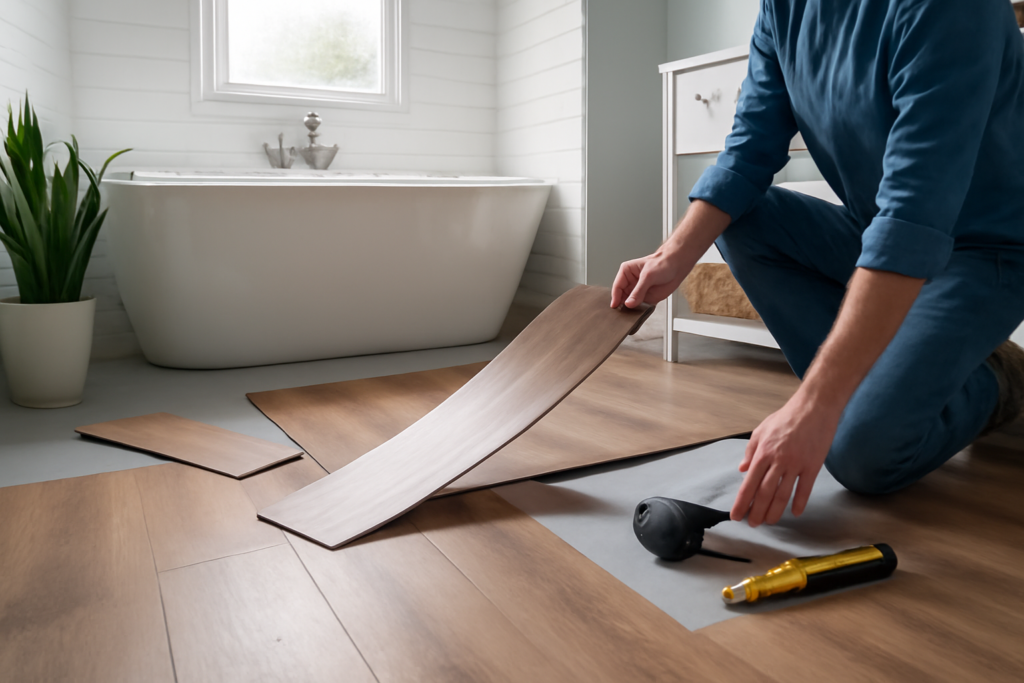
Click vinyl, often sold as luxury vinyl plank (LVP) or luxury vinyl tile (LVT), is a multi-layer product with a tongue-and-groove locking edge milled into each board. Instead of glue or nails, planks snap together edge to edge and float over the subfloor. The two dominant core types are SPC (stone polymer composite) and WPC (wood polymer composite). SPC uses a dense limestone-and-PVC core that resists dents and stays dimensionally stable when temperatures swing, which is why most installers steer bathroom buyers toward it. WPC is slightly softer and warmer underfoot but a touch more reactive to heat.
On top of the core sits a printed design film that mimics oak, marble, slate, or concrete, protected by a clear wear layer measured in mils. For a bathroom, look for a wear layer of at least 12 mil, and 20 mil if the room sees heavy traffic. The bottom layer is often an attached pad that quiets footsteps and bridges minor subfloor imperfections.
Is Click Vinyl Truly Waterproof?
The plank itself is waterproof. A solid SPC core will not absorb water, swell, or delaminate even after prolonged submersion. That is the headline reason it has displaced laminate in bathrooms, where laminate’s fiberboard core fails fast. The honest caveat is that a floating floor is only as waterproof as its seams and perimeter. Click joints are tight, but they are not welded. If water pools and sits for hours, it can wick through the seams and reach the subfloor underneath, where it has nowhere to evaporate. That trapped moisture can foster mold or warp a wood subfloor over time.
For a powder room or guest bath, this is rarely an issue. For a primary bath with a glass shower that splashes, or a home with small children who flood the tub, you should plan for it. Many installers run a thin bead of 100 percent silicone in the expansion gap around the tub, toilet flange, and vanity to keep splash water from migrating below the planks. That single step dramatically improves real-world performance.
Pros of Vinyl Click Flooring in a Bathroom
- Waterproof core: Spills, drips, and humidity will not ruin the planks themselves.
- DIY friendly: The floating click system needs no adhesive and cuts with a utility knife or jigsaw, so a confident homeowner can finish a small bathroom in a weekend.
- Warm and quiet: Vinyl feels warmer than ceramic tile on bare feet and muffles sound, a welcome contrast to cold porcelain.
- Comfort underfoot: The slight give of the core and attached pad is easier on knees and dropped glassware than rigid tile.
- Affordable: Material commonly runs $2 to $5 per square foot, well below natural stone or quality tile installed.
- Realistic looks: Modern embossing and printing convincingly imitate wood and stone, giving the spa aesthetic without the maintenance.
Cons and Real Limitations
- Seam vulnerability: As noted, standing water can eventually reach the subfloor through joints if the perimeter is not sealed.
- Not a permanent fixture: Some buyers want the tiled, grouted look that reads as a luxury finish to appraisers and buyers; floating vinyl, while attractive, is sometimes perceived as a mid-tier surface.
- Subfloor sensitivity: Rigid planks telegraph high spots and dips. An uneven subfloor causes hollow spots and clicking underfoot, so prep matters.
- Heat and sunlight: A bathroom with a large sunny window can cause cheaper planks to expand and contract; quality SPC minimizes this but does not eliminate it.
- Repair quirks: Replacing a damaged plank in the middle of a floating run can mean disassembling rows back to a wall.
Choosing the Right Product
Start with the core. For bathrooms, prioritize SPC for its stability around tubs and radiant heat. Confirm the manufacturer rates the product for wet areas; many state this explicitly. Next, check the wear layer and choose 12 mil or thicker. Then look at the locking system; premium angle-tap or drop-lock mechanisms create tighter, more water-resistant seams than budget systems. Finally, weigh the attached underlayment. An integrated cork or IXPE pad saves a step and adds comfort, but if you are gluing the perimeter you may prefer a bare-backed plank.
Always buy roughly 10 percent extra for cuts, mistakes, and future repairs. Bathrooms have many obstacles such as toilets, vanities, and pipes, which means more cuts and more waste than an open room. Keep a few spare planks in storage; manufacturers rotate styles, and an exact match years later is unlikely.
Installation Tips for Wet Rooms
- Prep the subfloor: It must be clean, dry, and flat within the tolerance the maker specifies, often 3/16 inch over 10 feet. Skim-coat low spots and sand high ones.
- Acclimate the planks: Let boxes sit flat in the room for 48 hours so the vinyl matches the home’s temperature and humidity.
- Leave expansion gaps: Maintain the recommended gap, usually about 1/4 inch, around every wall and fixture so the floor can move.
- Remove the toilet: Run the floor under the toilet flange rather than cutting around the base. This looks cleaner and seals better.
- Seal the perimeter: After installation, fill the expansion gap at the tub, shower, and toilet with a flexible silicone bead, then cover walls with baseboard and a shoe molding.
- Use proper transitions: At doorways, install a T-molding or threshold to bridge to adjacent rooms while preserving the floating movement.
Cost and Long-Term Value
Counting material at $2 to $5 per square foot plus optional underlayment and trim, a typical 40 to 50 square foot bathroom runs a modest material bill for a DIY job. Professional installation adds labor, usually a few dollars per square foot more depending on your market and how many fixtures must be removed and reset. Compared with porcelain tile, which carries higher material and far higher installation cost because of mortar, grout, and skilled labor, click vinyl is the budget-conscious choice that still delivers a waterproof, attractive floor.
The Bottom Line
For most homeowners, a quality SPC click product is an excellent bathroom floor: waterproof at the plank level, warm, quiet, affordable, and within reach for a weekend DIY install. The key to long-term success is respecting the seams. Seal the perimeter, prep the subfloor properly, and run the floor under the toilet, and your vinyl click flooring bathroom will look and perform well for many years. If you want help matching a product to your specific room, the team at D and G Flooring can point you toward a core and wear layer that fits your traffic, budget, and style.
Prefer to explore on your own?
See how new flooring looks in your actual room in seconds — free, no signup.
Try the free Floor Studio →