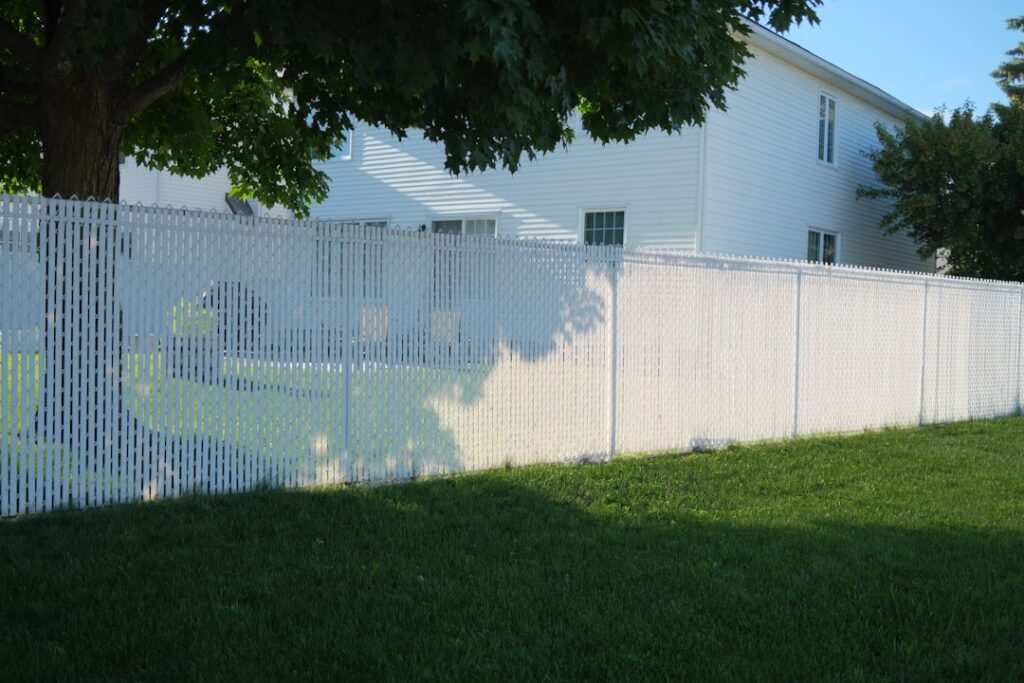
If you want a fence that looks equally good from both sides and still lets a breeze through, a vinyl shadowbox fence is one of the most practical designs you can install. The name comes from the way the pickets alternate between the front and back of the rails, overlapping just enough to block a direct line of sight while leaving a small gap for airflow. From either yard the fence reads as finished and attractive, which is exactly why it is often called a good-neighbor style.
I like recommending shadowbox to homeowners who are torn between full privacy and a more open, decorative boundary. It gives you semi-privacy, a softer look than a solid wall of pickets, and, in vinyl, none of the painting or rot headaches that come with a wood version of the same design. It is a genuine middle-ground fence that keeps both you and the neighbor happy.
How a Shadowbox Fence Works
A shadowbox fence uses three horizontal rails, top, middle, and bottom, with pickets fastened in an alternating pattern. One picket sits on the front face of the rails, the next sits on the back, and so on down the run. The pickets are spaced so that each one overlaps its neighbors on the opposite side, closing off the straight-through view while leaving a narrow vertical gap.
That alternating layout is what produces the two signature benefits. Because pickets appear on both faces, there is no ugly rail-and-post back side, so it looks identical from your yard and the neighbor’s. And because the gaps are offset rather than sealed, air moves through the fence, which reduces wind load and helps the fence survive gusts that would push against a solid privacy panel like a sail.
Privacy Versus Airflow
Shadowbox is a semi-privacy design, and it is important to set expectations correctly. When you stand square to the fence, the overlapping pickets block a direct view. But when you look at the fence at an angle, walking along it, for example, the offset gaps open up and you can see through more than you would with a solid panel. For most backyards that is a perfectly acceptable trade, but if you need total screening for a pool or hot tub, a solid privacy panel is the better call.
The airflow, on the other hand, is a real advantage in windy areas and hot climates. Breezes pass through instead of hammering the panels, so the fence experiences less stress and your yard stays cooler and less stuffy than it would behind a solid wall. Plants along the fence line also tend to do better with that air movement and filtered light.
Why Choose Vinyl
Shadowbox has always been a popular wood design, but vinyl brings clear advantages to the pattern. Vinyl, or PVC, does not rot, warp, split, or need painting. A wood shadowbox fence demands periodic sealing and eventually starts to gray and cup, while a vinyl version keeps its color and shape for decades with almost no upkeep beyond an occasional rinse with a hose.
Quality vinyl fencing uses UV inhibitors to resist fading and impact modifiers to keep it from becoming brittle. Because the pickets and rails are extruded to consistent dimensions, the alternating pattern stays crisp and even along the whole run, something that is harder to achieve with dimensionally variable wood. The higher upfront cost of vinyl is offset over time by the money and weekends you never spend maintaining it.
Styles and Height Options
Vinyl shadowbox fencing typically comes in heights from 4 to 6 feet, with 6 feet being the go-to for backyard semi-privacy and 4 feet more common where a lower, decorative boundary is wanted. Picket widths and spacing vary by manufacturer, and the amount of overlap determines how much privacy you get. Tighter overlaps lean more private, while wider spacing feels more open and airy.
Color choices generally include white, tan or almond, and various gray and wood-look tones. You can dress up the fence with post caps, from flat and gothic to solar-lit versions, and pair it with matching vinyl gates. Some homeowners combine a shadowbox pattern with a lattice or accent top for extra character. Because everything comes as a coordinated system, the finished fence looks cohesive from posts to caps.
Cost of a Vinyl Shadowbox Fence
Installed, a vinyl shadowbox fence generally runs about $30 to $60 per linear foot, with height, picket density, terrain, and local labor rates driving the range. A 6 foot fence with tight picket spacing sits toward the upper end because it uses more material. Materials alone, if you install it yourself, typically fall in the $20 to $40 per linear foot range for quality panels, posts, and hardware.
For a common backyard run of 150 linear feet, that puts a professionally installed project somewhere around $4,500 to $9,000, with gates adding a few hundred dollars each. Vinyl costs more upfront than wood, but remember you are buying out of decades of staining, painting, and board replacement. Over the life of the fence, the total cost of ownership often lands in vinyl’s favor.
Installation Considerations
Shadowbox panels install on posts set in concrete, and level, plumb posts are everything. The alternating picket pattern makes any lean or uneven spacing obvious, so take extra care with layout and post depth, digging below the frost line in cold climates to prevent heaving. Many vinyl systems use routed posts that the rails slide into, which speeds assembly but means your post spacing has to match the panel width precisely.
Before you dig, call your local utility locating service to mark buried lines, and check property lines and any homeowner association or municipal fence rules on height and setback. On sloped ground you will either step the panels or rack them to follow the grade, and not every vinyl system racks the same amount, so confirm that detail before buying. Done carefully, a vinyl shadowbox fence delivers a clean, low-maintenance boundary that both you and your neighbor will be glad to look at for years.
Shadowbox Versus Other Fence Styles
It helps to see where shadowbox sits among the common vinyl fence options. A solid privacy fence gives complete screening but presents a flat wall of pickets, offers no airflow, and catches the wind like a sail, which stresses the posts. A standard picket or spaced-picket fence is open and decorative but provides little privacy at all. Shadowbox lives in the middle, trading a small amount of privacy for a two-sided finished look and much better wind performance.
Compared with a board-on-board fence, which overlaps pickets on the same face for near-total privacy, shadowbox alternates pickets on opposite faces instead, which is what creates both the good-neighbor symmetry and the ventilating gaps. If your priority is a beautiful boundary that both households enjoy and that survives storms, shadowbox is usually the better pick. If you truly need to hide a hot tub or a busy street view, step up to a solid or board-on-board panel and accept the one-sided look or the extra cost of a double-sided design.
Maintenance and Longevity
Once a vinyl shadowbox fence is up, the ongoing work is minimal. Because there is no wood to rot or paint to peel, upkeep amounts to rinsing the panels with a garden hose a couple of times a year and spot-cleaning any algae or dirt with mild soap and water, which is more common on the shaded, north-facing side. The open pattern actually helps here, since better airflow keeps the pickets drier and slower to grow mildew than a solid panel.
Quality vinyl fencing typically carries a limited lifetime warranty, and UV-stabilized material resists the fading and yellowing that would otherwise show over decades in the sun. Barring physical impact from a vehicle or a falling branch, a well-installed shadowbox fence should hold its shape and color for many years. Check the gates occasionally, since hinges and latches are the parts that see the most wear, and tighten or adjust them as needed to keep them swinging true.