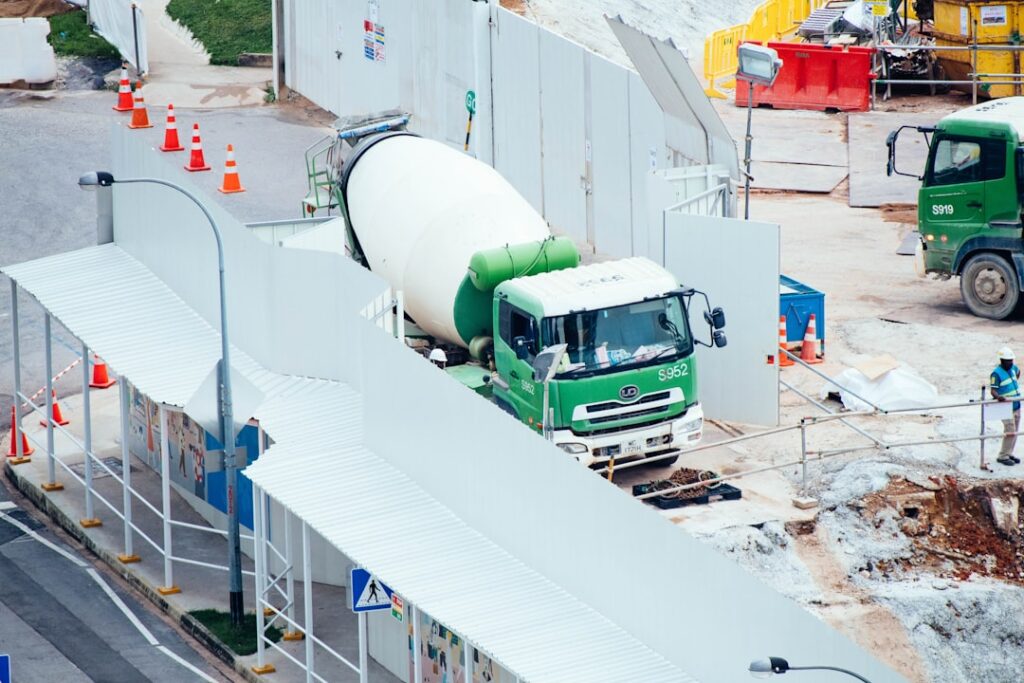
Ordering 2 yards of concrete from a traditional ready-mix plant often costs nearly as much as ordering 6, thanks to short-load fees that can add $200 or more. A volumetric concrete truck sidesteps that math entirely: it carries sand, stone, cement, and water in separate compartments and mixes only what you use, right at your curb, metered by the cubic foot. For small pours, staggered pours, and jobs where timing is unpredictable, mobile metered mixing is frequently the cheapest and least stressful way to get real, plant-quality concrete. Here is how the trucks work, what they cost, and where a conventional drum truck still wins.
How a Volumetric Mixer Actually Works
Look at the truck and you will see divided bins instead of a spinning drum. A typical unit carries 6 to 10 cubic yards of material split across a large aggregate bin (sand on one side, stone on the other), a sealed cement silo holding 40 to 90 bags’ worth of powder, a 250-to-500-gallon water tank, and often small tanks for liquid admixtures and a hopper for fiber.
At the pour, the operator sets gate openings and feeder speeds that meter each ingredient onto a conveyor in the programmed ratio. Everything drops into an auger at the rear of the truck — a mixing screw about 8 to 12 feet long — where water joins the dry materials. The auger blends the mix in roughly 15 to 30 seconds of travel and discharges fresh concrete off the chute. Output runs 15 to 60 cubic yards per hour depending on the machine, more than enough to keep a finishing crew moving on a driveway. Because mixing happens continuously, the truck can pour a wheelbarrow’s worth, stop for 45 minutes while you set the next form, then start again — and every yard comes out equally fresh.
Volumetric vs. Drum Ready-Mix: The Real Differences
A drum truck is a delivery vehicle for concrete batched at a plant; the clock starts the moment water hits cement, and specs typically require discharge within 90 minutes. A volumetric truck is a rolling batch plant, and that difference cascades into practical advantages:
- Zero waste and no shortage: you pay for what is metered out. If the slab takes 3.4 yards instead of your estimated 4, you buy 3.4. If it takes 4.3, the truck just keeps mixing — no panicked second truck ordered against a cold joint.
- No short-load fee structure: most volumetric operators price small quantities without the $100-to-$250 penalties ready-mix plants charge below 4 or 5 yards.
- Freshness on long or slow pours: fence-post runs, curb sections, and pours with lots of hand-buggying never fight a stiffening load.
- Mix changes mid-job: the operator can switch from a 3,000 psi footing mix to a 4,500 psi air-entrained slab mix, or add fiber, between discharges.
- Distance and heat tolerance: rural sites 50 miles from any plant, and 95°F summer pours, do not degrade the product because nothing is mixed until arrival.
Drum trucks keep the edge on very large continuous pours. A commercial slab needing 60 yards in a morning wants a fleet of 10-yard drum trucks cycling from a plant; a single volumetric unit carrying 8 yards of raw material cannot match that volume without reloading. Ready-mix plants also produce tightly controlled, moisture-corrected batches all day, which is why some high-spec structural jobs still call for plant tickets — though modern volumetric mixers meet ASTM C685 (concrete made by volumetric batching and continuous mixing) and are accepted by most DOTs.
What a Volumetric Concrete Truck Delivery Costs
Pricing in 2026 generally lands at $150 to $200 per cubic yard for standard 3,000-to-4,000 psi mixes, modestly above ready-mix’s $125 to $170 — but the comparison changes once fees enter. Expect a delivery or service charge of $75 to $150, sometimes waived over a minimum quantity, and per-yard totals that beat ready-mix decisively under about 5 yards. A realistic small-job comparison: 2 yards for a shed slab might run $420 total from a volumetric operator versus $300 of concrete plus $200 in short-load fees from the plant. Extras price out roughly like this:
- Fiber reinforcement: $8 to $15 per yard
- Air entrainment or accelerator: $5 to $12 per yard
- Colored concrete: $25 to $60 per yard depending on pigment load
- Standby time: often 30 to 60 free minutes, then $1.50 to $2.50 per minute — still gentler than drum-truck demurrage because the load is not perishing
Ask how the meter is verified. Reputable operators print or log the cubic-foot count from the calibrated feeder and charge off that figure, and many will show you the counter before and after the pour.
Jobs Where Volumetric Shines
Homeowner-scale work is the sweet spot: sidewalk sections, stoops, generator and hot-tub pads, a 400-square-foot patio at 4 inches (about 5 yards), post footings scattered around a fence line, and repair work where quantities are honest guesses. Contractors lean on volumetric trucks for curb and gutter, utility trench backfill with flowable fill, and remote sites. The stop-start capability deserves special mention for DIY finishers: if you have never floated and troweled a slab before, being able to pour half the forms, finish them, and then pour the rest an hour later removes the time pressure that ruins first slabs.
Site Prep and How to Order
Treat the truck like any loaded concrete truck: 60,000-plus pounds gross weight that will crack a residential driveway with a thin base and absolutely will rut a soggy lawn. Plan a path on the street or firm gravel, and rent a concrete buggy ($90 to $150 a day) or line up wheelbarrows and help if the pour sits far from truck access — the discharge chute reaches roughly 12 to 16 feet.
When you call, have four things ready: total estimated volume (length × width × depth in feet, divided by 27, plus 10 percent), the strength you need (3,500 to 4,000 psi with air entrainment is the safe residential default in freeze-thaw states), slump or workability preference, and whether you want fiber. Ask about the minimum charge, standby policy, and washout — volumetric trucks wash out their auger on site, so designate a corner where a small pile of rinse water and grout can land legally, or ask if they carry a washout container.
Hot- and Cold-Weather Advantages
Extreme temperatures are where the volumetric model quietly earns its keep. In summer, a drum load batched at the plant on a 95°F afternoon can lose 2 inches of slump before it reaches you, tempting drivers to add water on site — the classic recipe for a weak, dusty slab. A volumetric mix has no travel time after water hits cement, so the concrete comes off the chute at full workability no matter how far the truck drove or how long it waited. Ask the operator to run a slightly higher dose of water reducer rather than extra water if the mix stiffens quickly in the heat, and schedule the pour for early morning regardless; finishing windows shrink fast above 90°F.
Cold weather flips the priorities. Confirm the operator carries heated water and, ideally, accelerator — 2 percent calcium chloride or a non-chloride accelerator lets a pour placed at 40°F reach set before evening frost. Because the truck can mix on demand, you can also break a marginal-weather job into smaller placements: pour and finish one section completely, cover it with blankets, then mix the next, instead of racing a full drum load against the thermometer. That flexibility, more than any single spec, is why remodelers who once dreaded shoulder-season concrete work now default to metered mixing from October through April.
Limitations Worth Knowing
Not every operator stocks every admixture, so specialty mixes — high-range water reducers, corrosion inhibitors, exposed-aggregate blends — need a conversation up front. Quality depends on the operator’s calibration discipline; feeders drift, and a sloppy outfit can run rich on water, so it is fair to ask when the unit was last calibrated and to request a stiffer slump if the discharge looks soupy. Very large monolithic pours, pumped high-rise work, and jobs with strict plant-batch submittal requirements remain drum-truck territory. And in winter, confirm the operator heats water; a volumetric mix made with 35°F tank water will sit dormant in the forms for hours.
For the small and mid-size pours that make up most residential concrete work, though, the metered model is hard to argue with. You get concrete as fresh as the moment it was invented, in exactly the quantity the forms demand, without donating $200 to a short-load fee — which is why volumetric fleets have been the fastest-growing segment of the US concrete delivery market for a decade running.