A flat painted wall behind the bed does nothing to soften sound, and in a typical drywall room you’re bouncing reflections right back into your ears all night. That’s why wall panels for bedroom projects have blown up over the past three years, from acoustic felt behind headboards to floor-to-ceiling MDF slat walls. Done right, panels add visual weight, knock down echo, and run $2 to $9 per square foot in materials. Here’s what actually works in a sleeping space and what’s just Pinterest bait.
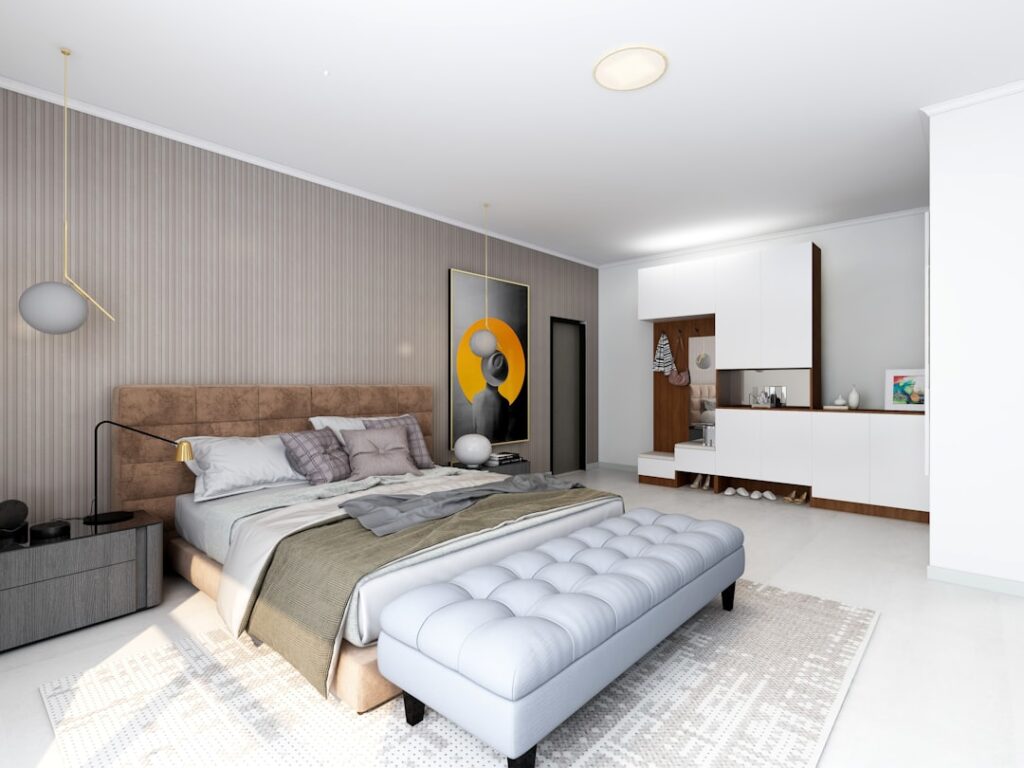
MDF Slat Panels: The Go-To Feature Wall
Pre-assembled MDF slat panels from brands like Walston, Ekena Millwork, and Decorshoe dominate the category for a reason. Each panel is typically 94 by 24 inches, with vertical slats glued to a polyester felt backer that looks like black fabric between the wood strips. You can paint them, stain them, or buy pre-finished oak, walnut, or smoked ash veneer.
Installation is genuinely easy. You adhesive-mount them to drywall with construction adhesive like Loctite PL Premium and a few finish nails through the felt backer. Cost runs $45 to $120 per panel, which works out to $3 to $8 per sq ft. For a typical 10 ft wide bedroom accent wall behind the bed, four panels and some finishing pieces land around $250 to $500.
Acoustic Felt Panels
If noise is the real problem, go straight to acoustic felt. PET felt panels (made from recycled polyester bottles) deliver a noise reduction coefficient around 0.45 to 0.85 depending on thickness and air gap. A 9 mm panel with a 1 inch air gap can cut reverb noticeably in a small room.
You’ll see felt in two formats. Plain half-inch or 3/8 inch sheets cut to size run $4 to $7 per sq ft, and pre-slotted acoustic panels (felt with decorative grooves) run $6 to $11 per sq ft. Both mount with double-sided tape or construction adhesive. For light sleepers or anyone with a loud HVAC return in the ceiling, this is the single best panel upgrade you can make.
Shiplap: The Classic Choice
Shiplap hasn’t gone anywhere despite the “it’s over” takes online. True tongue-and-groove shiplap in 1×6 or 1×8 pine runs $1.80 to $3.50 per linear foot, or about $3 to $6 per sq ft installed DIY. Faux shiplap using 1/4 inch plywood rips (cut into 6 inch strips at a lumberyard) drops the cost to under $2 per sq ft.
Styling matters more than the material. Vertical shiplap stretches a short ceiling; horizontal shiplap widens a narrow room. Painted in a moody tone like Benjamin Moore Hale Navy or Sherwin-Williams Urbane Bronze, it reads contemporary rather than farmhouse. Stick with a 1/8 inch reveal gap for a crisp shadow line and caulk only the outer edges, never the individual boards.
3D Panels for Visual Texture
Three-dimensional panels (sometimes called dimensional or sculpted panels) are molded PVC or plant-fiber tiles that create repeating geometric patterns. Brands like Mio, Inhabit, and Wall Flats sell them in 2 by 2 ft tiles at $10 to $25 per sq ft.
They work best as a targeted accent, not a full wall. A 4 by 8 ft section behind the headboard picks up dramatic shadow under picture lights or sconces. Full-wall coverage can overwhelm a bedroom, especially in smaller 10 by 12 rooms where you need visual breathing room.
Installation Prep You Shouldn’t Skip
Regardless of panel type, prep the drywall first. Anything less and you’ll be staring at bumps, telegraphed screws, or a seam every time the sun hits the wall at an angle.
- Fill screw pops and dings with lightweight spackle, sand with 120 grit
- Mark studs with a laser line; most panels need at least two stud hits per panel
- Paint the wall the same color as the panel backer before mounting (especially for slat panels with exposed felt)
- Acclimate wood or MDF panels in the room for 48 hours at normal humidity
- Start from a plumb reference line, not a “square” corner, because bedroom corners almost never are
Cost Comparison
Here’s what you’ll actually spend on a 10 by 9 ft accent wall (90 sq ft) using each system:
- MDF slat panels: $270 to $720 in materials, plus $50 in adhesive and trim
- Acoustic felt panels: $540 to $990 for pre-slotted decorative felt
- Real shiplap: $270 to $540 in lumber plus $25 in nails and caulk
- Plywood faux shiplap: $150 to $200 including paint
- 3D PVC panels: $900 to $2,250 for full coverage
Labor, if you hire out, adds $3 to $7 per sq ft for straightforward installs and more for mitered corners or outlet cutouts.
Color and Lighting Pairings
Bedroom panels live or die by the lighting. Slat and shiplap walls look flat under ceiling cans and dramatic under a warm 2700K wall sconce or picture light aimed down at 15 degrees. Felt in charcoal, olive, or rust pairs well with matte brass hardware and linen bedding. Painted shiplap in a saturated color needs a ceiling in the same paint or one shade lighter to avoid the “bathroom wainscot” look.
When to Skip Wall Panels Entirely
Rentals where you can’t damage drywall are rough territory for panels. Removable peel-and-stick versions exist, but the adhesive residue is real and the visual quality is obviously worse. In small bedrooms under 100 sq ft, a single panel wall is often enough; cladding all four walls makes the room feel smaller and costs four times as much.
For everyone else, a single focal wall behind the bed is the sweet spot. You get the visual weight, a measurable acoustic improvement, and a weekend project that doesn’t blow through the budget.