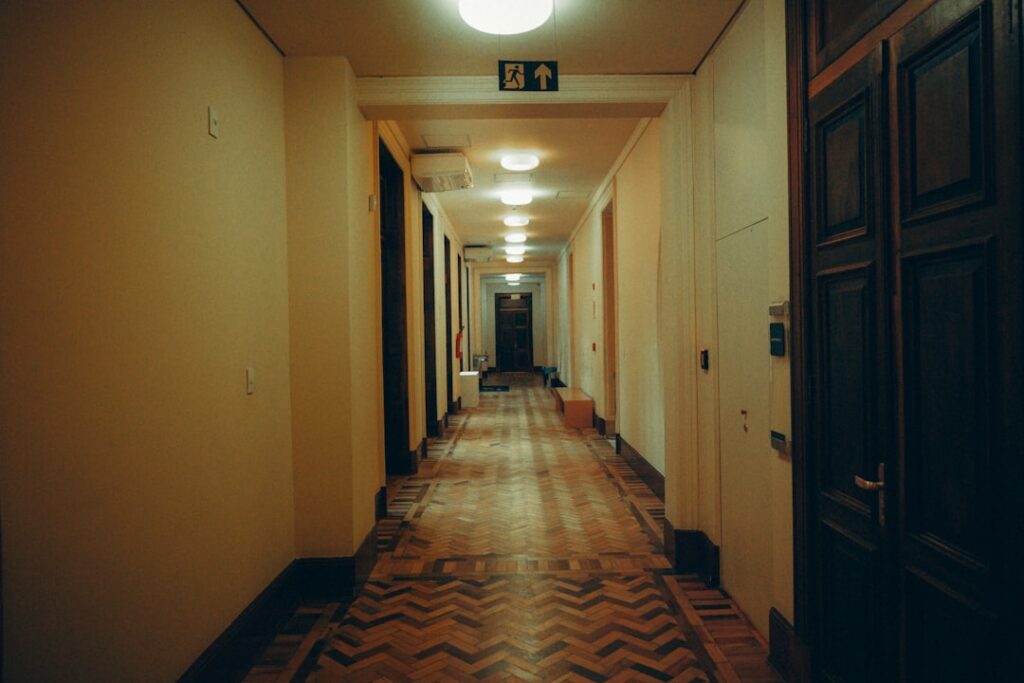
Drop a chevron pattern into a 14-foot living room and the floor becomes the most expensive-looking feature in the house. Walnut chevron flooring takes that effect further than any oak version by adding a chocolate undertone that photographs warm in daylight and rich at night. The catch is cost — and the install tolerances are tight enough that a sloppy crew can ruin a $14 per sq ft material in a weekend.
What Makes Chevron Different From Herringbone
Chevron planks are cut at a 45- or 60-degree angle on the ends so adjoining boards meet point-to-point in a continuous V. Herringbone planks are cut at 90 degrees and meet in a staggered L. Visually, chevron looks like a parade of mountain peaks; herringbone reads as a woven basket. Chevron costs more because each plank carries two angled cuts that waste roughly 12-15 percent of the source board.
American black walnut (Juglans nigra) brings a Janka hardness of 1,010 — softer than red oak at 1,290 but still acceptable for residential traffic. The species takes finish beautifully and rarely yellows like maple does after five years.
Pricing Tiers You Should Expect
Walnut chevron sits in the premium engineered category. Budget for materials alone, not labor:
- Entry engineered ($8-$11/sq ft): 2mm wear layer, 5/8-inch total thickness, 4-inch plank widths, factory UV oil finish
- Mid-tier ($12-$17/sq ft): 3-4mm wear layer, wider 5- to 6-inch planks, hand-scraped or wire-brushed texture
- Luxury ($18-$28/sq ft): 6mm sawn-face veneer, French oak core, bespoke stain matching, available in 8-inch widths
Solid walnut chevron exists but runs $22-$35 per sq ft and demands a humidity-controlled subfloor, so most contractors steer homeowners toward engineered construction.
Subfloor and Moisture Requirements
Before a single plank goes down, the subfloor needs to pass ASTM F2170 (relative humidity in concrete) and ASTM F1869 (calcium chloride moisture vapor emission). Most walnut engineered products cap RH at 75 percent and MVER at 3 lbs per 1,000 sq ft per 24 hours. Wood subfloors should test between 6 and 9 percent moisture content with a pin meter, and the planks themselves should sit within 2 percentage points of the subfloor before install.
Flatness tolerance for chevron is stricter than straight-lay: 3/16 inch over a 10-foot radius. Anything looser shows up as gaps at the points.
Install Methods Compared
Three approaches dominate, each with trade-offs:
- Full-spread adhesive: The pro standard. Use a urethane glue like Bostik GreenForce or Mapei Ultrabond ECO 980. Bond strength holds the chevron points tight for decades.
- Floating click-lock: A handful of brands now sell chevron with micro-bevel click joints. Faster, but the points loosen over time in homes that swing from 25 to 60 percent humidity.
- Nail-down: Only for solid walnut over plywood. Use a 16-gauge cleat at 18-degree angles every 8 inches.
Expect labor at $7-$12 per sq ft on top of materials. Crews experienced with chevron specifically are worth the premium — a generalist will average 60 sq ft per day instead of 150.
Brand Spotlight: Who Actually Sells It
Not every major brand carries chevron in walnut. The reliable suppliers in 2026:
- Mirage Hardwood: Canadian-made, 4mm wear layer, $14-$18/sq ft, lifetime structural warranty
- Mannington Maison: American black walnut chevron at $16/sq ft, 25-year residential finish warranty
- Lauzon Designer Collection: Smoked walnut with Titanium finish, $19/sq ft, 35-year wear warranty
- Carlisle Wide Plank: Custom-milled walnut chevron starting at $24/sq ft, made-to-order in Stoddard, NH
- Bruce Hydropel: Budget walnut-look chevron at $7/sq ft using engineered hickory with walnut stain
Skip the no-name Alibaba imports. Walnut veneer cut too thin telegraphs every subfloor imperfection within two years.
Pros and Cons in Plain English
The upsides are real but so are the headaches.
Pros: Resale value bump of 3-5 percent over straight-lay hardwood in appraisals from comparable neighborhoods. Hides minor subfloor seasoning movement better than long planks. Reads as bespoke even in a tract home. Walnut’s natural color means less stain reapplication if you sand and refinish in year 15.
Cons: Material waste runs 12-18 percent versus 7-10 percent for straight planks — order accordingly. Furniture layouts get awkward because the V points fight rectangular rugs. Walnut shows scuffs from grit faster than oak; a quality entry mat matters. And finding a refinisher who can re-sand chevron without dishing the angled seams is harder every year.
Maintenance That Actually Works
Use a pH-neutral cleaner like Bona Pro Series Hardwood Floor Cleaner or Pallmann Magic Cleaner. Skip vinegar-and-water mixes — the acidity etches UV-cured finishes within six months. Vacuum with a soft brush head twice a week to remove the abrasive grit that scratches walnut faster than denser species. Place felt pads under every chair leg; expect to replace them annually. Keep indoor humidity between 35 and 55 percent year-round to prevent gapping at the chevron points during dry winter months.
Stain and Finish Choices
Walnut takes finish beautifully because the natural oils in the wood blend smoothly with most penetrating sealers. Three finish approaches dominate the premium walnut chevron market. UV-cured aluminum oxide topcoats deliver maximum scratch resistance and ship pre-applied on factory-finished engineered planks; expect 25-35 year wear warranties. Hard-wax oil systems like Rubio Monocoat or Pallmann Magic Oil preserve the rawest, most natural walnut tone but require annual maintenance oil refreshes at about $0.20 per sq ft. Site-applied water-based polyurethane (Bona Mega ONE, Pallmann Pall-X 96) splits the difference — clear, non-yellowing, and refinishable in year 12-15.
For stain options, smoked walnut darkens the planks several shades using ammonia fuming reactions with the natural tannins. Bleached or natural walnut keeps the wood lighter. Most homeowners choose the natural finish to let the walnut color speak for itself.
Is Walnut Chevron Worth It
If your finish budget runs $20 per sq ft installed or higher, walnut chevron delivers the kind of design impact that justifies the spend. Below that price point, a wide-plank straight-lay walnut or even a high-end LVP in a chevron pattern from Karndean Knight Tile will give 80 percent of the look for 30 percent of the cost. The pattern is timeless, the species is classic, and the combination ages well — just budget honestly for the install crew and the waste factor before you commit.
Prefer to explore on your own?
See how new flooring looks in your actual room in seconds — free, no signup.
Try the free Floor Studio →