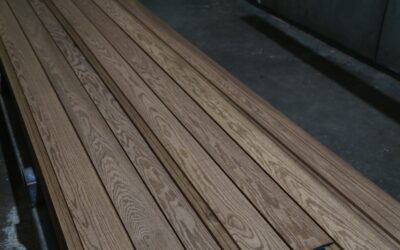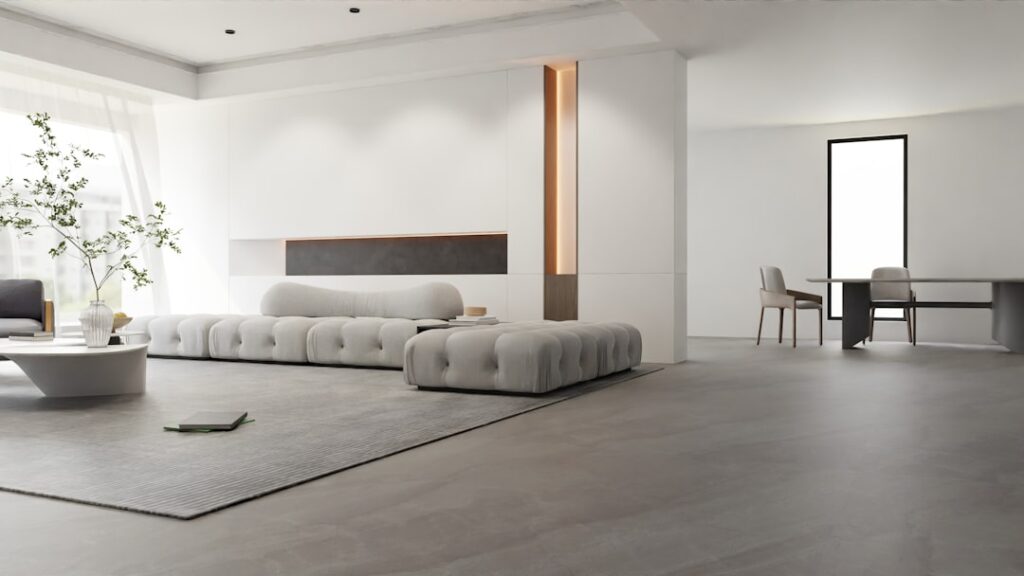
Stone Polymer Composite changed the rigid-core vinyl category almost overnight, and shoppers still get confused about what they are actually buying. What is SPC flooring made of comes down to four bonded layers: a dense limestone-and-PVC core, a printed decor film, a clear urethane wear layer measured in mils, and (on most planks) an attached IXPE or EVA acoustic pad. That stack is why COREtec Pro Plus, LifeProof Rigid Core, and SmartCore Ultra all feel like a board under your foot rather than a flexible sheet.
- The Limestone Core: 70% of the Plank’s Weight
- Wear Layer: Mil Thickness Determines Lifespan
- Decor Film and Embossed-in-Register Texture
- Attached Underlayment Pad
- Click-Lock Edge Profile
- SPC vs WPC vs LVP: Where SPC Wins
- Certifications That Actually Matter
- Pros and Cons of SPC Flooring
- What to Buy and Where
- Subfloor Preparation and Common Install Mistakes
- Repair, Replacement, and Lifespan
The Limestone Core: 70% of the Plank’s Weight
The “stone” in SPC is finely milled calcium carbonate (limestone powder) blended roughly 70/30 with virgin PVC, stabilizers, and a small dose of plasticizer. Manufacturers extrude that mix into a plank between 3.2mm and 5mm thick, which makes the floor harder to dent than WPC (Wood Polymer Composite) and dimensionally stable from 32°F to 140°F. Mohawk’s SolidTech Plus and Shaw’s Pantheon HD Plus both publish core densities above 1,900 kg/m³, which is why heavy refrigerators rarely leave permanent indents.
Wear Layer: Mil Thickness Determines Lifespan
Above the core sits a transparent urethane-coated PVC wear layer. This is the single spec that separates a 12-year residential floor from a 25-year light-commercial one. Budget SPC at Floor & Decor’s NuCore line runs 12 mil. Mid-tier products like LifeProof and SmartCore Pro hit 20 mil. Premium lines—COREtec Plus Premium, Karndean Korlok, Mannington Adura Apex—use 22 mil with aluminum oxide and ceramic bead additives.
- 6 mil: builder-grade rental use only
- 12 mil: light residential, 10-year warranty typical
- 20 mil: heavy residential, kids and pets
- 22 mil and above: light commercial, lifetime residential
Decor Film and Embossed-in-Register Texture
Between the core and the wear layer is a high-resolution printed film—usually a six-color rotogravure print on PVC. Premium SPC adds embossed-in-register (EIR) texture, meaning the grain you feel matches the grain you see. Pergo Extreme and COREtec Pro Plus Enhanced both use EIR with painted micro-bevels, which is why the planks pass for engineered oak from three feet away. Cheaper goods use rolled embossing that does not align with the print, an instant tell on shiny finishes.
Attached Underlayment Pad
Most modern SPC ships with a 1mm to 1.5mm IXPE (cross-linked polyethylene) or EVA foam pad already bonded to the back. IXPE handles moisture better and rebounds longer; EVA is cheaper and quieter underfoot. The attached pad eliminates a separate underlayment in 90% of installs, but it does not replace a 6-mil poly vapor barrier when you go over concrete slab below grade.
Click-Lock Edge Profile
The interlocking edge is usually a Valinge 2G or Unilin Uniclic angle-tap profile, milled directly into the SPC core. A well-cut click joint will withstand 450 lbs of horizontal pull-out per Valinge’s spec sheet, which is why SPC floats so confidently over 40-foot great rooms without T-moldings. Cheaper imports skip the locking ridge geometry; you can spot them because the planks open up at the short ends during seasonal humidity swings.
SPC vs WPC vs LVP: Where SPC Wins
WPC has a foamed wood-plastic core that feels softer underfoot but dents more easily. Standard glue-down LVP is flexible and telegraphs every subfloor imperfection. SPC sits in the middle: rigid enough to hide a subfloor flat to 3/16″ over 10 feet, hard enough to handle a kitchen drop, and waterproof to the core. Expect to pay $1.50-$2.50 per sq ft for builder SPC, $3-$5 for mid-tier Mohawk RevWood Plus or Shaw Floorte Pro, and $5-$8 for COREtec Pro Plus Premium or Mannington Adura Apex.
Certifications That Actually Matter
Look for FloorScore certification (low VOC), CARB Phase 2 compliance for formaldehyde, and an ASTM F1869 calcium chloride or ASTM F2170 RH probe pass on the subfloor before install. Reputable brands also list phthalate-free plasticizers—LifeProof, COREtec, and Karndean all disclose this. ASTM E648 Class 1 radiant flux means the floor meets commercial fire code, useful if you ever convert space.
Pros and Cons of SPC Flooring
Strengths: 100% waterproof core, dent resistance that beats laminate AC4, dimensional stability up to spans of 50 feet without transitions on premium lines, and easy DIY install with a tapping block and pull bar. Weaknesses: harder underfoot than WPC, cold in unheated basements without radiant, and the limestone core can crack if you drop a cast-iron pan on a corner. Expansion gaps of 1/4 to 3/8 inch around walls and pipes are still required even though manufacturers love to call SPC “dimensionally stable.”
What to Buy and Where
For most kitchens and main floors, a 20-mil wear layer with attached IXPE pad in the $3-$5 range hits the sweet spot. LifeProof at Home Depot, SmartCore Ultra at Lowe’s, and CoreLuxe XD at LL Flooring all qualify. If you have radiant heat, confirm the product is rated to 85°F surface temperature—COREtec Pro Plus and Shaw Pantheon HD Plus both pass. Buy 10% overage for cuts and waste, and acclimate the boxes flat in the install room for 48 hours before the first cut.
Subfloor Preparation and Common Install Mistakes
SPC is dimensionally stable but unforgiving of subfloor flatness violations. A 1/4-inch hump under a kitchen island will telegraph through as plank rock within a month. Grind concrete high spots with a single-head planetary grinder and patch low spots with self-leveling compound (Mapei Ultraplan, Ardex K-15) before any planks land. Over plywood, screw down loose squeaky spots with 2-1/2-inch deck screws on 6-inch centers and sand any proud nail heads flat. Confirm RH below 75% via ASTM F2170 probe on concrete; above 80% expect adhesive-pad failure even on “waterproof” SPC.
The other top install mistakes: skipping perimeter expansion gaps under thresholds, locking transitions to vertical pipes without a relief cut, and stacking unopened boxes vertically against a wall during acclimation. SPC boxes need to lay flat on the install floor for 48 hours to equalize at room temperature—stacking warps the planks at the box ends. Always cut against the locking ridge, not into it, and use a multi-tool to undercut door jambs rather than coping the plank.
Repair, Replacement, and Lifespan
Individual SPC plank replacement is surprisingly tractable. Cut the damaged plank in half with a track saw set to 5mm depth, lift the halves, and unclip the surrounding planks back to a workable seam. Most premium brands maintain dye-lot inventory for 5-7 years after a SKU launches, so plan to bank 2-3 unopened planks from the original install for future repairs. With moderate residential use, a 20-mil wear layer should reach 18-22 years before showing finish wear in heavy traffic paths; a 22-mil premium will hit 25+ years. Replace floors that show core delamination at the click joints—the SPC core is not field-repairable once the layers separate.
Prefer to explore on your own?
See how new flooring looks in your actual room in seconds — free, no signup.
Try the free Floor Studio →