The two-tone neutral kitchen has held the top spot on every home listing site for a decade, and it is not slowing down. A well-executed white and gray kitchen looks clean in photos, forgives the chaos of daily cooking, and appeals to 80 percent of potential buyers when it is time to sell. But there is a wide gap between “tasteful” and “dated before the paint dries.” The difference comes down to undertones, proportions, and hardware choices most DIYers overlook. This guide walks through the palette combinations that age well, which surfaces should get which color, and the specific products that deliver a magazine-quality look.
Why White and Gray Works So Well
Kitchens operate under harsh lighting, constant moisture, and heavy use. Dark cabinets show fingerprints and dust; bright colors date fast and limit resale. White and gray hit the sweet spot — they reflect light to make small kitchens feel larger, forgive scratches and nicks, and provide a neutral stage for whatever style of decor the homeowner layers on top.
Real estate data backs this up. Zillow and Redfin analyses consistently show two-tone white and gray kitchens add 2-4 percent to home sale prices versus single-color alternatives, and homes in this palette sell 7-12 days faster than comparable listings.
The 70/20/10 Color Rule
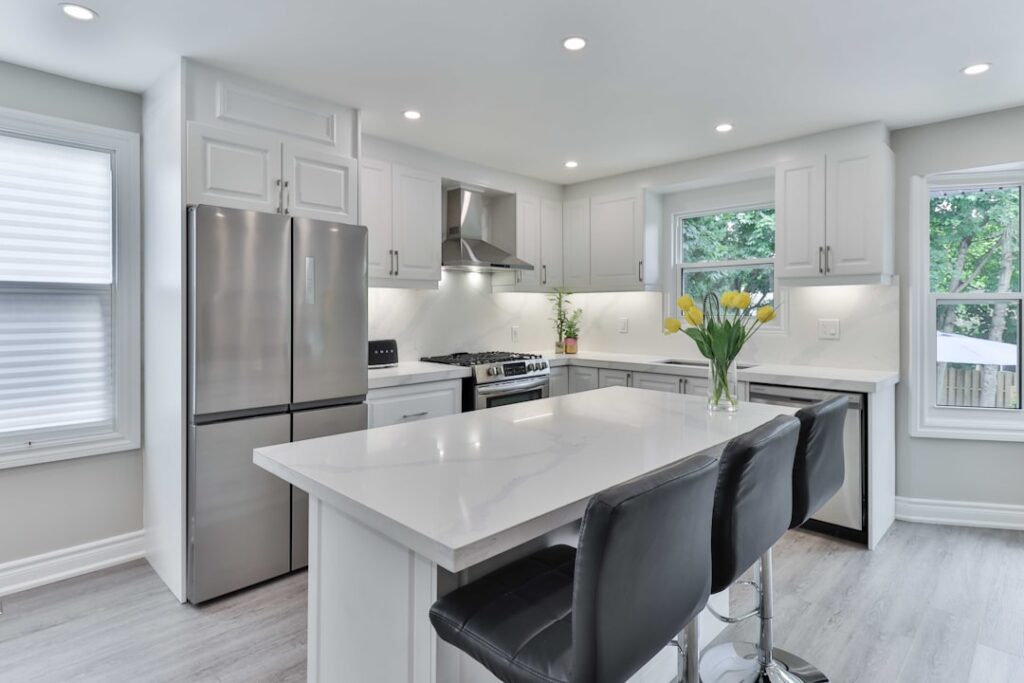
Designers use a proportion rule that keeps two-tone kitchens from feeling chaotic: 70 percent dominant color, 20 percent secondary, 10 percent accent. In a white and gray kitchen, that typically means 70 percent white (cabinets, walls, ceiling), 20 percent gray (island, lower cabinets, backsplash grout), and 10 percent accent (hardware, pendant lights, bar stools).
- 70% white: perimeter cabinets, crown molding, ceiling, walls
- 20% gray: island base, countertops with gray veining, or lower cabinets
- 10% accent: brass or matte black hardware, wood open shelving, accent backsplash
Flipping the ratio — 70 percent gray, 20 percent white — works in sun-drenched modern kitchens with 9-foot ceilings but reads heavy and cramped in smaller spaces with less natural light.
Cabinet Combinations That Sell
White Uppers, Gray Lowers
The most common and most versatile combination. White wall cabinets keep the upper portion of the room visually open; gray base cabinets ground the space and hide daily scuffs from feet and pets. Pair with a mid-tone wood or warm white countertop. Sherwin-Williams Extra White (SW 7006) uppers and Agreeable Gray (SW 7029) or Repose Gray (SW 7015) lowers is a bulletproof combination.
White Perimeter, Gray Island
The premium designer look. All perimeter cabinets stay white; the island becomes the feature in medium to dark gray. Works best in kitchens with 10+ foot islands where the gray mass does not overwhelm. Benjamin Moore Chelsea Gray (HC-168) or Kendall Charcoal (HC-166) on the island anchors the space without feeling heavy.
Light Gray Overall with White Accents
For homeowners who find pure white sterile. A soft gray like Benjamin Moore Gray Owl (2137-60) on all cabinets with white Shaker-style open shelves and white quartz counters creates a warmer version of the palette. Reads more custom and less builder-grade.
Countertop Pairings
Countertops make or break the palette. The wrong choice fights with the cabinets instead of complementing them. Options that consistently work:
- Calacatta quartz: White base with gray veining — $60-$100/sq ft installed, reads luxury
- Carrara marble: Classic but stains and etches — $50-$90/sq ft, budget carefully for sealing
- White quartzite (Taj Mahal, White Macaubas): More durable than marble, $75-$120/sq ft installed
- Silestone Eternal Calacatta Gold: Warm-white quartz with soft gold and gray veining — $65-$95/sq ft
- Concrete (custom): Medium gray with slight mottling — $80-$150/sq ft, adds texture contrast
- Soapstone: Deep gray, no sealing needed, ages beautifully — $100-$140/sq ft
Skip: speckled granite with too many colors, yellow-based cream stones (fights gray), anything with heavy red or gold tones.
Backsplash That Completes the Look
Four backsplash directions work reliably with a white and gray kitchen:
- Classic white subway tile with gray grout: $3-$7/sq ft material. Use 1/8-inch grout line in warm gray (not stark charcoal) for subtle definition
- Large-format slab backsplash matching the counter: Seamless, luxurious, $20-$40/sq ft additional material
- Herringbone gray marble mosaic: Adds pattern without color — $12-$25/sq ft, dramatic but dated within a decade
- Textured white handmade tile (zellige, cle, fireclay): Artisan feel, $15-$35/sq ft, reads custom
Avoid busy mosaic blends with multiple grays and whites mixed together. They read 2010s and date the whole kitchen.
Flooring Choices That Anchor the Space
White oak in a natural or light-washed finish is the current top choice — it warms up the cool palette and pairs with either warm or cool grays. Installed cost: $8-$15/sq ft for site-finished 3/4-inch plank, $6-$10/sq ft for engineered.
Other strong options:
- Luxury vinyl plank in warm medium tones: $5-$10/sq ft installed, waterproof and practical
- Large-format porcelain tile (24×48, gray wood-look): $10-$18/sq ft, ideal for open concept
- Polished concrete: $6-$12/sq ft if pouring new, more expensive as overlay
Avoid stark white tile floors (read cold and clinical) and orange-toned red oak (clashes with cool grays).
Hardware and Fixture Choices
Hardware is the jewelry of the kitchen. Three metal finishes work well:
- Matte black: bold contrast, modern, low-maintenance. $4-$12 per pull at Home Depot, $15-$35 for premium brands like Emtek
- Brushed brass: warm contrast, reads custom, trending strongly since 2019. $8-$20 per pull
- Polished nickel or satin chrome: timeless, coordinates with most appliances. $10-$25 per pull
Pick one finish for cabinet hardware and one for faucet/lighting — or match all three. Mixing three or more finishes looks busy. Skip: oil-rubbed bronze (dated), polished chrome on everything (cold), rose gold (already passing).
Lighting Temperature Matters
White and gray kitchens can skew cold and hospital-like if you use the wrong bulbs. Stick with 2700K to 3000K LEDs for all kitchen lighting — warm white that makes gray read sophisticated rather than industrial. Avoid anything 4000K or above unless you specifically want a commercial feel. Pendants over the island should hit 3000K; under-cabinet LEDs likewise.
Dimmer switches on every circuit let you shift the mood from bright cooking to intimate dining. Budget $30-$50 per dimmer and plan for three to five circuits in a typical kitchen.
Mistakes That Date the Look Fast
Avoid these common missteps that mark a kitchen as “early 2020s” within five years:
- Painted gray cabinets with gray speckled granite — too matchy, no contrast
- Gray walls plus gray cabinets plus gray floor — the “50 shades” trap
- Cool gray paint in a north-facing kitchen — reads blue and depressing
- Open shelving packed with coordinated decor — looks staged, not lived-in
- All-brass hardware on all-white cabinets — too 2022 Pinterest
- Gray-washed wood floors with gray cabinets — fights for visual attention
A thoughtful white and gray kitchen balances warmth and cool, contrast and harmony, and resists over-trending. Done well, it still looks sharp at the 10-year mark, which is exactly what makes it such a reliable renovation investment.