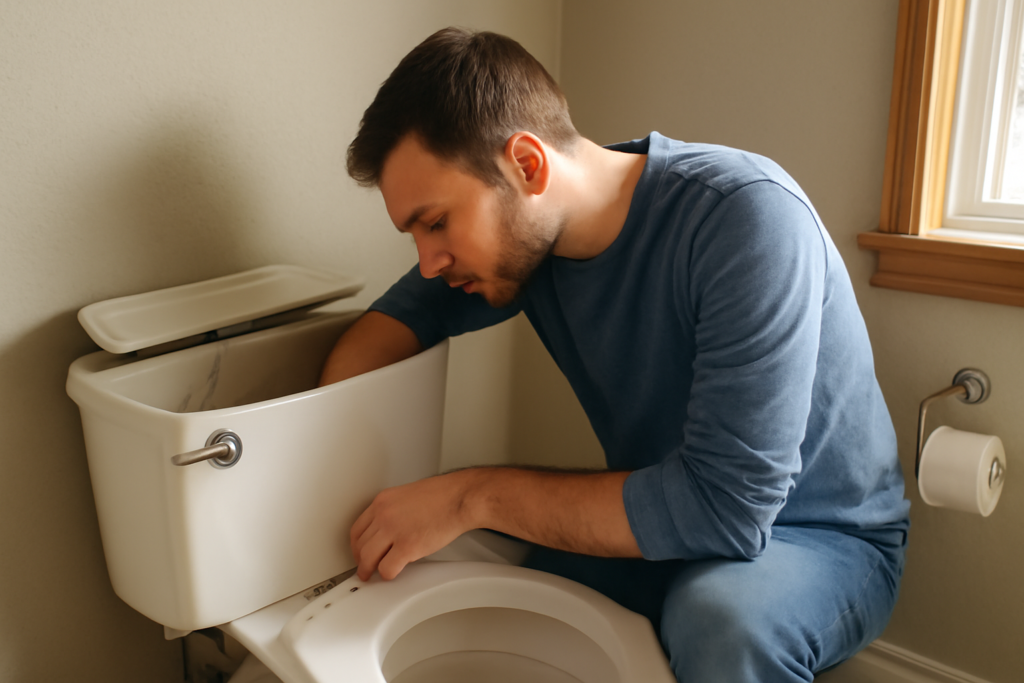
You lift the lid, expect to see a reservoir ready for the next flush, and instead find an empty or barely filled tank. If you’re asking why is there no water in my toilet tank, the good news is that most causes are simple, cheap, and fixable in an afternoon without a plumber. The culprit is almost always the water supply, the fill valve, or the float, and you can diagnose all three yourself.
Work through the checks below in order, from the easiest to the most involved.
Start With the Shut-Off Valve
The first thing to check is the small oval or football-shaped valve on the wall behind the toilet, near the floor. This is the supply shut-off, and it’s the number one reason a tank goes dry. Someone may have closed it during cleaning, a repair, or a leak scare and forgotten to reopen it.
Turn the handle counterclockwise until it stops. You should hear water begin to hiss into the tank. If the valve was already fully open and nothing happens, move on; if it was closed, watch the tank refill and you’ve likely solved it.
Check the Supply Line
If the valve is open but the tank stays empty, follow the flexible supply hose from the valve up to the bottom of the tank. A kinked, disconnected, or clogged supply line will starve the tank even with the valve wide open.
Feel the line for kinks and make sure both connections are snug. Older homes sometimes suffer from mineral buildup or debris inside the line or the fill valve inlet, which chokes the flow to a trickle. Shutting off the supply and briefly disconnecting the line to check for blockage is a quick test.
Inspect the Fill Valve
The fill valve is the tall assembly on the left side of the tank that refills it after each flush. When it fails, water either won’t enter the tank or shuts off far too early. Flush the toilet and watch: if the valve doesn’t release water into the tank at all, or sputters and stops, it’s a prime suspect.
Fill valves are inexpensive, usually $10 to $20, and are one of the most common toilet parts to replace. Sediment can clog the valve’s seal, so sometimes cleaning it restores flow, but a valve more than a decade old is often worth simply swapping out.
Examine the Float
Every tank has a float that tells the fill valve when to stop. If the float is set too low, or if it’s stuck, the valve thinks the tank is full when it’s nearly empty. There are two common styles:
- Ball float: The classic arm-and-ball. Gently bend the arm upward to raise the water level.
- Cup float: A cylinder that slides along the fill valve. Adjust the clip or screw to raise it.
Set the water line to about an inch below the top of the overflow tube. A float that has cracked and filled with water will sink and hold the valve shut, which also mimics an empty-tank problem.
Rule Out Water-Saver Mode and Settings
Some newer and dual-flush toilets are designed to hold a deliberately low tank level to save water, so what looks like a problem may be normal. Check the manufacturer’s marked fill line inside the tank. If your water sits at that line and the toilet flushes fine, nothing is wrong.
It’s also worth confirming the whole house has water. If a main shut-off was closed or the utility is doing work, every fixture will be dry, not just the toilet. Test a nearby faucet before you start disassembling anything.
Look for Cracks and Hidden Leaks
If the tank refuses to hold water even after the valve fills it, you may have a leak. A hairline crack in the porcelain, a failed tank-to-bowl gasket, or worn bolt washers can let water drain out as fast as it enters. Check the floor and the base of the tank for dampness.
A worn flapper is the sneakiest version of this: it lets water siphon slowly from tank to bowl, so the fill valve keeps topping up but the level never seems right. Drop a few drops of food coloring in the tank and wait 15 minutes; color in the bowl confirms a flapper leak.
Step-by-Step Diagnosis
To pull it all together, here’s the order to work through when the tank is dry. Following a sequence saves you from guessing and from replacing parts you don’t need.
- Step 1: Confirm the home has water by testing a nearby faucet.
- Step 2: Open the shut-off valve behind the toilet fully.
- Step 3: Check the supply line for kinks or a loose connection.
- Step 4: Flush and watch whether the fill valve releases water into the tank.
- Step 5: Inspect and adjust the float to the correct level.
- Step 6: Test for a flapper leak with food coloring.
- Step 7: Look for cracks or dampness around the tank base.
Nine times out of ten, you’ll solve the problem by step three or four.
Preventing the Problem Long-Term
A little maintenance keeps a healthy tank from going dry again. Every year or two, inspect the fill valve and flapper for mineral buildup and wear, and replace the flapper before it hardens and leaks. If you have hard water, the scale that clogs valves and jets builds faster, so a periodic vinegar soak of the tank components pays off.
It’s also worth knowing where your main water shut-off is and keeping the toilet’s own shut-off valve exercised so it doesn’t seize. Understanding why is there no water in my toilet tank once means you can spot the early signs, a slow fill or a wandering water level, and fix them before they leave you staring at an empty tank on a busy morning.
When to Call a Plumber
Most cases of why is there no water in my toilet tank end at the shut-off valve or the fill valve. But if you’ve confirmed water is reaching the toilet, replaced the fill valve, and the tank still won’t fill, or if you find a genuine crack in the porcelain, it’s time to call a professional. A cracked tank usually means replacing the tank or the whole toilet, and a stubborn supply blockage in the wall is beyond a simple DIY fix.
The reassuring takeaway is that the vast majority of empty-tank situations are quick, inexpensive fixes you can handle with basic tools and no plumbing experience. A closed valve costs nothing to reopen, and a fill valve or float adjustment is a modest repair. Before you panic or pay for a service call, work methodically through the checks in this guide. More often than not you’ll find the culprit in a few minutes and have your toilet filling normally again without spending a dime.