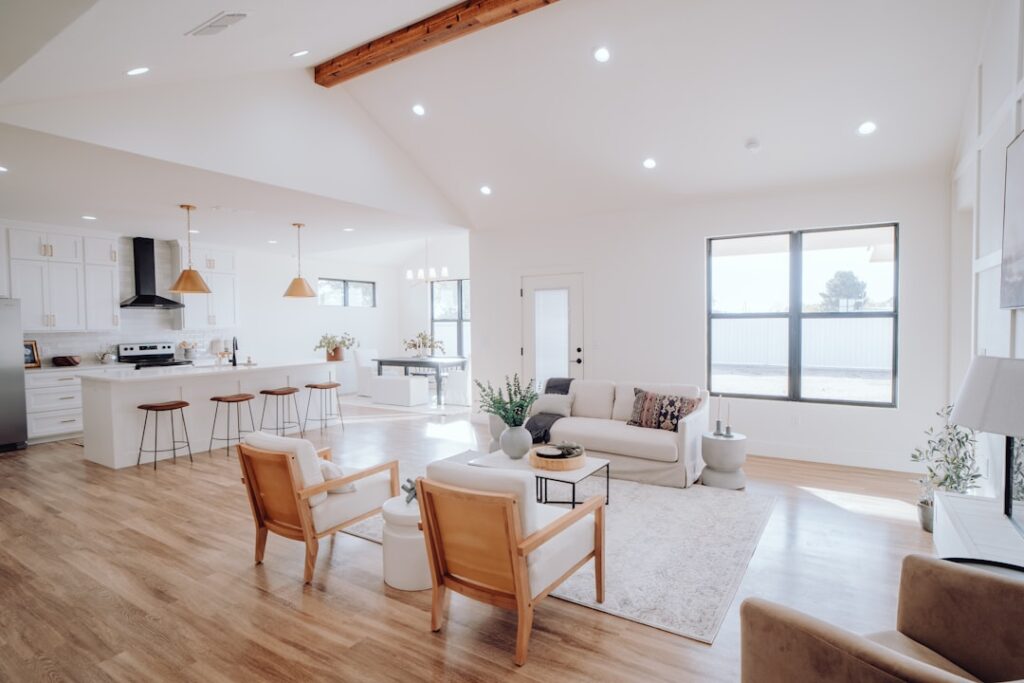
Wilsonart built its reputation on countertop laminate, then quietly became one of the largest commercial flooring manufacturers in North America. Wilsonart flooring shows up under hospital corridors, hotel rooms, and a growing share of residential remodels where buyers want commercial-grade durability at a residential price. Most homeowners have never heard of it, which keeps prices below the well-marketed national brands. After spec’ing it on two retail buildouts and one custom home, I have a clear take on where it shines and where it gets out-bid by the competition.
The Wilsonart Flooring Lineup
Wilsonart sells three main flooring product families. The Estrie and Brio collections cover luxury vinyl plank with rigid SPC cores. The Aspire line is high-pressure laminate plank, related to their countertop technology. The traditional Laminate Decorative Floor pattern catalog targets light commercial spaces.
All three share the company’s print-and-press manufacturing pedigree, which means richer wood-look graphics than many big-box brands at a similar price. Plank widths run from 7 to 9 inches, lengths from 48 to 72 inches.
Construction and Wear Layers
The Brio SPC line carries a 20 mil wear layer over a stone-polymer composite core, similar in spec to mid-grade COREtec or Mohawk RevWood Premier. Total plank thickness lands at 6 mm with a pre-attached IXPE acoustic underlayment.
Aspire laminate uses Wilsonart’s proprietary HPL surface, which scores higher on Taber abrasion than typical AC4 laminates. The core is HDF rated at 12 mm. For an entry hallway or a home office that takes a desk chair, the wear resistance is meaningfully better than a $1.99 per square foot Home Depot laminate.
Pricing and Where To Buy
Wilsonart sells almost exclusively through flooring distributors, not big-box stores. Expect $3.20 to $4.80 per square foot for Brio SPC, $2.80 to $4 for Aspire HPL plank. Installation by a flooring contractor runs $2 to $3.50 per square foot on a clean substrate.
You can find dealers through the Wilsonart Engineered Surfaces dealer locator. The trade-only distribution model frustrates DIYers but yields better installation support and a more consistent product than the box-store route.
Pros That Stand Out
- Commercial-grade wear layer at residential pricing
- HPL laminate resists indentation better than typical melamine laminate
- Realistic wood graphics thanks to in-house digital print technology
- Lifetime residential warranty on most SPC lines, 10 to 15 years light commercial
- Low gloss matte finishes that hide micro-scratches better than glossy competitors
- Made in the USA at the Temple, Texas plant
Cons and Trade-offs
The product is harder to source than Shaw, Mohawk, or LL Flooring. If you are 60 minutes from a dealer, getting samples and replacement boxes can take a week. Returns are slower too. For homeowners who like to walk a store and bring tiles home that afternoon, Wilsonart is not the easiest fit.
Color selection is narrower than the giants. Roughly 40 SKUs across the residential lines compared with 200 plus from Shaw. If you have your heart set on a specific gray-washed white oak look, you may need to compromise.
Finally, the Aspire laminate is not waterproof, only water-resistant. Spills wiped within 30 minutes are fine; standing water at a dishwasher leak will cause edge swelling like any other HDF laminate.
Installation Notes
Brio SPC clicks together with a 5G drop-lock fold-in system that DIYers handle confidently after the first row. The locking mechanism is tighter than Shaw COREtec, which means more force on the tap block but also less peaking later. Use a Crain 928 or Roberts pull bar.
Plan a 1/4 inch expansion gap at all walls and a transition strip every 35 linear feet, per the manufacturer instructions. Aspire HPL needs the same gap plus a 2 mm foam underlayment if it is not pre-attached. Acclimate boxes flat for 48 hours at 65 to 85 degrees F before install.
How It Compares
Against Shaw Floorte Pro: Wilsonart Brio matches the spec at a slightly lower price, with thinner plank graphics. Against Mohawk RevWood Premier: Brio wins on water resistance, RevWood wins on color count. Against COREtec Pro Plus: COREtec has the brand recognition; Wilsonart costs roughly 10 percent less and ships from Texas, often shaving lead time for southern projects.
For an HPL laminate comparison, Wilsonart Aspire sits a step above Pergo Outlast Plus and below specialty European HPL brands like Quick-Step Reclaime.
Best Use Cases
Wilsonart flooring fits best in a home office, finished basement, kid’s bedroom, or hallway where you want commercial wear resistance and a clean modern look. It is also a smart pick for rental property owners who want a step up from $2 per square foot laminate without overspending.
Skip it for primary-bath or laundry-room installs where you would rather have full waterproof porcelain. The SPC lines are technically rated for those zones, but a true tile floor outlasts any plank product in a wet space.
Warranty Fine Print
The lifetime residential warranty on the Brio SPC line covers wear-through, manufacturing defects, and topical staining when the floor is installed and maintained per the manual. It excludes scratches, damage from heavy point loads, and any damage in spaces exposed to direct sunlight more than 8 hours a day without window film. Light commercial coverage runs 10 to 15 years for most product lines, with a prorated structure after year five. Keep your purchase receipt and the original lot sticker from each box; both are required for any successful claim.
Final Take
If you can find a local dealer with stock and you value a quieter, commercial-grade product over endless color choices, Wilsonart flooring delivers excellent value. The brand will not catch the eye in a big-box aisle, which is exactly why the price stays reasonable. Get two or three samples, look at them in your room at night under your actual lighting, and you will likely come away pleasantly surprised.
Prefer to explore on your own?
See how new flooring looks in your actual room in seconds — free, no signup.
Try the free Floor Studio →