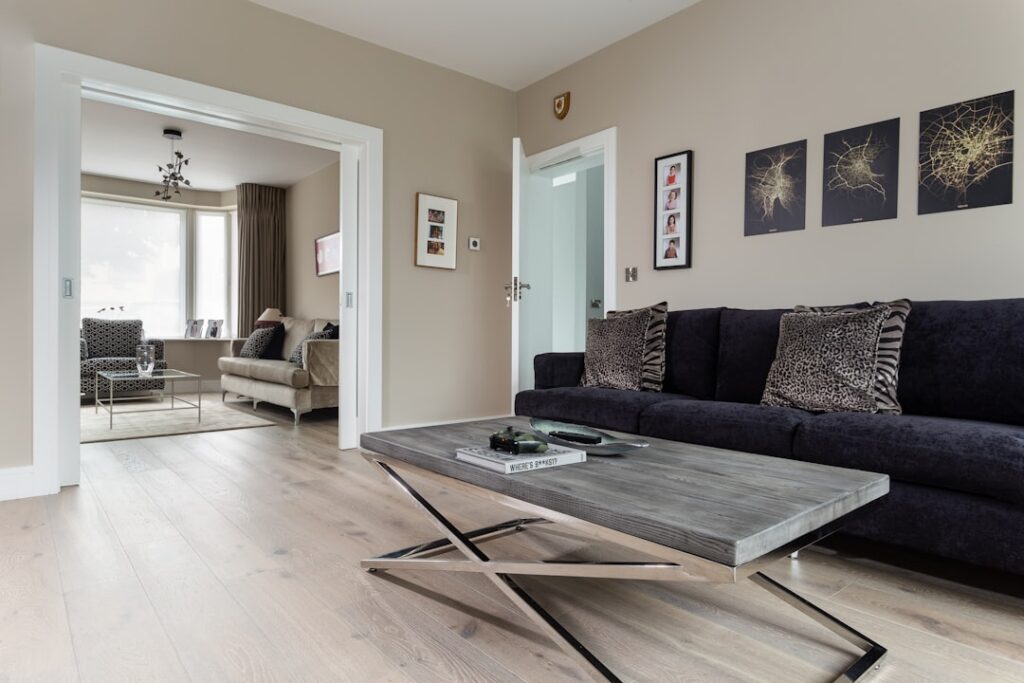
The phrase “lino floor” still makes some homeowners picture a yellowed kitchen circa 1978. Today’s wood effect lino flooring is a different product entirely — high-resolution prints, embossed grain texture, and waterproof cores that mimic real oak so convincingly that visitors regularly mistake it for the genuine article. The price gap, however, remains the same: lino runs roughly one-fifth the cost of hardwood.
- Lino, Vinyl, and the Confusion Worth Sorting Out
- Pros of Wood Effect Lino Flooring
- Cons You Should Not Ignore
- Wood Effect Lino vs Laminate vs LVP
- Best Brands and Product Lines for 2026
- Installation Methods That Actually Last
- Subfloor Prep and Common Mistakes
- Cleaning and Long-Term Care
- Frequently Asked Questions
This guide cuts through the marketing to explain what wood-look lino actually is in 2026, how it stacks up against LVP and laminate, and where it makes sense in a real US home.
Lino, Vinyl, and the Confusion Worth Sorting Out
Strictly speaking, “lino” refers to linoleum — a natural product made from linseed oil, pine rosin, cork dust, wood flour, and limestone pressed onto jute backing. True linoleum is biodegradable and has been manufactured since 1864. What most stores sell as “wood effect lino” today is actually luxury vinyl plank (LVP) or sheet vinyl with a wood-grain print. Both share the soft underfoot feel and waterproof claim, but the materials are completely different.
For this guide, “wood effect lino flooring” covers both true linoleum with wood-grain prints (Marmoleum Wood) and vinyl-based wood-look sheet and plank flooring, since US shoppers use the term interchangeably.
Pros of Wood Effect Lino Flooring
Real-world advantages that hold up under scrutiny:
- Cost: $1.50 to $5 per sq ft material, $4 to $8 installed — a fraction of hardwood
- Waterproof options: Vinyl-based products handle bathroom and kitchen floods without warping
- Soft underfoot: 2-4 mm wear layer with foam backing absorbs impact, easing joint pain
- Low maintenance: Damp mop with pH-neutral cleaner, no refinishing ever required
- Realistic visuals: Modern embossed-in-register printing matches grain texture to the visual print
- DIY friendly: Click-lock plank versions install over most existing floors in a weekend
- Quiet: Cushion backing reduces footfall noise by 18-22 dB versus tile
For rentals, kids’ rooms, basements, or any space where moisture is a real risk, wood-effect lino solves more problems than it creates.
Cons You Should Not Ignore
The downsides separate informed buyers from the disappointed ones:
- Lifespan caps at 15-25 years, well below real hardwood’s 75+
- Heavy furniture leaves permanent indentations in soft-bodied vinyl
- Direct sunlight fades cheaper prints within 5-7 years
- Sharp objects (dropped knives, dog claws) gouge the wear layer
- Cannot be sanded or refinished — damage means replacement
- Lower-end vinyl can off-gas phthalates; check FloorScore and Greenguard certs
- Resale value adds nothing compared to hardwood or tile
True linoleum (Marmoleum) avoids the off-gassing concern and lasts 30-40 years, but it costs $5 to $8 per sq ft and requires periodic re-waxing.
Wood Effect Lino vs Laminate vs LVP
The three are constantly compared and frequently confused. Here is how they actually differ:
- Wood effect lino (vinyl-based): 100% waterproof, soft, $1.50-$5/sq ft, lifespan 15-25 years
- Laminate: HDF core, water-resistant only, hard underfoot, $1-$4/sq ft, lifespan 10-25 years
- True linoleum: Natural materials, semi-water-resistant, $5-$8/sq ft, lifespan 30-40 years
For wet zones, vinyl wins. For the most realistic appearance, premium laminate (12mm with deep emboss) tends to edge out lino. For the greenest option, true linoleum stands alone.
Best Brands and Product Lines for 2026
Recommended product lines by price tier:
- Forbo Marmoleum Wood — true linoleum, $6-$8/sq ft, 30-year warranty
- Karndean Knight Tile — premium LVP, $4.50-$6/sq ft, lifetime residential warranty
- COREtec Plus HD — rigid core LVP, $4-$5.50/sq ft, waterproof, 25-year wear warranty
- Mohawk RevWood Plus — wood-look hybrid, $3-$4.50/sq ft, all-pet warranty
- Lifeproof (Home Depot) — budget LVP, $2.50-$3.50/sq ft, lifetime residential warranty
- Armstrong Vivero Better — value sheet vinyl, $1.80-$2.50/sq ft
Aim for at least a 20-mil wear layer in active households. Anything below 12 mil should be reserved for low-traffic guest rooms.
Installation Methods That Actually Last
Three installation styles dominate the wood-look lino market:
Click-Lock Floating
The DIY favorite. Planks snap together over a 2 mm foam underlay. Skip the underlay if planks come pre-attached. Leave a 1/4 inch expansion gap at all walls. Average install: 250 sq ft per day for an experienced amateur.
Glue-Down
Best for heavy commercial traffic and wet areas. Uses pressure-sensitive adhesive over a fully prepared subfloor. More stable underfoot, no bounce, but harder to repair individual planks. Hire a pro for anything over 200 sq ft.
Loose-Lay
Heavy backing keeps planks flat without glue or clicks. Excellent over uneven concrete or radiant heat systems. Comes off cleanly for renters. Limited brand availability — Karndean LooseLay is the standout.
Subfloor Prep and Common Mistakes
Wood effect lino telegraphs every imperfection beneath it. Follow these prep rules to avoid callbacks:
- Concrete must test below 4 lbs of moisture vapor per 1,000 sq ft per 24 hours
- Wood subfloors require 3/4 inch tongue-and-groove plywood minimum
- Self-level any dip exceeding 3/16 inch over 10 feet
- Acclimate flooring 48 hours in the room at 65-85°F
- Never install over carpet, regardless of click-lock claims
Most installation failures come from skipped moisture testing on slab-on-grade floors.
Cleaning and Long-Term Care
Maintenance is genuinely easy. Sweep or vacuum (brush roll off) two to three times weekly. Damp mop with a pH-neutral cleaner like Bona Hard-Surface Floor Cleaner once a week. Skip steam mops — heat softens the wear layer and voids most warranties.
Furniture pads under every leg are non-negotiable. Use 1.5 inch felt pads on light furniture and rubber-cup glides under heavy pieces over 100 lbs.
Frequently Asked Questions
Is wood effect lino waterproof?
Vinyl-based products are fully waterproof. True linoleum is water-resistant but seams can fail with prolonged standing water.
Will wood effect lino fool guests into thinking it is real wood?
Premium options with embossed-in-register grain pass the visual test from standing height. Touch and acoustic feel give it away on close inspection.
Can I install wood effect lino in a basement?
Yes, vinyl-based products are ideal for basements. Confirm the slab passes a 72-hour moisture test before installation.
How long does wood effect lino last?
15-25 years for vinyl, 30-40 for true linoleum, depending on wear layer thickness and traffic level.
Prefer to explore on your own?
See how new flooring looks in your actual room in seconds — free, no signup.
Try the free Floor Studio →