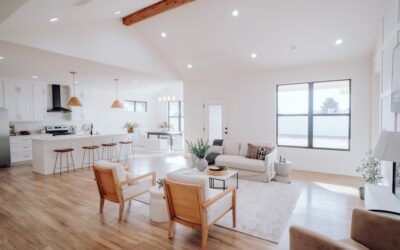
Open the floor in a 1940s bungalow and you almost always find 2-1/4 inch red oak running diagonal to the joists. Wood strip flooring in narrow 1-1/2 to 2-1/4 inch widths defined American residential construction for decades and has staged a quiet comeback in restorations, period reproductions, and homes where wider planks feel out of scale. The narrower format brings unique benefits in stability, repair, and budget that wider plank floors cannot match.
- What Counts as Strip Flooring
- Why Narrow Widths Still Make Sense
- Common Species and Janka Ratings
- Prefinished vs Site-Finished
- Installation Method
- Acclimation Is Critical
- Cost Breakdown for 400 Sq Ft
- Finishing Options
- Long-Term Repair Advantage
- Pattern and Layout Options
- Common Subfloor Issues
- Is It the Right Choice for You
What Counts as Strip Flooring
The industry defines wood strip flooring as solid or engineered boards between 1-1/2 inches and 2-1/4 inches wide. Anything wider is called plank flooring, and anything narrower falls into specialty parquet territory. Common strip widths include 1-1/2, 1-3/4, 2, and 2-1/4 inches, with random lengths from 9 inches up to 84 inches. Most prefinished strip runs 3/4 inch thick on a tongue-and-groove milling profile that takes nail-down installation.
Why Narrow Widths Still Make Sense
Narrow strips move less with humidity than wide planks. A 2-1/4 inch red oak board expands roughly 1/64 inch from January to August in a typical climate-controlled home, while a 7-inch plank moves nearly 1/8 inch over the same period. That smaller movement means tighter joints year-round, fewer gaps in winter, and less risk of cupping in humid summers. Strip flooring also handles old-house subfloor imperfections better, hiding minor unevenness that wide planks would highlight.
Common Species and Janka Ratings
- Red oak at 1,290 Janka, the most common American strip, $4 to $7 per square foot unfinished
- White oak at 1,360 Janka, lighter color and tighter grain, $5 to $9 per square foot unfinished
- Hard maple at 1,450 Janka, very tight grain and difficult to stain evenly, $5 to $8 per square foot
- Hickory at 1,820 Janka, dramatic color variation board to board, $5 to $9 per square foot
- Heart pine reclaimed at 1,225 Janka, primarily restoration product, $9 to $18 per square foot
Prefinished vs Site-Finished
Prefinished strip flooring from Bruce, Mullican, Somerset, and Owens Plank Floor arrives with aluminum-oxide UV-cured topcoats applied at the mill. Installation takes 1 to 2 days for a typical 600-square-foot living room, and the floor is walkable immediately. Site-finished strip runs cheaper as raw material at $3.50 to $5 per square foot but adds labor for sanding, staining, and three coats of water-based finish like Bona Traffic HD or Pallmann Magic Oil. Total install cost lands in roughly the same place once labor is added.
Installation Method
Solid 3/4-inch strip flooring installs over a 3/4-inch plywood or OSB subfloor with 15-pound felt paper or rosin paper between. Use a pneumatic flooring cleat nailer like the Bostitch MIIIFN, Powernail 50P, or Primatech P250 with 1-1/2 to 2-inch cleats every 6 to 8 inches along each board. The first three rows near walls get face-nailed by hand because the cleat nailer cannot reach into corners. Stagger end joints by at least 8 inches and avoid creating obvious patterns across the floor.
Engineered strip in 3/8-inch and 1/2-inch profiles can install over concrete with a glue-down method using Bostik’s Best, Mapei Ultrabond ECO 980, or similar urethane adhesive at $0.60 to $1 per square foot.
Acclimation Is Critical
Solid strip flooring must acclimate inside the conditioned space for 5 to 14 days before installation. HVAC must run at 65 to 75 degrees and 35 to 55 percent relative humidity throughout. Take moisture readings on both the subfloor and the flooring with a pin-type meter like the Wagner MMC220 or Delmhorst BD-2100. Subfloor should read 12 percent or less and within 4 percentage points of the flooring itself.
Cost Breakdown for 400 Sq Ft
- Red oak prefinished strip material: $1,600 to $2,800
- Underlayment paper and supplies: $80 to $150
- Installation labor at $4 to $6 per square foot: $1,600 to $2,400
- Existing floor demolition and disposal: $400 to $800
- Transitions and shoe molding: $200 to $500
Total installed cost for a 400-square-foot room: roughly $3,900 to $6,700.
Finishing Options
Site-finished strip flooring opens up custom stain colors not available in prefinished product. Bona DriFast and Minwax oil stains in espresso, jacobean, and provincial remain timeless choices. Water-based finishes like Bona Traffic HD provide three coats of clear protection in a single day, while oil-modified urethane delivers warmer amber tones but requires 24 hours between coats. Hardwax oil from Rubio Monocoat or Pallmann Magic Oil creates a matte natural look but needs maintenance refresh every 18 to 30 months in busy households.
Long-Term Repair Advantage
The single greatest benefit of wood strip flooring is repairability. Damaged boards can be replaced individually with hand tools and a few hours of work. Salvaged matching strips from closets or under cabinets can patch entry-area damage invisibly. Solid 3/4-inch product can be sanded three to five times over a 100-year lifespan, which is why so many original strip floors in older homes are still in service today.
Pattern and Layout Options
Wood strip flooring lends itself to several traditional layouts. Random-length parallel runs are the most common and historically accurate for early 20th century homes. Diagonal layouts at 45 degrees create visual interest in square rooms but waste 12 to 18 percent more material in cuts. Herringbone and parquet patterns assembled from short strips are dramatic but labor-intensive, adding 40 to 70 percent to install costs. Borders and inlays using contrasting walnut or mahogany strips elevate formal rooms with relatively minor material cost.
Common Subfloor Issues
Older homes often have plank subfloors running diagonal to joists, with significant gaps and uneven boards. Add a layer of 1/2-inch plywood over the existing planks before installing new hardwood, screwed every 6 inches into the joists below. Skip this step and you risk squeaks, popping nails, and visible board-print telegraphing through the new floor. Slab homes need ASTM F1869 or F2170 moisture testing and a vapor barrier before any solid hardwood, with engineered product the safer choice on grade and below grade.
Is It the Right Choice for You
Wood strip flooring suits homeowners who appreciate traditional proportions, plan to stay in the house long enough to refinish, and want a floor that can be repaired rather than replaced. If your design leans modern with wide-plank European oak in 7 to 9 inch widths, strip flooring will feel undersized. For Craftsman, Colonial, Tudor, and bungalow homes, narrow strip is the historically correct and dimensionally stable choice that ages beautifully.
Prefer to explore on your own?
See how new flooring looks in your actual room in seconds — free, no signup.
Try the free Floor Studio →