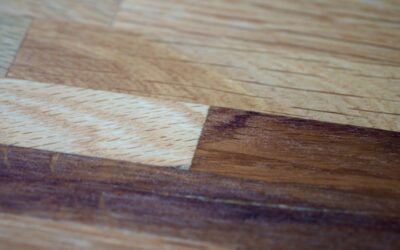
A 60-year-old oak floor with three deep gouges and a mystery dark stain is almost always salvageable for under $300. A 5-year-old engineered floor with one cupped board after a dishwasher leak is sometimes not. The condition of the boards, the finish, and the subfloor all determine whether wooden flooring repair makes economic sense or whether you should plan a full replacement instead. After fifteen years repairing hardwood across colonials, ranches, and high-rise condos, I have learned to walk a floor for ten minutes before quoting anything — the visible damage is rarely the actual problem.
Diagnose Before You Repair
Three categories of damage drive entirely different fixes:
- Surface damage: Scratches, scuffs, light wear in finish only — 60% of repair calls
- Board damage: Gouges through finish into wood, dents, gaps, splits — 30%
- Structural damage: Cupping, crowning, buckling, popping nails, subfloor failure — 10%
Surface and board damage repair locally. Structural damage almost always involves moisture or subfloor problems that must be diagnosed and corrected before any cosmetic fix. Patching a cupped board without addressing the moisture source guarantees the cup returns within months.
Surface Repair: Scratches and Wear
Most scratches that appear catastrophic only damage the finish, not the wood underneath. Test by running a fingernail across the scratch perpendicular to its length — if your nail does not catch, the finish is intact. For light scratches, a wax stick from Minwax or Howard ($8-$15) rubbed in and buffed with a soft cloth removes 80% of visible damage in five minutes.
Deeper scratches that do catch a fingernail call for a touch-up marker (Old Masters or Varathane, $9-$14) followed by a urethane top coat. Match the sheen — gloss markers on satin finish look obvious in raking light. For wear patterns in heavy-traffic lanes, a screen-and-recoat with the same urethane chemistry restores the entire floor for $1-$2 per sq ft DIY, $2.50-$4 per sq ft professional.
Filling Gouges and Dents
Gouges through the finish into the wood need filler before any color work. Latex wood filler (Minwax Stainable, $8 per pint) or two-part epoxy (Famowood, $14 per pint) for deeper damage fills the void, sands flush, and accepts stain matching the surrounding floor. Two-part epoxies handle gaps wider than 1/4 inch where latex shrinks and cracks.
Dents from dropped objects sometimes raise back up with steam — a damp cotton cloth with an iron set to medium for 5-10 seconds expands the compressed grain. Works on solid hardwood; usually fails on engineered because the dent compressed the print veneer past recovery.
Replacing a Damaged Board
For board-level damage that cannot be filled, the standard repair is to remove and replace the affected plank. Tongue-and-groove solid hardwood requires cutting the damaged board out — a circular saw set to plank thickness, two parallel rip cuts down the center, then chiseling out the halves. Slot in a replacement board with the bottom of its groove cut off so it drops into place from above, glue, and nail through the face with finishing nails set and filled.
Engineered hardwood with click systems disassembles back from the nearest wall, replaces the board, and reassembles. For glued engineered or nail-down installs, the cut-and-replace method applies. Material cost runs $30-$80 for a single board replacement; labor adds $150-$400 if hired out.
Sand and Refinish: When It Makes Sense
If wear patterns cover more than 30% of the floor, or if multiple repairs would be visible after blending, full sand-and-refinish is the better path. The process removes 1/32 inch of wood each pass, restores a uniform color, and applies fresh urethane for another 8-15 years of life. Solid 3/4 inch hardwood tolerates 4-7 sand cycles over its lifetime; engineered hardwood with a 4mm wear layer typically supports 2-3 sands, and engineered with 2mm wear layer supports 1.
Pricing for full refinish in 2026 averages $3-$8 per sq ft, depending on stain choice and finish chemistry. A 1,000 sq ft house refinish runs $3,000-$8,000 — significant but typically 15-25% of the cost of full replacement.
Cupping, Crowning, and Buckling
These are moisture failures, not finish problems. Cupping (edges higher than center) means moisture is entering from below — a subfloor leak, basement humidity migrating up, or a slab without vapor barrier. Crowning (center higher than edges) means top-side moisture, often from over-aggressive wet cleaning. Buckling (planks lifting off the subfloor entirely) means catastrophic moisture exposure.
Repair sequence: identify and stop the moisture source first, allow the floor to dry over 4-12 weeks, monitor with a pin moisture meter until readings stabilize at 6-9% (matching the original installation specs), then evaluate. Mild cupping often flattens during dry-out. Severe cupping or buckling requires board-by-board replacement or full replacement of the affected area.
Cost Reality
Common wooden flooring repair costs in 2026:
- DIY scratch fill (full kit): $25-$60
- Pro spot scratch repair: $150-$350 minimum
- Single board replacement: $200-$500 installed
- Section refinish (under 100 sq ft): $400-$900
- Full sand and refinish: $3-$8 per sq ft
- Buckled section replacement: $8-$20 per sq ft
For floors over 25 years old with significant board damage and moisture history, full replacement at $10-$18 per sq ft sometimes makes more economic sense than chasing repairs that uncover hidden problems.
DIY vs. Hire-It-Out
Surface scratches, dents, and individual board replacements on click-engineered floors are within DIY range for a confident homeowner with basic tools. Costs run $25-$150 in materials, time investment 2-6 hours.
Full sanding requires a drum sander rental ($55-$85 per day) plus edger, vacuum, and three grits of paper. The risk of gouging the floor with a drum sander is real — a single moment of inattention while the drum is in contact creates a divot that requires another full pass to remove. Most homeowners are better off hiring a pro for $3-$8 per sq ft than rolling the dice on their own floor.
When to Stop Repairing
If the floor has been refinished three times before, if cupping recurs after moisture remediation, or if board separation gaps exceed 1/8 inch across most of the floor, repair is throwing good money after bad. Plan a full replacement and budget accordingly. Done at the right moment, replacement costs less over a 20-year horizon than chasing failures every two years.
Prefer to explore on your own?
See how new flooring looks in your actual room in seconds — free, no signup.
Try the free Floor Studio →