The American chestnut tree was functionally extinct as commercial timber by 1940. Every plank of wormy chestnut flooring on the market today is reclaimed — pulled from collapsed barns in Pennsylvania, Tennessee, Kentucky, and Vermont, or salvaged from old railroad ties, fence posts, and tobacco-curing structures. The “wormy” character comes from chestnut blight survivors that stood dead for years before harvest, attacked by ambrosia beetles and other insects that left the signature worm tracks and pinholes prized today.
The History That Drives the Price
Before 1904, American chestnut (Castanea dentata) made up roughly a quarter of all Appalachian hardwood forests. A Chinese blight (Cryphonectria parasitica) arriving on imported nursery stock wiped out an estimated 4 billion trees in three decades. The blight kills the above-ground tree but leaves the root crown alive, occasionally throwing up small sprouts that die before reaching commercial size. As a result, every chestnut plank you can buy today is salvaged from structures built between 1850 and 1930.
Supply is finite. As old barns are demolished and the supply chain runs out, prices have climbed steadily — 8 to 12 percent annually for the last decade.
What Wormy Chestnut Looks Like
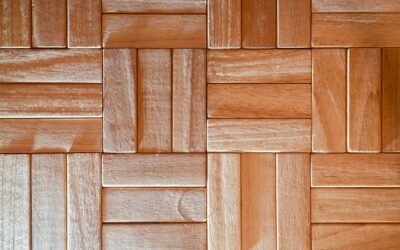
The wood ranges from warm honey amber to deep walnut brown depending on age and finish. Grain is straight to slightly interlocked, similar to oak but with a softer, more open ring porous structure. The defining visual features are the worm holes — small dark pinholes and meandering tracks left by ambrosia and powderpost beetles — plus nail holes, oxidation marks, and the occasional small knot from the original barn use.
Two character grades dominate the reclaimed market: standard wormy chestnut (moderate worm tracks, occasional knots) and heavy character or “barn” grade (denser worm activity, larger knots, and original surface patina retained on one face).
Hardness and Performance
Chestnut measures about 540 on the Janka hardness scale — softer than red oak (1,290), comparable to white pine (380) and softer than black cherry (950). That’s the honest downside. Wormy chestnut flooring dents under high heels, dropped tools, and dog claws more readily than oak or maple. Many buyers embrace this and treat new dents as patina that adds character; if you want pristine, this isn’t your wood.
Dimensional stability is excellent, however. Reclaimed chestnut has spent 80 to 150 years stabilizing in service, so it moves less seasonally than a freshly kiln-dried oak plank.
Pricing and Where to Source
Standard wormy chestnut from reputable reclamation dealers (Olde Wood Limited, Mountain Lumber Company, Pioneer Millworks, Carlisle Wide Plank, E. T. Moore) runs $14 to $22 per square foot in material, milled to tongue-and-groove with 3/4-inch solid or 5/8-inch engineered formats. Heavy character barn grade with original surface patina can hit $26 to $38 per square foot.
Install labor adds $3.50 to $6.50 per square foot depending on plank width and finish requirements. Site-finished installations with custom Bona Traffic HD waterborne polyurethane, Rubio Monocoat, or oil-and-wax topcoats push the all-in cost to $22 to $48 per square foot — easily two to four times the cost of new white oak.
Subfloor and Installation Notes
Wormy chestnut solid planks 4 to 8 inches wide are typically nail-down over 3/4-inch plywood or OSB subfloor using a Powernail 50P or Bostitch MIIIFN cleat gun with 2-inch nails at 8 to 10 inches on center. Wider planks (8 to 12 inches) often require a glue-assist with Bostik BEST or Sika AcouBond to control seasonal cupping.
For concrete slab installations, an engineered wormy chestnut product with a 4 mm to 6 mm sawn-face wear layer over a Baltic birch core is the only viable spec. Float-installed or glue-down with a urethane adhesive (Bostik Greenforce, Mapei Ultrabond ECO 980). ASTM F2170 in-situ RH testing should read under 80 percent before install.
Finishing the Character Out
Three finish approaches dominate. Hardwax oil (Rubio Monocoat, Pallmann Magic Oil, Osmo Polyx) penetrates the open ring porous grain and accentuates the worm tracks and color variation. Waterborne polyurethane (Bona Traffic HD, Loba 2K Supra) builds a clear film that protects the surface and slightly cools the warm honey tone. Conversion varnish offers maximum durability but tends to amber over time, deepening the color further.
Most installers recommend a single coat of natural oil sealer followed by two coats of waterborne poly for the best balance of patina preservation and wear protection.
Where It Shines, Where It Struggles
Wormy chestnut belongs in homes where character is the point: restored farmhouses, mountain cabins, historic urban renovations, and high-end great rooms with exposed timber framing. It complements wide-plank limestone fireplaces, cast-iron hardware, and rough-hewn beam ceilings.
It struggles in modern minimalist homes — the heavy character clashes with white walls and chrome fixtures. It also struggles in high-traffic households with large dogs and small children, simply because the soft wood dents and the dents are visible. Bathrooms, basements, and any area below grade are off-limits regardless of finish.
Verifying You’re Getting Real Wormy Chestnut
Sycamore, butternut, and even oak are occasionally mismarketed as wormy chestnut. Real Castanea dentata has a distinctive ring porous pattern with large early-wood pores visible to the naked eye on end-grain, similar to white oak but with smaller, more numerous rays. Reputable dealers provide certificates of origin tied to specific barn or building demolitions. Ask for the source structure’s location and approximate build date.
Avoid reclaimed chestnut sold without provenance documentation — the price is too high to gamble on substitute species.
Is It Worth the Premium
For the right home, yes. Wormy chestnut flooring carries 150 years of American history in every plank and reads instantly as authentic in a way no engineered product can replicate. Budget $25 to $45 per square foot installed, source from a dealer with verifiable provenance, and accept that the floor will pick up additional patina over the decades you own it. That’s not a flaw — it’s the entire point.
Prefer to explore on your own?
See how new flooring looks in your actual room in seconds — free, no signup.
Try the free Floor Studio →