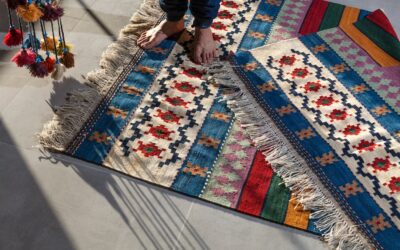
The word “woven” gets thrown around loosely in the rug world, but it points to a real distinction that affects how long your rug lasts and how it feels underfoot. A genuine woven area rug is constructed on a loom, with warp and weft threads interlaced into a stable, durable structure, as opposed to tufted rugs where fibers are punched into a backing and glued down. That construction difference is why a good woven rug can survive a hallway for 20 years while a bargain tufted rug sheds and falls apart in three.
Understanding weaves, fibers, and construction helps you spend your money on a rug that fits how the room is actually used. This guide breaks down the choices so you buy once instead of twice.
What “Woven” Actually Means
Woven rugs are made by interlacing threads on a loom, either by hand or by machine, so the pattern is integral to the structure rather than printed or glued on. You can usually confirm a rug is woven by checking the back: a woven rug shows the pattern echoed on the reverse, while a tufted rug has a plain fabric or latex backing hiding the construction.
This matters because woven construction holds together without adhesives that break down over time. That’s the root of the durability advantage, and it’s why woven rugs generally reveal a cleaner back with visible knots or a mirrored pattern.
Flatweave vs. Pile Woven Rugs
Within woven rugs, the biggest split is flatweave versus pile:
- Flatweave (kilim, dhurrie, soumak): No pile, thin and reversible, easy to clean, and great for high-traffic and layering. Less cushioned underfoot.
- Hand-knotted pile: Individual knots tied by hand, plush and extremely durable, the gold standard and the most expensive.
- Machine-woven pile (Wilton, Axminster): Loom-woven with pile at a fraction of hand-knotted cost, a strong value for most homes.
Flatweaves suit entryways, kitchens, and spaces where you want a low profile that a door clears easily. Pile weaves bring warmth and softness to bedrooms and living rooms where comfort matters more than a thin profile.
Fiber Choices and Their Trade-offs
Fiber determines feel, durability, and care more than anything else. Wool is the classic choice: naturally stain-resistant, resilient, and soft, it springs back from foot traffic and lasts decades, though it costs more. Cotton flatweaves are affordable, washable, and casual, ideal for kitchens and kids’ rooms. Jute, sisal, and seagrass bring natural texture and rugged durability but feel coarse and don’t love moisture.
On the synthetic side, polypropylene and polyester woven rugs resist stains and fading, handle indoor-outdoor duty, and cost the least. They don’t match wool’s resilience or feel, but for a busy family room or a covered porch, they’re a practical pick.
Matching Weave to Room
Think about how each room lives before you choose. High-traffic zones like hallways and entries favor tight flatweaves or dense synthetics that hide dirt and take abuse. Living rooms benefit from a plush wool or machine-woven pile that feels good under bare feet and anchors the seating. Bedrooms can go softest of all, since traffic is light and comfort is the priority.
Dining rooms are a special case: choose a flatweave or low pile so chairs slide easily and crumbs vacuum out without catching in deep fibers.
Sizing and Placement
The most common rug mistake is buying too small. In a living room, the rug should sit under at least the front legs of all the seating, which usually means an 8-by-10-foot rug for a standard setup and a 9-by-12 for larger rooms. Under a dining table, the rug needs to extend at least 24 inches past the table edge on all sides so chairs stay on it when pulled out.
For bedrooms, an 8-by-10 under a queen bed lets the rug frame three sides with a soft landing when you step out. Measure the space and tape out the rug’s footprint on the floor before you buy.
Cleaning and Maintenance
Woven rugs are generally easy to live with. Vacuum regularly, but on flatweaves and delicate wool, skip the beater bar or set it high to avoid pulling threads. Rotate the rug 180 degrees every few months so it wears and fades evenly, especially near windows. Blot spills immediately rather than rubbing, which drives them into the weave.
Most flatweave cotton rugs are spot-cleanable or even machine washable in smaller sizes, while wool and hand-knotted pieces are best professionally cleaned every one to three years. Always use a rug pad; it prevents slipping, cushions the rug, and extends its life by reducing friction on the backing.
How to Spot a Quality Woven Rug
Telling a well-made woven rug from a disposable one takes about thirty seconds of inspection. Start by flipping it over. On a genuine woven or hand-knotted rug, the pattern shows clearly on the back, and on a knotted piece you can see the individual knots; the tighter and more numerous the knots per square inch, the finer and more durable the rug. A rug with a plain fabric or thick latex backing hiding the construction is tufted, not woven, and it will generally shed and wear faster.
Feel the density and weight next. A quality woven rug feels substantial and dense when you fold it, and the pile, if it has any, springs back when you press it rather than staying crushed. Wool should feel slightly springy and resilient. Fold a corner and look at the base of the fibers; on a good rug they’re packed tightly, while a cheap one shows the backing through sparse fibers. Give a pile rug a gentle rub, too, since some low-quality pieces shed heavily out of the gate.
Check the edges and finishing, which is where corners get cut. The sides should be neatly bound or serged, and the ends finished with a secure, even fringe or a clean fold rather than raw, fraying edges. On hand-knotted rugs, a fringe that’s an integral extension of the warp threads signals authenticity, whereas a fringe sewn on afterward is a shortcut. Finally, ask about fiber content in writing; a rug sold vaguely as “wool blend” may contain very little actual wool. These few checks separate a rug that lasts a decade or more from one that looks tired within a couple of years.
What You’ll Pay
Price spans a huge range with construction and fiber. Machine-woven synthetic rugs start around $50 to $200 for an 8-by-10, cotton flatweaves run $100 to $400, and quality wool machine-woven pieces land at $300 to $900. Hand-knotted wool rugs are an investment at $1,000 to several thousand dollars, but they can last generations and hold value.
For most households, a well-made machine-woven wool or a durable synthetic in the $200 to $600 range hits the sweet spot of looks, longevity, and price. Choose the fiber and weave for your room’s real demands, add a good pad, and a woven area rug will define your space beautifully for years.