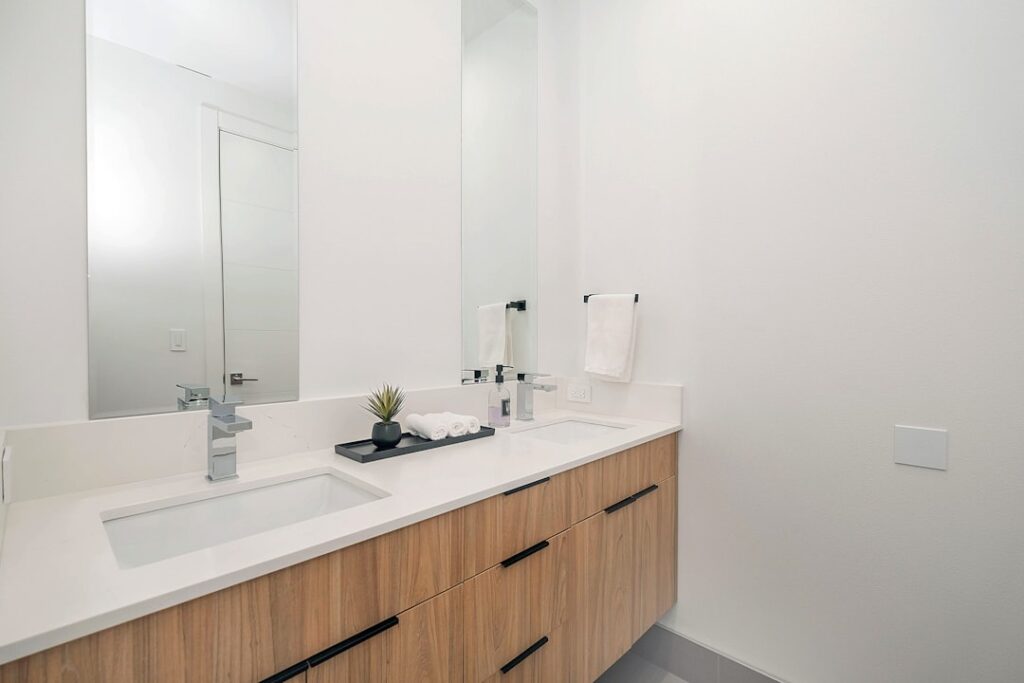
Of all the vanity sizes on the market, one comes up again and again as the practical champion. A 36 inch bathroom vanity with top gives you a real sink, genuine counter space, and useful storage without swallowing a mid-size bathroom the way a 48- or 60-inch unit would. Buying it as a combo — cabinet and top together — takes the guesswork out of matching materials and cutting sink holes. Here’s how to pick the right one, what the top options really cost, and how to get it installed clean.
Why 36 Inches Is the Sweet Spot
The 36-inch width threads the needle. It’s wide enough for a full-size sink with usable counter on both sides — room to set a soap dispenser, a phone, and your morning coffee without knocking anything into the bowl. Yet it stays compact enough to leave comfortable floor space in a standard 5-by-8-foot bathroom, the most common layout in American homes.
Step down to a 24- or 30-inch vanity and counter space gets tight fast. Jump to 48 inches and you often lose walking room or door clearance. For a single-user primary bath, a hall bath, or a well-appointed guest bath, 36 inches is usually the size that just works.
Standard Dimensions
Buying the combo means the top is sized and pre-drilled to match the base, but you still need the footprint to fit your room and plumbing.
- Width: 36 inches for the cabinet; tops often overhang to about 37 inches.
- Depth: commonly 36 inches wide by 22 inches deep, though 18- and 21-inch-deep versions exist for tight rooms.
- Height: 32 inches (standard) up to 36 inches (comfort height). Add a vessel sink and the usable rim rises several inches.
- Sink center: usually centered at 18 inches, though offset-bowl models push the sink left or right to free up counter on one side.
Leave at least 24 inches of clear floor space in front of the vanity, and check that a swinging door or an adjacent toilet won’t crowd the overhang.
Top Materials and What They Cost
The “with top” part is where combos differ most. The top drives both the price and the day-to-day experience, so it’s worth understanding the tiers.
Cultured Marble and Resin
The budget default. A molded top with an integrated sink and no seams — nothing to caulk around the bowl. Runs cheap and cleans easily, but it can scratch and yellow over years and looks less premium up close. Combos in this tier start around $250 to $450.
Ceramic and Porcelain
An integrated ceramic top gives a crisp, glossy, easy-clean surface popular on modern vanities. Durable and non-porous, though a dropped bottle can chip the glaze. Expect $350 to $600 for the combo.
Quartz (Engineered Stone)
The premium sweet spot. Non-porous, never needs sealing, resists stains and scratches, and pairs with an undermount sink for a clean wipe-down. A 36-inch quartz-top combo typically lands at $600 to $1,200.
Granite and Natural Stone
Beautiful and heat-tolerant, but porous — it needs sealing every year or two. Each slab’s pattern is unique. Combos run $500 to $1,100, with wide variation by stone.
Cabinet Construction Matters More Than Looks
The prettiest door front means little if the box behind it swells the first time water splashes in. Check the material before you check the finish.
Solid wood and plywood boxes hold up to bathroom humidity far better than particleboard or low-grade MDF, which can swell and delaminate if water gets in. MDF doors are fine and stable for painted finishes, but you want the cabinet carcass and floor to be plywood if the budget allows. Look for soft-close hinges and drawer glides, dovetailed drawer boxes, and a finished interior — these separate a vanity that lasts 15 years from one that looks tired in five.
Storage layout is worth a hard look too. A vanity with drawers gives you far more usable space than one with a single door and a shelf blocked by the P-trap. Drawers notched around the plumbing are the smartest use of that awkward center zone.
Freestanding vs. Floating
Most 36-inch vanities are freestanding, resting on the floor with a toe kick and hiding the plumbing behind a cabinet. They’re forgiving to install and offer the most storage.
Floating (wall-mounted) vanities bolt to the wall with open space below, which makes a small bathroom feel larger and simplifies floor cleaning. The catch: they must anchor into solid blocking or studs rated for the load, so if your wall lacks backing you’ll be opening drywall to add it. Floating units also sacrifice some lower storage. For a remodel where you control the framing, floating is a clean look; for a straight swap, freestanding is simpler.
Sink Options Within the Top
The combo’s top comes configured for one of a few sink styles, and it changes both cleanup and looks. Integrated sinks — molded into a cultured-marble or ceramic top as one seamless piece — are the easiest to wipe because there’s no rim or seam to trap grime. Undermount sinks, cut into quartz or granite, give the most premium result and let you sweep water straight into the bowl, which is why they dominate the higher tiers. Drop-in sinks with a rim on top are the cheapest and easiest to replace later, but that rim collects toothpaste and needs a caulk bead that discolors over time. For most buyers an integrated top in the budget range or an undermount in quartz higher up covers the field.
Faucet and Fixture Fit
Check the faucet drilling before you order, because the top arrives pre-punched. A single-hole top takes a single-lever faucet; a three-hole top spaced 4 inches on center takes a “centerset” faucet, while 8-inch spacing takes a “widespread.” Buying a widespread faucet for a centerset top, or the reverse, means a return trip. Match your faucet finish to the cabinet pulls and the drain — a brushed-nickel or matte-black set across all three reads intentional. Budget $60 to $200 for a solid single faucet, sold separately from nearly every vanity combo.
Installation Tips
Buying the top and base together removes the hardest part — matching and drilling — but a clean install still comes down to fundamentals.
- Shut off the water and dry-fit the cabinet against the wall before committing anything.
- Shim the base level in both directions; an out-of-level top pushes water to one side and skews your caulk lines.
- Scribe the cabinet or use a filler strip against out-of-square walls so gaps don’t show.
- Set the top in a bead of silicone, then run silicone where the backsplash meets the wall.
- Replace old shutoff valves and supply lines while everything is exposed — cheap insurance against a future leak.
- Seal a natural-stone top right after install, and re-seal on the manufacturer’s schedule.
A confident DIYer can swap a 36-inch combo in an afternoon. If you’re moving plumbing or adding wall blocking for a floating model, budget for a plumber or handyman — expect $200 to $500 for a straightforward professional install.
Common Questions
Will a 36-inch vanity fit a small bathroom? In most 5-by-8-foot baths, yes, as long as it doesn’t block the door swing and you keep 24 inches of clear floor in front. Measure from the sidewall and account for the top’s overhang past the cabinet.
Standard height or comfort height? Comfort height at 36 inches suits most adults and matches kitchen-counter ergonomics. Stick with 32 inches in a kids’ bath or if shorter household members are the main users.
Can I put a vessel sink on a 36-inch combo? Only if the top is designed for one — a flat top with a single drilled hole. A top pre-cut for an undermount or drop-in sink can’t take a vessel. Remember a vessel raises the usable rim several inches.
How long does installation take? A straight swap with existing plumbing runs one to three hours for a confident DIYer. Add time and likely a pro if you’re relocating the drain or adding wall blocking for a floating model.
The Bottom Line
A 36 inch bathroom vanity with top is the size most homeowners should reach for first: enough counter and storage to live with, small enough to fit the bathrooms most of us actually have, and simple to buy as a matched combo. Spend where it counts — a quartz or ceramic top and a plywood box with soft-close hardware — and you’ll get a vanity that still looks and works right well over a decade from now.