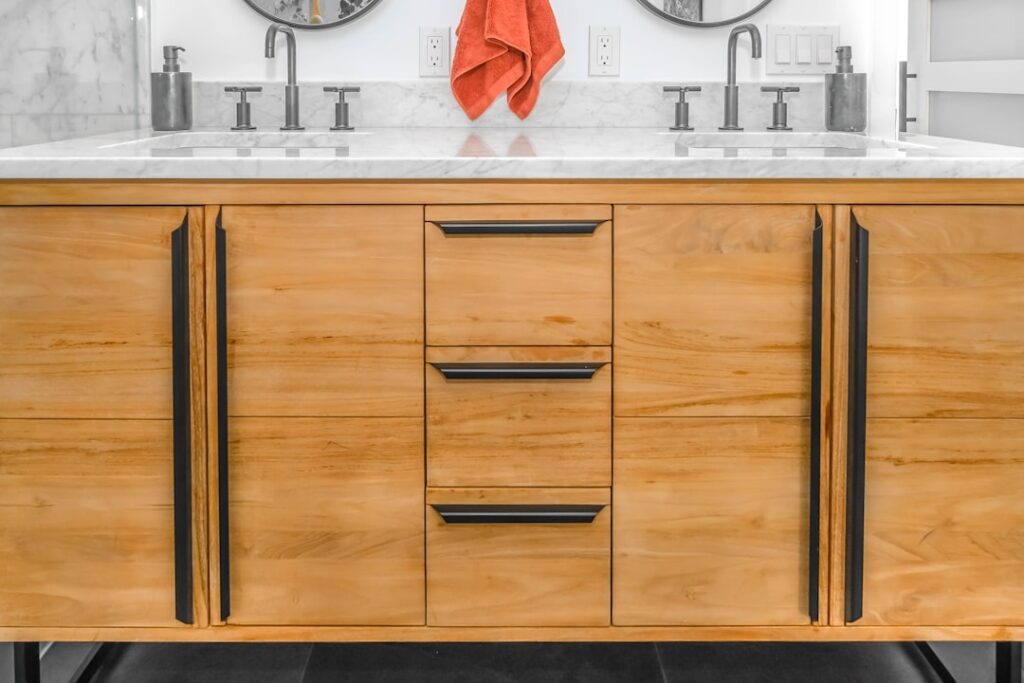
Fitting two sinks into four feet of bathroom sounds like magic, and plenty of showrooms are happy to sell you the dream. A 48 inch double sink vanity can absolutely work, but it lives right at the edge of what’s practical — get the proportions wrong and you end up with two cramped basins and no counter to set anything down. Having installed and replaced my share of these, here’s the honest breakdown of when a 48-inch double works, when you should size up or down, and what to check before you buy.
The Reality of Two Sinks in 48 Inches
A 48-inch vanity gives you 48 inches of total width. Subtract the cabinet end panels and the space between the two basins, and each sink area ends up with roughly 20 to 22 inches of usable width. That’s enough to wash your hands and brush your teeth without bumping elbows, but it is not a luxury spread. The tradeoff you’re making is counter space: with two sinks eating the middle, your only real landing area is the narrow strips at each end.
For comparison, the same footprint as a single-sink vanity gives you a generous basin plus a wide expanse of counter. So the honest question is whether two people genuinely use the bathroom at the same time, or whether one bowl and more counter would serve you better day to day.
Standard Dimensions to Expect
Most 48-inch double vanities land in a predictable range. Knowing these numbers keeps you from ordering something that won’t fit your rough-in or your body.
- Width: 48 inches (some read 47 to 48.5 with the top overhang).
- Depth: 18 to 22 inches, with 21 inches the most common. A 48 inches wide by 21 inches deep footprint is the norm.
- Height: 32 to 36 inches. “Comfort height” or “counter height” runs 36 inches, which most adults prefer over the older 32-inch standard.
- Sink spacing: basin centers typically sit about 24 inches apart, roughly 12 inches from each end.
Measure your room before anything else. You want at least 24 inches of clear floor space in front of the vanity, and check that the swing of your door and any adjacent walls leave room for the top’s overhang.
Countertop and Sink Configurations
The sink style changes both the look and how much usable surface you keep. Undermount sinks sit below the counter and give you a clean, wipeable surface with a bit more effective room — the counter runs unbroken to the bowl edge. Drop-in sinks have a rim that sits on top; cheaper and easier to swap, but the rim collects grime and interrupts the surface.
Integrated tops, where the sinks and counter are a single molded piece (often cultured marble or a resin composite), are the budget-friendly and seamless choice for doubles. There are no seams to caulk and nothing to collect water around the bowls. The downside is you’re locked into that material and can’t upgrade the sinks separately later.
If you want stone — quartz or granite — you’ll usually buy the base and top separately and have undermount sinks cut in. Budget more for that route, both in material and fabrication.
What It Costs
Prices swing hard based on material and construction. Here’s what to expect in 2026 dollars for the vanity with top and sinks:
- Budget MDF or particleboard with cultured marble top: $400 to $700.
- Solid wood or plywood-box construction with a stone or quartz top: $900 to $1,800.
- Semi-custom or designer brands: $2,000 and up.
Faucets are almost always sold separately — plan on $80 to $250 for a decent pair. If you’re replacing an existing single vanity with a double, add the cost of a plumber to run a second set of supply and drain lines, typically $400 to $1,200 depending on how far the new sink sits from existing plumbing.
Plumbing: The Part People Underestimate
Two sinks means two of everything below the counter — two drains, two hot-and-cold supply pairs, two P-traps. If your bathroom was plumbed for a single sink, you’re adding a branch line, and where that new drain ties in matters. A good installer will run the second drain into the existing waste line rather than cutting into a stack unnecessarily.
Inside the cabinet, all that plumbing eats storage. Double vanities usually give you side drawers and doors but a mostly blocked center where the pipes live. If storage is a priority, look for models with drawers that are notched around the plumbing rather than a solid dead zone.
One practical tip: confirm your shutoff valves and supply lines are in good shape before install. Swapping a vanity is the ideal moment to replace 20-year-old valves for a few dollars rather than after a fresh install when a leak means tearing things back apart.
Materials and Construction to Look For
What’s behind the door front decides how long the vanity survives a wet bathroom. Particleboard and low-grade MDF boxes swell and delaminate the first time a supply line drips unnoticed, and a double vanity has twice the plumbing to leak. Spend up for a plywood carcass or solid wood where you can, and at minimum make sure the cabinet floor under the sinks is a moisture-resistant material, since that’s where slow leaks pool.
Hardware is the other tell. Soft-close hinges and full-extension drawer glides signal a manufacturer that didn’t cut corners, and dovetailed drawer boxes outlast stapled ones by years. On a double vanity you’ll often see a bank of drawers down the center flanked by a door on each side — a smart layout that turns the space between the two plumbing runs into real storage instead of a dead cavity.
Style and Finish Options
A 48-inch double comes in every look from shaker-panel farmhouse to slab-front modern. Painted finishes in white, gray, and navy dominate right now, and they hide water spots better than a dark stained wood. If you want warmth, a natural oak or walnut veneer reads high-end but shows every splash, so match the finish to how tidy the household actually is. Hardware finish ties it together — matte black and brushed gold are the current favorites, and both pair cleanly with two matching faucets. Order the faucets, drains, and cabinet pulls in the same finish family so the pair of sinks reads as one intentional design rather than a mismatch.
Is 48 Inches Right, or Should You Size Up?
If your bathroom can physically take a 60-inch vanity, a double sink is far more comfortable there — each basin gets real elbow room and you keep meaningful counter space. The 48-inch double is best reserved for bathrooms where 60 inches simply won’t fit but two people still need to share the space, like a busy kids’ or guest bath.
Be honest about usage. A couple who rarely overlap at the sink is often happier with a single-basin 48-inch vanity: one big bowl, sweeping counter, and a roomier cabinet. Two teenagers fighting over one mirror at 7 a.m. are the classic case where cramming in a second sink pays off.
Installation and Buying Tips
A few things separate a smooth swap from a frustrating one:
- Buy the vanity and top a week ahead and let a solid-wood unit acclimate to your bathroom’s humidity before install.
- Dry-fit the base against the wall and scribe it to any out-of-square walls before you set the top.
- Shim the cabinet level in both directions — an unlevel top means water pooling toward one bowl and lopsided caulk lines.
- Run a bead of silicone where the backsplash meets the wall, and where the top meets the cabinet, to keep water out of the box.
- Check that your chosen model’s faucet holes match your faucet’s configuration (single-hole versus widespread) before ordering.
Handled right, a 48 inch double sink vanity turns a tight shared bathroom into something that actually functions during the morning rush. Just go in clear-eyed about the counter-space tradeoff, measure twice, and price the plumbing before you fall for the showroom floor model.