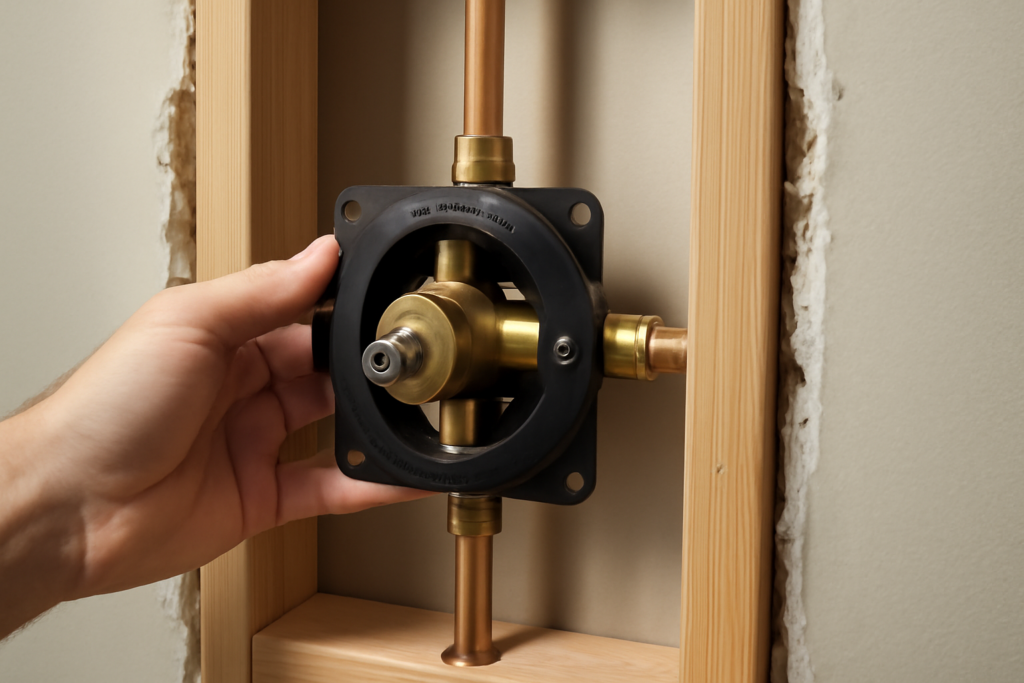
American Standard has been putting brass in American walls since before indoor plumbing was universal, which means an American Standard shower valve in your bathroom could be anything from a 1960s Colony compression stem to a current Flash pressure-balancing rough-in. That range confuses homeowners shopping for parts, because the brand name on the trim tells you almost nothing about which cartridge sits behind it. This guide maps the company’s valve system as it exists today, decodes the older families you are likely to find in existing homes, and covers costs and repair paths so you can buy the right part the first time.
The Flash Rough-In: One Valve Behind Everything Modern
Since the mid-2010s, American Standard has consolidated nearly all of its shower lines onto the Flash Shower Rough-In Valve (model numbers RU101, RU102, and related). The strategy mirrors what Delta does with its MultiChoice body: one universal valve goes in the wall, and any Flash-compatible trim kit — from a $90 Colony PRO set to a $400 Studio S kit — snaps onto it. For homeowners this is genuinely useful. You can upgrade the look of the shower years later without opening the wall, and every Flash body takes the same pressure-balancing cartridge, so the repair part is a known quantity.
Flash bodies come in configurations with and without integral stops (service shutoffs built into the valve, worth the small upcharge every time), with 1/2-inch connections in PEX, copper sweat, and threaded variants. Street price runs $60 to $110 for the rough-in and $90 to $400 for trim. If you are building or gut-renovating, buying the stops-equipped Flash body is the closest thing to a no-regrets choice in the brand’s catalog.
Pressure Balancing vs. Thermostatic Options
Most Flash-based showers use a pressure-balancing cartridge: a sliding piston reacts to pressure drops — a toilet flush, a washing machine fill — and rebalances hot and cold within about a second, holding output temperature within roughly 3°F and satisfying the anti-scald requirements in modern plumbing codes. American Standard also sells thermostatic valve packages in its Studio and Serin luxury lines, which hold a set temperature regardless of both pressure and supply-temperature changes and allow separate volume control. Thermostatic setups cost meaningfully more — $350 to $700 with trim — and matter most in multi-head custom showers. For a standard tub/shower, the pressure-balancing Flash cartridge is what code intends and what the vast majority of the brand’s installations use.
Identifying Older American Standard Valves
Existing homes hold several distinct generations, and repair parts differ for each.
- Colony-era two- and three-handle valves (1960s-1980s): Compression or washerless stems, square or splined broach. Handles labeled hot and cold, sometimes with a center diverter. Repairs use replacement stems, seats, and washers — many are still available generically at plumbing supply houses for $10 to $25 per stem.
- Reliant and Cadet single-handle (1990s-2000s): A washerless cartridge behind a round escutcheon; the common repair cartridge for many of these is the American Standard 951470 series. Symptoms of failure are drips at the spout and stiff handle rotation.
- Ceramix and ceramic-disc era (2000s): Ceramic disc cartridges that rarely drip but can be damaged by debris after supply work. Cartridge replacements run $25 to $50.
- Pre-Flash pressure-balancing bodies (2000s-2010s): Look for a large plastic balancing cartridge behind the trim; part numbers in the 023529 and M962 families cover many of these.
The fastest identification route: pull the handle and escutcheon, photograph the cartridge and body casting, and check for “AS” or “American Standard” cast into the brass. The company’s parts support and any Ferguson counter can match a photo to a cartridge number, and OEM parts remain available surprisingly deep into the back catalog.
Common Problems and the Standard Fixes
Three failure patterns cover most service calls on these valves. A drip from the tub spout or shower head that persists when off means the cartridge or stem seal has worn — on Flash and other cartridge valves, swap the cartridge ($25-$55, fifteen minutes with the water off); on old stem valves, replace the washer and dress or replace the brass seat. Sudden temperature swings when someone runs water elsewhere mean the pressure-balancing piston is sticking, usually from mineral scale; soaking the cartridge in vinegar sometimes revives it, but replacement is the durable fix. Weak flow after plumbing work points to debris lodged in the cartridge inlets or the showerhead — flush the valve body with the cartridge out and stops open briefly, then reassemble.
Two practical cautions. First, always close the integral stops or house supply before pulling a cartridge; several American Standard cartridges retain full line pressure. Second, note the cartridge’s orientation before removal — reinstalling some models 180 degrees off reverses hot and cold, an error that takes ten confused minutes to diagnose and ten seconds to fix.
Prices Across the Line
Budget planning is straightforward because the brand publishes list pricing and street prices sit below it. A Flash rough-in body runs $60 to $110. Complete tub/shower trim kits: Colony PRO $90 to $150, Edgemere and Fairbury mid-range $130 to $250, Studio S and Serin $250 to $450. Replacement pressure-balancing cartridges cost $25 to $55; old-style stems $10 to $25. A plumber’s labor to swap a cartridge runs $100 to $200, while cutting a new Flash valve into an existing wall — including opening and patching access — typically lands between $400 and $800 all-in. Against comparable Delta and Moen packages, American Standard usually prices slightly under both at the builder-grade tier, which is why tract builders use so much of it.
How It Stacks Up Against Delta, Moen, and Kohler
All four major brands now sell the same architecture: universal rough-in, interchangeable trim, pressure-balanced cartridge, lifetime limited warranty to the original homeowner. Moen’s 1222 and Delta’s RP19804 cartridges are stocked in every hardware store in America, and that parts ubiquity is the one real advantage they hold — a rural big-box store may not shelve American Standard cartridges, so a repair can mean a two-day wait for shipping. In casting quality and valve performance the differences are minor. If the house already has a Flash body in the wall, there is no rational reason to switch brands; if you are choosing fresh and same-day parts availability matters to you, weigh the local shelf stock as seriously as the spec sheet.
Installation Notes for DIYers
Setting a Flash body yourself is within reach of a confident DIYer when there is rear access or the wall is already open. Depth is the detail that bites people: the valve’s plasterguard marks a min/max range for how far the body may sit behind the finished wall surface, and a body set too deep leaves the trim sleeve unable to reach it — a mistake you discover only at tile-finishing time, when it is miserable to correct. Dry-fit the trim before closing the wall. Orient the body with the arrow up, keep hot on the left as you face the valve from the room, and pressure-test before insulation and drywall go back. If you sweat copper to the valve, pull the cartridge first or wrap the body in a damp rag; overheating the brass cooks the cartridge seals before the shower ever runs. PEX and push-fit variants sidestep the torch entirely and are the sensible route for most homeowners.
One more planning note: order the trim kit and the rough-in together and confirm the trim box says Flash-compatible. American Standard’s older trim lines for pre-Flash bodies look nearly identical in renderings, and mismatched trim is the brand’s most common return.
Bottom Line
Treat the trim as fashion and the rough-in as infrastructure. For new work, the Flash body with integral stops plus whichever trim suits the bathroom gives you a code-compliant, easily serviced shower with an upgrade path that never touches tile. For existing valves, identify the generation before ordering anything, favor OEM cartridges over clones, and keep the old part until the new one proves itself. Handled that way, an American Standard shower valve is about as low-drama as wall plumbing gets — a cartridge every decade or so, and quiet service in between.