
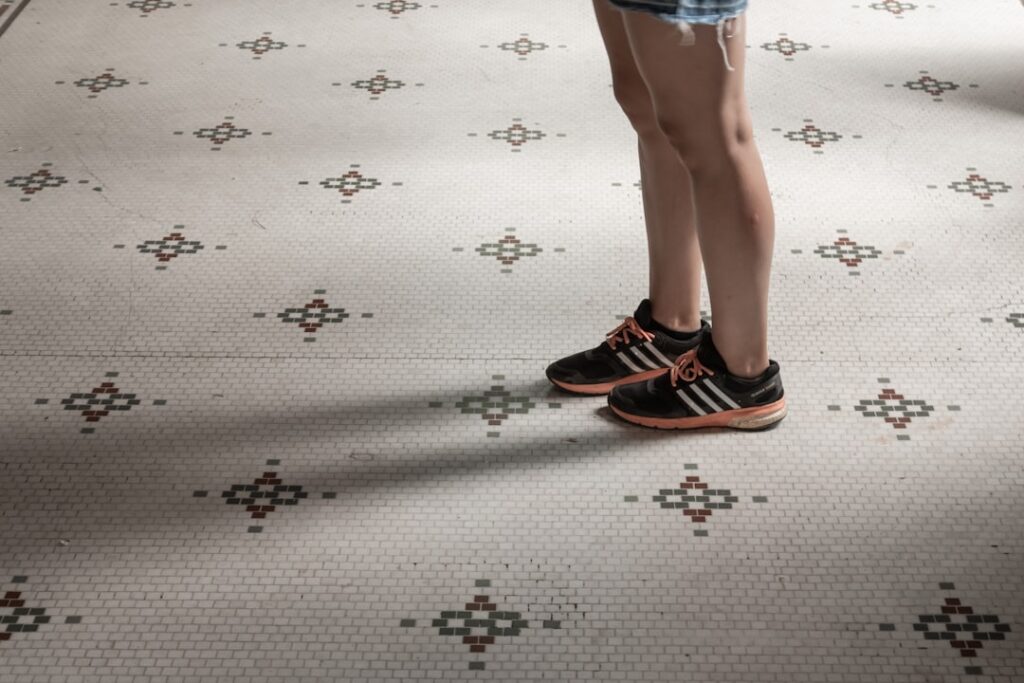
Nothing announces a room’s personality faster than a floor with real graphic punch. Art deco vinyl flooring delivers exactly that, borrowing the geometry, symmetry, and glamour of the 1920s and 1930s and translating it into affordable luxury vinyl and sheet goods. Think fan motifs, sunbursts, stepped zigzags, and crisp black-and-white grids trimmed with faux brass lines. It is a look that reads as both vintage and startlingly current, which is why designers keep reaching for it in powder rooms, entryways, and boutique kitchens.
What Makes a Pattern “Art Deco”
Art deco is defined by strong lines and repeating geometry rather than the soft florals of earlier eras. On a floor, that usually means one of a few signature moves. Bold two-tone contrast is the backbone, most often black paired with white or cream, though jade green, deep navy, and oxblood show up in higher-end lines. Metallic accents matter too. Many patterns imitate inlaid brass or gold strips separating each tile, a nod to the terrazzo and marble floors of grand deco hotels.
Common shapes include the sunburst or fan, the stepped ziggurat border, scalloped shell arcs, and interlocking hexagons. A true deco floor feels engineered and deliberate, with everything meeting at clean angles. That precision is what separates it from a generic retro print.
Sheet Vinyl Versus Luxury Vinyl Tile
You can buy this look in two main formats, and the choice shapes both installation and the final effect. Sheet vinyl prints the entire pattern across a continuous roll, so a large sunburst or a seamless brass-lined grid appears without any physical grout lines. That keeps water out and makes a small room feel like one uninterrupted graphic. The downside is that repairs mean replacing a large section.
Luxury vinyl tile, by contrast, comes as individual squares or planks you lay piece by piece. LVT gives you a slight embossed texture and lets you swap a damaged tile, but the pattern has to be simpler and repeat tile to tile. For a bold checker or a repeating hex, LVT works beautifully. For a single dramatic medallion, sheet vinyl usually wins.
Where Art Deco Flooring Works Best
This is a statement floor, and statements land hardest in smaller, self-contained spaces. Powder rooms are the classic choice because the whole floor is visible at once and the drama does not compete with much furniture. Entryways and mudrooms make a strong first impression and shrug off wet shoes thanks to vinyl’s waterproof core. Butler’s pantries, bar nooks, and laundry rooms also suit the retro-modern energy.
In larger open-plan rooms, use restraint. A full deco pattern across 400 square feet can overwhelm, so many homeowners define a zone, such as under a dining table or inside a kitchen island footprint, and run quieter flooring elsewhere.
Styling the Retro-Modern Look
The floor is loud, so let the rest of the room play supporting roles. Pair a black-and-white deco floor with warm brass or matte gold fixtures to echo the metallic inlay. Velvet upholstery in emerald or navy leans into the Gatsby-era mood, while flat white walls and simple trim keep things from tipping into theme-park territory.
- Fixtures: unlacquered or brushed brass, black matte hardware
- Walls: crisp white, soft plaster, or a single deep accent color
- Lighting: fluted glass, opal globes, or fan-shaped sconces
- Accessories: curved furniture, chrome accents, geometric mirrors
Color Palettes Beyond Black and White
While black and white is the signature combination, art deco was never strictly monochrome, and stepping outside it opens up sophisticated options. Jewel tones dominated the era’s glamour, so deep emerald green paired with cream, or a rich sapphire blue against gold, feels authentically period without being predictable. Oxblood and burgundy read warm and dramatic, especially in a study or dining room, while soft blush and gray with brass lines lean lighter and more contemporary.
Neutral deco patterns exist too, using tonal grays, taupes, and creams in geometric layouts for people who love the shapes but want a calmer floor. These quieter versions bring the architectural interest of deco geometry without the high-contrast commitment, and they hide dust far better than stark black and white. If you love the style but worry about it overwhelming a room, a tonal palette is the smart middle path.
How the Cost Compares
Part of what makes this look so appealing is the price gap between vinyl and the materials it imitates. A genuine marble or terrazzo floor with brass inlay can run $30 to $75 per square foot installed, plus specialized labor, while deco-pattern luxury vinyl typically lands between $2 and $7 per square foot for the material, with sheet vinyl often cheaper still. Installation is faster and simpler too, since you are not cutting stone or setting individual pieces of terrazzo.
That affordability is exactly why designers reach for vinyl to create the look in projects where a real inlaid floor would blow the budget. You get the visual drama of a grand deco lobby in a residential powder room for a few hundred dollars rather than several thousand, and if your taste changes in a decade, replacing it does not feel like a painful loss.
Pros and Cons Before You Buy
The upside of art deco vinyl flooring is obvious: enormous visual impact for a fraction of the cost of real marble inlay or hand-cut encaustic tile, plus a fully waterproof, warm-underfoot surface that installs quickly. It hides dust between cleanings better than solid black tile and stands up to bathrooms and kitchens with ease.
The trade-offs are worth naming. High-contrast patterns show every crumb and hairline scratch, so busy households will clean more often. Trendy looks can date faster than neutral wood-look planks, and a dramatic floor can hurt resale if a buyer’s taste differs. Sheet vinyl also demands a very flat subfloor, since any bump telegraphs through the thin material and distorts the crisp lines.
Buying and Installation Tips
Order a physical sample before committing, because screen photos exaggerate contrast and misrepresent the brass tones. Check the wear layer: 12 mil or thicker holds up in entryways, while 6 to 8 mil is fine for a low-traffic powder room. For sheet vinyl, measure carefully and buy enough to center the pattern in the room, since a sunburst pushed into a corner looks like a mistake. If you want an art deco vinyl flooring look that lasts, invest in leveling the subfloor first. A skim coat of self-leveling compound over concrete or plywood pays off every time the crisp geometry catches the light. Buy about 10 percent extra material to cover cutting waste and any future repairs, and keep a few spare tiles or a leftover roll end stored flat, since discontinued patterns can be impossible to match down the road. Finally, consider a matte finish over a high-gloss one; the sheen you choose changes the mood dramatically, with matte reading modern and understated while gloss leans full-on vintage glamour.
Prefer to explore on your own?
See how new flooring looks in your actual room in seconds — free, no signup.
Try the free Floor Studio →

