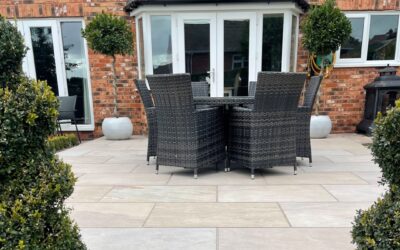
A magazine-perfect porch does not require a magazine-sized budget. With $300 and a free Saturday, you can transform a bare concrete pad or neglected wooden platform into a space you actually want to sit on every evening. These back porch ideas on a budget rely on smart thrifting, a few strategic plants, and lighting tricks that hide any imperfections your porch currently has. Nobody will guess you spent less than a decent dinner for two.
- Start With the Floor You Have
- Pallet Seating That Does Not Look Cheap
- Stock Plants That Deliver Maximum Impact
- String Lights Make Any Space Magic
- Thrifted and Upcycled Furniture Finds
- Containers as Decorative Anchors
- Shade and Privacy on a Dime
- Lighting Beyond the String Lights
- The $300 Budget Breakdown
Start With the Floor You Have
Whatever your porch is made of — concrete, wood, composite, or painted plywood — a single upgrade transforms it: an outdoor rug. A 5×8 polypropylene rug at Target, Home Depot, or Amazon runs $60-$120. The synthetic fibers handle rain, sun, and mildew, and the rug instantly anchors a seating area. Stripes or simple geometric patterns read as more expensive than they are.
If the underlying surface is rough or stained concrete, a $35 can of concrete stain or a $25 gallon of porch paint covers a lot of sins before you lay the rug. Skip this step only if the existing surface is already passable.
Pallet Seating That Does Not Look Cheap
Reclaimed shipping pallets stacked two high make a surprisingly solid bench base when sanded, stained, and topped with outdoor cushions. A corner sectional made from six pallets, bolted together with 4-inch lag screws, takes a weekend to build and runs under $60 for the bolts, sandpaper, and stain.
Source pallets from local warehouses — many give them away free to whoever hauls them off. Look specifically for HT-stamped pallets (heat treated rather than chemically treated) which are safe for outdoor use around food and pets. Cushions are where most of the budget goes: a pair of 24×24 inch outdoor cushions from HomeGoods or Ross runs $15-$25 each.
Stock Plants That Deliver Maximum Impact
Skip the designer nursery and head to the big-box garden center. You want volume, not rare specimens. A few well-chosen plants make a porch feel lived-in and intentional.
- Two 2-gallon boxwoods flanking the door: $40-$60 total
- One large Boston fern hanging from the porch ceiling: $15-$25
- Three pots of trailing petunias or sweet potato vine: $25-$40
- One statement pot with tall ornamental grass: $30-$50
- A small herb trio (basil, rosemary, thyme) in a shared planter: $18-$25
Use matching planters or at least matching colors — terracotta throughout or black throughout reads as designed, while mismatched plastic pots read as cluttered. Dollar Tree sells 6-inch terracotta pots for $1.25 each; spray paint them black or white for a $5 pot that looks like $20.
String Lights Make Any Space Magic
The single highest return-per-dollar upgrade for a back porch is overhead string lights. Solar-powered options run $25-$50 for 48 feet of Edison-style bulbs. Plug-in commercial-grade strings from Brightown or Addlon run $40-$80 and last 5+ years because they use actual replaceable bulbs rather than integrated LEDs.
Run the lights in a zigzag pattern across the porch ceiling or drape them from eave to tree to create an outdoor room feeling. The warm glow hides wall imperfections, makes cheap furniture look cozy, and extends your usable porch hours well past sunset. No homeowner I have met has regretted adding string lights.
Thrifted and Upcycled Furniture Finds
Facebook Marketplace, Craigslist, estate sales, and ReStore locations have become goldmines for outdoor furniture. Old wooden Adirondack chairs, wrought iron bistro sets, and teak dining tables show up regularly for 20-40% of retail. A weekend of sanding and a $15 can of Rust-Oleum spray paint brings most pieces back to life.
Look specifically for solid cast aluminum furniture. It is often priced the same as cheaper aluminum tubing pieces at thrift stores even though it originally retailed for 3x more. The weight is the tell — real cast aluminum is heavy and will not blow over in a thunderstorm.
Containers as Decorative Anchors
A large galvanized tub, vintage wooden crate, or secondhand metal bucket becomes a rustic planter or impromptu bar cart. Drill drainage holes in the bottom of metal containers with a 3/8-inch bit before filling with soil. Five-gallon feed buckets painted with Rust-Oleum Hammered Copper spray paint ($8 per can) look exactly like $60 copper planters from restoration-style retailers.
Stack two stained wooden crates to create a small side table between chairs. Top with a circle of plywood cut to fit and you have a perfectly usable surface for drinks and books for under $15 total.
Shade and Privacy on a Dime
A 10×10 outdoor shade sail from Amazon runs $35-$60 and mounts to existing porch posts or trees with inexpensive turnbuckles and eye bolts. The triangular or square fabric filters sunlight without making the porch dark, and it reads as a design choice rather than a necessity.
For privacy from neighbors, a $20 roll of reed fencing wired to an existing rail creates an instant screen. Or plant a row of tall ornamental grasses like Miscanthus sinensis in long rectangular planters — they grow 5-6 feet tall in one season and disappear in winter when you would want more sun anyway.
Lighting Beyond the String Lights
Solar path lights lining the walkway to your porch steps add curb appeal for $20-$40 per set of 8. Lantern-style candle holders with battery-operated flickering LED candles ($10-$25 each at HomeGoods) create evening ambiance without fire risk. A large outdoor wall sconce replacing a dated porch light updates the entry for under $60 and a 20-minute install.
The $300 Budget Breakdown
- 5×8 outdoor rug: $80
- Pallet seating materials and cushions: $80
- Assorted plants and containers: $60
- String lights: $40
- Decor and accessories (lanterns, small decor): $40
That leaves room to flex. If you found your furniture free on Marketplace, reroute those dollars to bigger statement plants or a higher-end outdoor rug. The principle holds: focus on the floor, the seating, the lights, and a few plants. Those four elements do 90% of the design work. Everything else is fine-tuning a porch that already feels like a retreat.