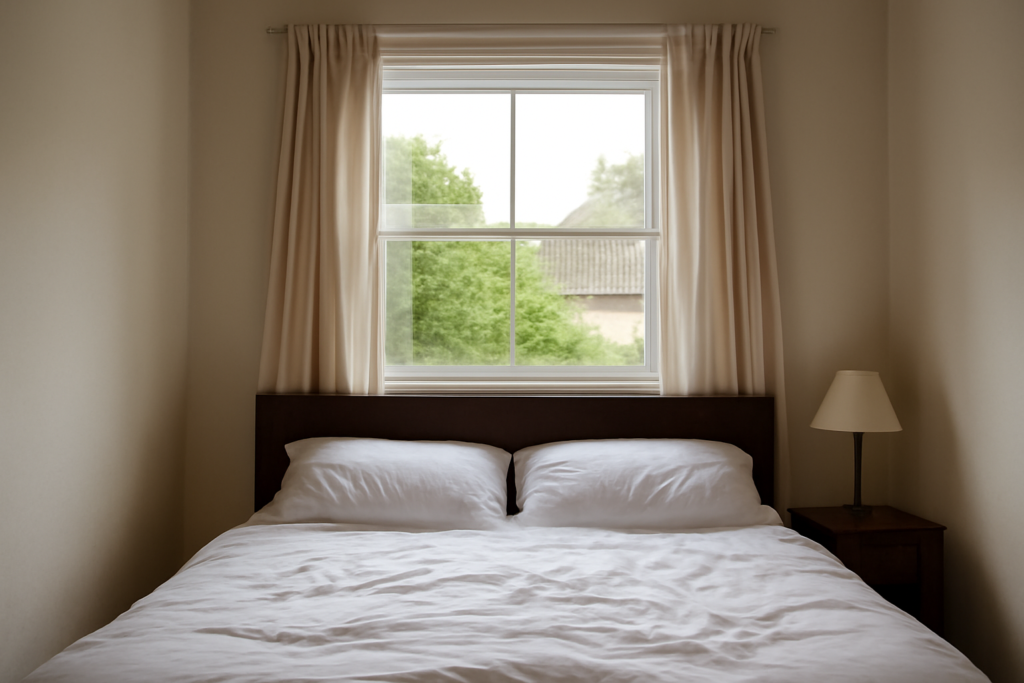
If you have ever pushed a bed against a window to save space and then felt a nagging sense that something was off, you are not alone. The bed under window superstition shows up across feng shui, European folklore, and old family rules of thumb, and it turns out the beliefs overlap with some very real, very practical problems. In this guide I will separate the folklore from the physics and give you fixes that actually work whether or not you buy into the spiritual side.
I have installed flooring and helped homeowners rearrange bedrooms for years, and the window-behind-the-bed layout comes up constantly in small rooms. Understanding both why people avoid it and how to make it livable will help you decide what to do with your own space.
Where the Superstition Comes From
The idea that a bed should not sit directly under a window is old and surprisingly widespread. Different cultures arrived at similar conclusions for different reasons, but the common thread is a sense of exposure and instability while you sleep.
In many European and Appalachian folk traditions, windows were seen as thresholds where spirits, illness, or bad luck could pass through. Sleeping with your head under an open window was thought to invite sickness, in part because night air was genuinely blamed for disease before germ theory. The phrase “night air is bad for you” survived for centuries precisely because damp, cold drafts really did make people miserable.
Feng shui, the Chinese practice of arranging space to support the flow of energy or chi, offers the most detailed version of the belief. According to feng shui principles, a solid wall behind the headboard provides support, stability, and a sense of being protected. A window behind the bed is considered a weak or unstable backing that lets your personal energy leak out overnight, leading to restless sleep, drained vitality, and a feeling that you can never fully relax.
The Core Beliefs, Broken Down
Whether you treat these as spiritual truths or as folk wisdom pointing at real discomfort, the recurring themes are worth knowing.
- Energy or chi loss: Feng shui holds that chi drifts out the window while you sleep, leaving you tired and unfocused.
- Vulnerability: With your head near an opening to the outside, the subconscious never fully lowers its guard. Humans evolved to want a wall at their back.
- Health concerns: Older beliefs tied window drafts to colds, stiff necks, and lingering illness.
- Restless or shallow sleep: The belief is that you wake more often and dream more chaotically with a window at your head.
- Bad luck and instability: Some traditions simply consider the position unlucky, associating it with money troubles or relationship friction.
Cross-Cultural Views
Feng shui gets the most attention, but it is not alone. In parts of Eastern Europe, grandmothers warned that sleeping under a window let the moonlight fall on your face, which was linked to bad dreams and even sleepwalking. Certain Hindu Vastu Shastra guidelines, similar in spirit to feng shui, also recommend a solid wall behind the head of the bed and discourage placing the headboard against a window or a door.
What is striking is how many unrelated cultures reached the same conclusion. When folklore lines up across continents, it usually means people noticed a real pattern, even if the explanation they gave was supernatural. In this case the real pattern is straightforward: windows create physical discomfort that disrupts sleep.
The Practical Downsides Are Real
Set the spirits aside for a moment. A bed directly under a window has genuine drawbacks that any contractor or sleep specialist will confirm.
Drafts and Temperature Swings
Windows are the weakest link in a room’s thermal envelope. Even a well-sealed modern unit is far less insulating than the wall around it, with a typical double-pane window rating around R-3 versus R-13 or higher for an insulated wall. Air leaks around older sashes send a cold draft right onto your head and shoulders in winter, and afternoon sun can bake the same spot in summer. That temperature instability is one of the most common causes of waking at 3 a.m.
Noise
Glass transmits far more outside noise than a framed, insulated wall. Traffic, wind, rain, barking dogs, and early-morning garbage trucks all land loudest right at the headboard when the bed is under the window.
Light
Streetlights, headlights sweeping across the ceiling, and early sunrise all interrupt melatonin production and pull you out of deep sleep. In summer, sunrise as early as 5:30 a.m. can end your night hours before your alarm.
No Room for a Headboard
From a design and safety standpoint, a window blocks a proper headboard. You lose back support when sitting up to read, curtains get crushed and dusty behind the mattress, and condensation on the glass can drip into bedding and encourage mildew.
Real Fixes That Work
Sometimes the window wall is the only wall long enough for the bed, especially in narrow bedrooms. If you cannot move the bed, you can neutralize almost every downside with a few targeted upgrades.
- Add a tall, sturdy headboard. An upholstered or solid-wood headboard that rises above the sill restores the psychological “wall at your back” and blocks the worst of the draft and noise. Expect to spend $120 to $400 for a quality queen headboard.
- Hang heavy or blackout curtains. Thermal blackout panels cut light, muffle sound, and add an insulating air layer. Good sets run $30 to $80 per window. Mount the rod several inches above and wide of the frame for full coverage.
- Seal the drafts. Apply fresh weatherstripping and a bead of removable rope caulk around the sash. A shrink-film window insulator kit costs about $15 and can knock out winter drafts in ten minutes.
- Use a canopy or bed drape. A canopy frame or a simple fabric drape creates a soft barrier overhead, which satisfies feng shui concerns and blocks direct light.
- Apply window film. Frosted or low-E film reduces glare, adds privacy, and cuts heat transfer for around $20 to $50 per window.
- Add a rug and soft furnishings. Absorbent materials near the bed dampen echo and outside noise, taking the edge off a hard, glassy corner.
Should You Actually Worry About It?
Here is my honest take after years in homes: you do not need to believe in chi to benefit from treating this layout with respect. The superstition endured because the physical problems are real. If your only sensible bed placement is under a window, fix the draft, block the light, add a real headboard, and you will sleep fine. If you have a free wall available, use it. There is no reason to fight physics and folklore at the same time when a simple furniture shuffle solves both.
Frequently Asked Questions
Is it bad luck to have your bed under a window?
In feng shui and several folk traditions it is considered unlucky because the window offers no solid support behind your head. Practically, the bigger issue is disrupted sleep from drafts, light, and noise, all of which are fixable.
Does the bed under window superstition have any real basis?
The spiritual claims are unprovable, but the discomforts they describe are measurable. Windows leak heat, transmit noise, and let in light, so the folklore lines up with genuine sleep science even if the explanation is supernatural.
How do I fix a bed that has to go under a window?
Add a tall headboard, hang blackout thermal curtains, seal drafts with weatherstripping or shrink film, and consider a canopy or window film. These steps address nearly every downside for well under $300.
Does feng shui allow any bed under a window?
Purists discourage it, but most feng shui practitioners accept it if you add a solid headboard and keep the window covered at night to symbolically restore the missing support behind the bed.
Which way should the bed face instead?
The common recommendation is a “commanding position” with the headboard against a solid wall, where you can see the bedroom door without being directly in line with it. Aim for that first, and only place the bed under a window when no other wall works.