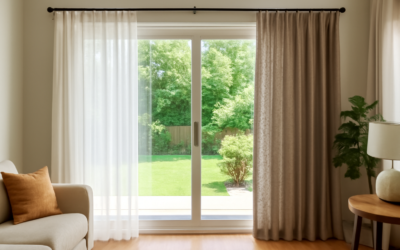
A standard 6-foot sliding glass door leaks more conditioned air and lets in more outside light than any other opening in a typical home, which makes blackout curtains a high-leverage upgrade for bedrooms and media rooms. The best blackout curtains for sliding glass doors need to handle a wider track, often 96 to 108 inches across, and deliver true 100 percent light blockage rather than the 90 to 95 percent that most “room darkening” curtains achieve. After hanging panels on three different doors over a year, the gap between marketing claims and actual performance is wider than most people realize.
Part of our Windows & Doors guide — explore the full guide →
What True Blackout Means
“Blackout” is loosely regulated in the US. To achieve true 100 percent light blockage you need a triple-layer construction: a face fabric, a thermal foam layer, and a polyester backing. Brands like Sun Zero, NICETOWN, and Eclipse all offer this construction, while many cheap Amazon panels skip the foam layer and call themselves blackout anyway.
Test before you commit by shining a flashlight against the curtain in a dark room. True blackout shows no light coming through; room darkening shows a faint glow. The difference matters in nurseries, shift-worker bedrooms, and home theaters.
Top Picks Across Price Tiers
Premium ($150 to $280 per pair)
Pottery Barn Emery Linen Blackout panels in 100 by 108 inch run $189 to $279 per panel and deliver hotel-grade light blocking with a refined drape. Restoration Hardware Estate Linen Cotton Blackout panels start at $250 per panel and run wider for oversized doors. Both come with optional thermal interlining at extra cost.
Mid-Range ($70 to $150 per pair)
Sun Zero Bella 100 by 108 inch grommet panels run $65 to $95 per pair on Amazon and deliver triple-weave construction with a thermal foam core. NICETOWN Thermal Insulated Blackout panels in similar dimensions sit at $55 to $85 per pair. Both block 100 percent of light, reduce 20 to 30 percent of heat transfer, and dampen sound by roughly 7 to 10 decibels.
Budget ($35 to $65 per pair)
Amazon Basics Room Darkening Curtains and Mainstays panels at Walmart run $25 to $50 per pair but block only 90 to 95 percent of light. They work fine for living rooms and offices where total darkness is not required but fall short for bedrooms.
Sizing the Curtains Correctly
A standard 6-foot patio door measures 72 inches wide. To achieve full coverage with proper gather, the total curtain panel width should equal 2 to 2.5 times the door width, so 144 to 180 inches total. That breaks down to two 72 to 90 inch wide panels.
For height, measure from 4 to 6 inches above the door frame to the floor, with panels grazing the floor or pooling 1 to 2 inches for a tailored look. Avoid panels that float more than 1/2 inch above the floor; they leak light at the bottom and look unfinished.
Rod and Track Hardware
A 6-foot sliding door needs a rod or track that extends 8 to 12 inches past the door frame on each side. That allows the panels to clear the doorway fully when open. Standard expandable rods rated for 96 inches max are too short for typical sliding doors. Look for 84 to 144 inch adjustable rods from Umbra Bolero or Kenney Mission, or use a ceiling-mounted track from IKEA Vidga or Bali Custom for a cleaner look.
For weight, blackout curtains run 8 to 14 pounds per panel. Use a center support bracket for any rod over 84 inches to prevent sagging. Bracket pricing runs $8 to $25.
Thermal and Energy Savings
Single-pane sliding glass doors leak heat at roughly 1.0 to 1.2 U-factor, compared to 0.25 to 0.35 for a well-installed quality double-pane unit. Blackout curtains with thermal lining drop apparent U-factor by about 25 to 40 percent when closed. That translates to roughly $40 to $90 per year in HVAC savings depending on your climate zone.
The Department of Energy estimates that closing thermal curtains at night during winter saves 7 to 25 percent on heating costs in cold climates. For Texas and Florida summers, the same curtains drawn during peak afternoon sun cut radiant heat gain by 30 to 45 percent.
Sound Dampening Benefits
Blackout panels reduce ambient noise by 5 to 12 decibels depending on thickness. This is meaningful for bedrooms facing busy streets or units near schools. For serious sound isolation, layer a sheer curtain behind the blackout panel and add weatherstripping to the door frame itself.
Soundproof Cow and Acoustic Geometry sell true acoustic curtains designed for home theater use at $350 to $700 per panel. Skip these unless you have a dedicated media room; the diminishing returns are steep.
Installation Tips
Mount the rod high and wide. Bracket placement 4 to 6 inches above the door frame and 8 to 12 inches outside the frame makes the door look taller and wider. Anchor brackets to studs whenever possible. For drywall-only mounting, use SnapToggle anchors rated for 30 pounds, not the plastic plugs included with cheap rod kits.
Iron or steam panels before hanging. Most blackout panels arrive folded with deep creases that take days to relax on their own. A handheld steamer like the Conair Turbo ExtremeSteam ($60) removes wrinkles in 5 minutes per panel.
Maintenance and Care
Most blackout panels are polyester or polyester-cotton blend, machine washable on cold gentle cycle. Tumble dry low or hang to dry. Avoid hot water and high heat dryer settings; the thermal foam layer can delaminate at sustained 130°F or higher.
Plan on washing twice a year unless pets shed heavily, in which case quarterly works better. Vacuum with the upholstery attachment monthly to remove dust between washes. With proper care, the best blackout curtains for sliding glass doors deliver 7 to 10 years of service before the thermal layer breaks down or the face fabric fades from UV exposure.