Dropping a 225-pound deadlift onto bare concrete cracks the slab and ruins the bar. Choosing the best flooring for home gym over concrete protects your equipment, your joints, and the structural integrity of the slab itself. After building out home gyms in basements, garages, and dedicated outbuildings, I have a clear hierarchy of which flooring types handle which workouts. The right pick depends on what you lift, what cardio you do, and how cold your concrete gets in winter.
- Why Bare Concrete Is the Wrong Surface
- Rubber Tiles: The Gold Standard
- Rubber Rolls for Larger Spaces
- Horse Stall Mats: The Budget Hack
- Foam Mats and Puzzle Tiles
- Vinyl Plank Over Underlayment
- Matching Flooring to Your Workout Style
- Moisture and Vapor Barrier Considerations
- Installation Tips That Save Time
- Cost Summary by Square Foot
- FAQ
Why Bare Concrete Is the Wrong Surface
Concrete is hard, unforgiving, and cold. Three problems hit every home gym built directly on a slab. First, dropped weights crack the surface and chip the concrete dust into the air, where it ruins lungs and equipment. Second, the slab transmits 100 percent of impact force back into your joints during plyometrics, jump rope, or running. Third, concrete sits 10 to 15 degrees colder than the surrounding air, which kills your warm-up and increases injury risk.
Even body-weight workouts benefit from a softer surface. Push-ups, planks, and yoga on concrete leave wrist and knee bruises within a session.
Rubber Tiles: The Gold Standard
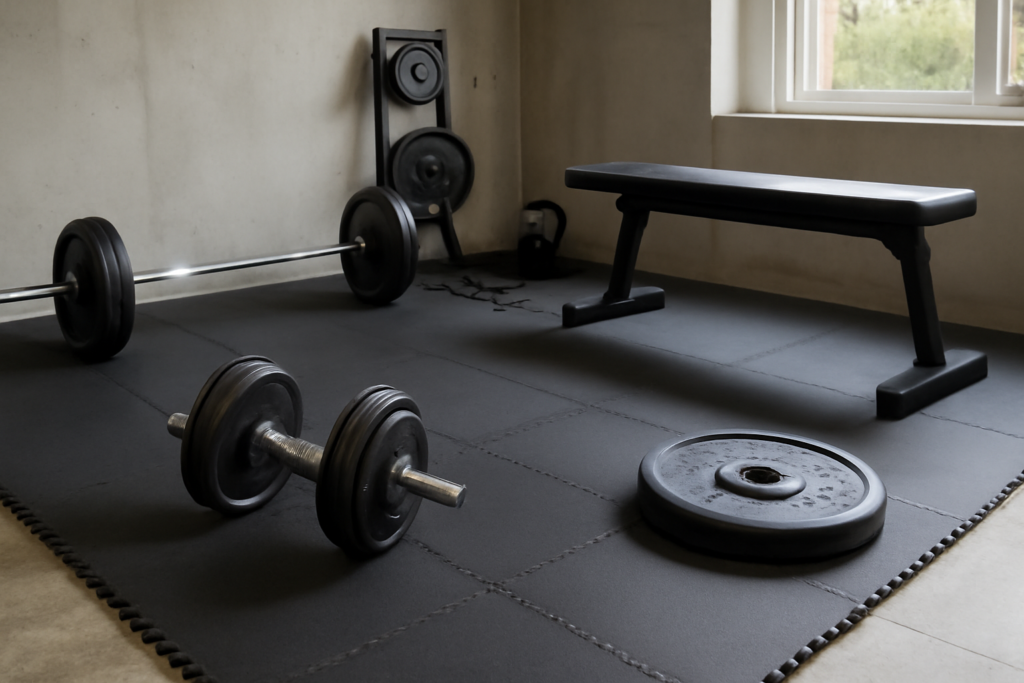
Interlocking rubber tiles are the most popular choice for serious home gyms. They install without adhesive, handle dropped weights, dampen sound, and clean easily. Standard sizes are 24-by-24 inches in 3/4-inch or 1-inch thicknesses.
Rogue Fitness Tiles ($60 to $80 per 4-tile pack) and PlyoMat tiles ($45 to $65 per pack) lead the premium tier. Tractor Supply and Amazon sell budget options for $25 to $40 per pack — these are fine for cardio zones but compress under heavy iron over time.
For a 200-square-foot gym, expect to spend $400 to $1,200 depending on tier.
Rubber Rolls for Larger Spaces
Rolled rubber covers 100-plus square feet in a single piece, which speeds installation and eliminates seams. Rolls come in 4-foot widths and lengths up to 50 feet, in thicknesses from 1/4 inch to 1/2 inch.
Rolls run $1.50 to $4.00 per square foot. They install with double-sided tape or full-spread adhesive depending on the manufacturer. Use full adhesive in any space where the floor will see heavy lateral load — sled drags, lateral lunges, or aggressive footwork.
Horse Stall Mats: The Budget Hack
Tractor Supply 4-by-6-foot horse stall mats are the cult favorite of cost-conscious lifters. At $50 to $65 per mat (covering 24 sq ft), they work out to roughly $2 per sq ft — half the cost of dedicated gym tiles.
The downsides: each mat weighs 90 to 100 pounds (you need a partner to move them), edges are not interlocking (gaps form between mats), and the rubber has a strong tire-like odor for the first month. Air them out in a garage for a week before installing inside.
For pure dropped-weight protection on a budget, stall mats are unbeatable. For aesthetics or finished basements, look elsewhere.
Foam Mats and Puzzle Tiles
EVA foam puzzle tiles ($1 to $2 per sq ft) work for yoga, stretching, light cardio, and kids’ play areas. They do not handle dropped weights — even a 25-pound dumbbell leaves a permanent dent.
Reserve foam for warm-up zones and stretching corners within a larger gym. The 5/8-inch thickness from We Sell Mats or BalanceFrom is firm enough for planks without bottoming out on concrete.
Vinyl Plank Over Underlayment
If you want a finished, residential look that handles light gym use, luxury vinyl plank over a 3mm cushion underlayment works. This is the right choice for a multipurpose room — gym equipment plus a desk plus a TV — where pure rubber would feel industrial.
Limit dropped weight to 15 pounds or less. Anything heavier dents the LVP wear layer. Use rubber crash pads under bars and dumbbells for added protection.
Matching Flooring to Your Workout Style
The right pick depends on what you do:
- Olympic lifting / heavy deadlifts — 1-inch rubber tiles or stall mats with platforms
- General strength training — 3/4-inch rubber tiles or rolls
- CrossFit-style training — 1/2-inch rubber rolls for the full footprint
- HIIT, plyometrics, jump rope — 1/2-inch rubber tiles
- Yoga, Pilates, stretching — 5/8-inch foam tiles or 1/4-inch cork rolls
- Cardio machines only — 1/4-inch rubber rolls or treadmill mats
Most home gyms benefit from a mixed setup — heavy rubber under the rack and platform, lighter rubber elsewhere, foam in the stretching zone.
Moisture and Vapor Barrier Considerations
Concrete slabs (especially below grade) wick moisture upward continuously. Without a vapor barrier, that moisture can rot rubber adhesive, mold the underside of foam, and rust equipment.
Test the slab with a calcium chloride kit. If readings exceed 3 lbs per 1,000 sq ft per 24 hours, install a 6-mil polyethylene vapor barrier under the gym flooring. Tape seams with construction tape and run the barrier 4 inches up the wall.
Installation Tips That Save Time
A few habits save hours and prevent rework:
- Acclimate rubber for 48 hours flat in the room before installing
- Sweep and damp-mop concrete twice — dust ruins adhesive bonds
- Start tile installation from the center of the room, not a corner
- Cut tiles with a sharp utility knife — score deeply, then snap
- Use a J-roller on rolls and adhesive installs to eliminate air pockets
- Install lifting platforms separately on top of rubber, not glued down
Plan equipment placement before laying flooring. Once heavy racks and machines sit on rubber, repositioning is a multi-hour job.
Cost Summary by Square Foot
- Foam puzzle tiles — $1 to $2 per sq ft
- LVP over underlayment — $3 to $5 per sq ft installed
- Horse stall mats — $2.00 to $2.50 per sq ft
- Rubber rolls — $1.50 to $4 per sq ft
- 3/4-inch rubber tiles — $3 to $5 per sq ft
- 1-inch premium rubber tiles — $5 to $8 per sq ft
FAQ
Do I need flooring under a treadmill on concrete?
Yes — a treadmill mat (1/4-inch rubber) absorbs vibration, prevents belt damage, and protects the slab from sweat and dust.
Can I drop weights on stall mats?
Yes — 3/4-inch stall mats handle Olympic lifts up to 405 pounds when properly stacked. For 500-plus pound deadlifts, double-mat or build a dedicated platform.
How much does it cost to floor a 200 sq ft home gym?
Budget $400 to $1,500 depending on flooring choice. Stall mats run $400; premium rubber tiles run $1,200 to $1,500.
Is rubber flooring safe to install in a basement?
Yes — but install a 6-mil vapor barrier first if the slab tests above 3 lbs/1,000 sq ft moisture. Keep airflow active to prevent off-gassing.