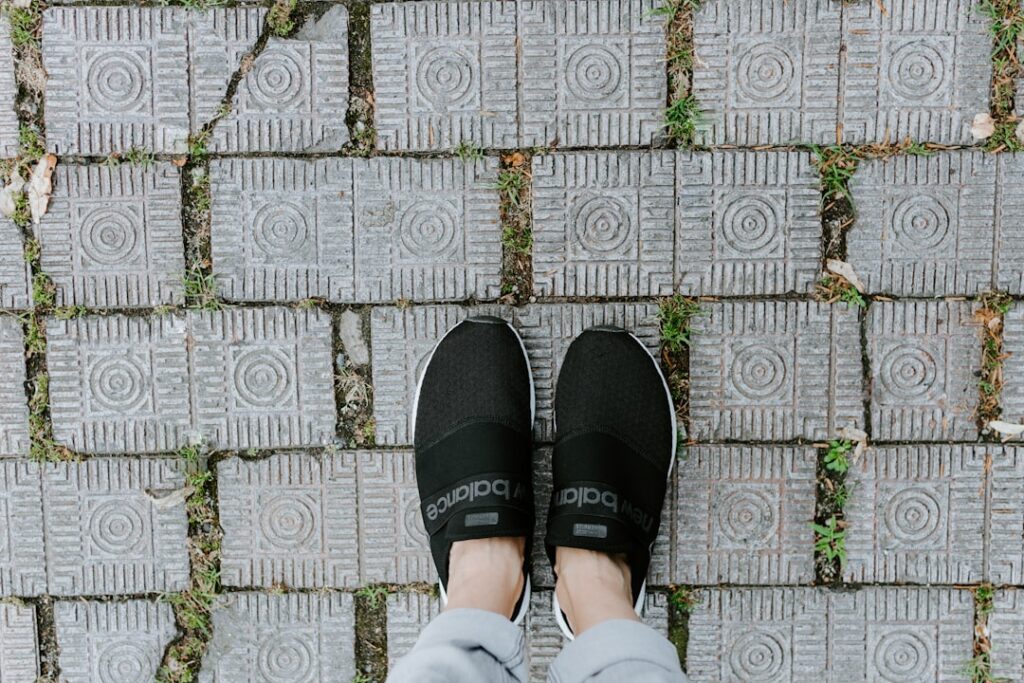
Concrete has zero give — every step returns 100 percent of the impact straight up your heels, knees, and lower back, and after a 10-hour shift on a slab that adds up to tons of cumulative force. Choosing the best shoes for walking on concrete is less about brand loyalty and more about a short list of mechanical features: thick resilient midsoles, a supportive footbed, a wide stable base, and a rocker profile that keeps your stride rolling. I have spent two decades on jobsite slabs and showroom floors, and this guide covers what genuinely works, specific models worth your money, and the replacement schedule almost everyone ignores.
- Why Concrete Punishes Feet More Than Any Other Surface
- The Five Features That Matter
- Top Picks by Use Case
- Warehouse, retail, and all-day standing: max-cushion trainers
- Jobsites requiring safety toes
- Kitchens and slip-critical floors
- Budget picks that still work
- Insoles: The Force Multiplier
- Fit Rules That Outrank Brand
- Replace Shoes on a Schedule, Not on Looks
- Beyond Shoes: Stack the Deck
- Matching Shoes to Your Foot Type
- Break-In, Lacing, and Daily Habits
- Quick Recommendations Recap
Why Concrete Punishes Feet More Than Any Other Surface
Dirt, turf, and even asphalt compress slightly underfoot, absorbing a share of impact energy. Cured concrete absorbs essentially none. The result is a familiar cascade: plantar fascia strain and heel pain, shin splints, aching knees, and a lower back that seizes up by Friday. Studies of industrial workers consistently link hard-surface standing with musculoskeletal complaints, which is why the fix is mechanical, not motivational — you need a compliant layer between heel and slab, either in the shoe, on the floor (anti-fatigue mats), or both.
The Five Features That Matter
- Midsole cushioning with rebound: Thick EVA or PU foam stacks (30-40 mm under heel in modern max-cushion designs) that compress and recover. PU lasts longer; EVA feels softer but packs out faster.
- Arch support: A shaped footbed or room for an aftermarket insole. Flat unsupported liners let the arch collapse a little on every one of your 12,000 daily steps.
- Wide, stable platform: A broad base and firm heel counter prevent the wobble that fatigues stabilizer muscles on hard floors.
- Rocker geometry: A curved sole profile (Hoka popularized it) rolls the foot through toe-off and measurably reduces forefoot pressure — a game changer for concrete.
- Outsole rubber that grips smooth concrete: Slip-rated rubber matters in shops and warehouses where dust and the occasional oil film turn troweled slabs slick.
Weight matters less than people assume; an extra two ounces of shoe is a fair trade for double the cushion.
Top Picks by Use Case
Warehouse, retail, and all-day standing: max-cushion trainers
Hoka Bondi 9 (about $170) remains the standing-all-day benchmark — enormous rocker midsole, plush without being mushy. Brooks Ghost Max ($150) offers a slightly firmer, more stable ride with the same rocker idea, and New Balance Fresh Foam More v5 ($155) gives the widest platform of the three with 2E and 4E widths readily available. All three are the difference between limping to the car and forgetting your feet at hour ten.
Jobsites requiring safety toes
Keen Utility Arvada and Skechers Work composite-toe sneakers ($100-$150) put athletic cushioning under an EH-rated safety package. For traditional boots on concrete, Thorogood American Heritage wedge-sole boots ($240-$270) are the trades classic — the full-contact wedge outsole spreads load beautifully on flat slabs — while Red Wing Traction Tred models compete at similar money. Add a quality footbed; boot factory insoles are an afterthought.
Kitchens and slip-critical floors
Shoes for Crews and Skechers Slip-Resistant Work lines ($60-$110) trade some cushion for aggressive SR outsoles that pass wet/oily slip tests. Pair with insoles for the cushion they lack.
Budget picks that still work
Brooks Ghost 16 on closeout ($100 or less), ASICS Gel-Contend ($60-$75), or last year’s Bondi colorways. A $70 shoe plus a $50 Superfeet or Currex insole routinely beats a $160 shoe with a flimsy liner.
Insoles: The Force Multiplier
Aftermarket footbeds fix the most common failure of otherwise good shoes — a flat, structureless liner. Superfeet Green ($55) suits medium-high arches with a deep heel cup; Powerstep Pulse ($45) is a softer all-rounder; Currex WorkPro comes in three arch profiles. Replace insoles every 6 months under daily use. If you have persistent plantar fasciitis, an insole plus a calf-stretching routine solves more cases than new shoes alone, and a podiatrist visit beats a fourth pair of experiments.
Fit Rules That Outrank Brand
- Shop in the afternoon — feet swell a half size over a workday on concrete.
- Leave a thumb’s width beyond your longest toe; downtime toe-bang on concrete is how nails go black.
- Match width honestly. Most work brands cut D width; if the shoe bulges over the sole edge, go 2E/4E (New Balance and Keen are the width-friendly houses).
- Heel should lock without slip; midfoot snug; toes free. Any hot spot at minute five in the store becomes a blister at hour five on the slab.
Replace Shoes on a Schedule, Not on Looks
Foam midsoles die long before uppers show wear. EVA loses meaningful rebound after roughly 300-500 miles — for a full-time worker walking 5-8 miles per shift, that is every 3 to 5 months, not annually. The tells: new aches that show up mid-shift, visible midsole compression wrinkles, uneven heel wear that leans the shoe on a countertop, and the flat, dead feeling underfoot compared to a fresh pair. The smart system is two-pair rotation — alternating days lets foam recover between shifts and extends total life 20-30 percent — and buying the replacement pair the day the first pair feels merely “okay.”
Beyond Shoes: Stack the Deck
Shoes are the biggest lever, but not the only one. Anti-fatigue mats ($30-$80 for a 2 x 3 ft industrial mat) at fixed stations cut standing fatigue dramatically. Compression socks (15-20 mmHg) help circulation on long shifts. And if you are speccing a shop or garage floor you control, a 5-6 mm rubber tile or rolled floor over the slab softens every future hour spent on it. Concrete is not going to get softer — but with a genuine cushioned rocker shoe, a real footbed, and a 4-month replacement habit, your feet can end a slab week feeling like it was a carpet week.
Matching Shoes to Your Foot Type
The same shoe rated five stars by one worker wrecks another, and foot mechanics explain most of it. Flat feet and overpronators do better with stability features — a firmer medial midsole or a structured insole — because max-soft foam lets a collapsing arch collapse faster; the Brooks Ghost Max or a neutral shoe plus Superfeet is the classic pairing. High-arched, rigid feet want the opposite: maximum cushion and flexibility (Bondi-class), since a rigid arch transmits shock instead of absorbing it. Wide forefeet with bunions should start at Altra or New Balance 4E lasts rather than forcing a D-width classic. And anyone with diagnosed plantar fasciitis, heel spurs, or neuropathy should treat this article as the warm-up and a podiatrist as the main event — a $45 gel heel cup in the wrong architecture is money burned.
A quick self-test
Wet your foot and stand on a paper bag. A full flat print suggests low arches and a stability lean; a thin outer band suggests high arches and a cushion lean; something between means nearly anything well-cushioned will work and fit should decide.
Break-In, Lacing, and Daily Habits
Even the right shoe needs the right routine. Give new work shoes two or three half-shifts before a full week — foam and uppers settle measurably in the first 20 hours. Learn the heel-lock (runner’s loop) lacing if your heel lifts on ladders or stairs; it eliminates most heel blisters without buying anything. Rotate two pairs on alternating days, store them out of hot trucks (heat kills foam faster than miles), and wash or replace insoles monthly because compressed, sweat-saturated foam loses half its function before it looks dirty. Off the clock, calves and plantar fascia respond to 60 seconds of wall stretching morning and night — the cheapest intervention in this entire article, and the one podiatrists repeat most.
Quick Recommendations Recap
- Best overall for concrete shifts: Hoka Bondi 9
- Best stability option: Brooks Ghost Max
- Best wide sizes: New Balance Fresh Foam More v5 (2E/4E)
- Best safety-toe sneaker: Keen Utility Arvada composite toe
- Best traditional work boot: Thorogood wedge-sole with upgraded footbed
- Best budget setup: closeout Brooks Ghost + Powerstep Pulse insole
- Replace every: 300-500 miles — 3 to 5 months full-time