The best vacuum for carpet does more than collect surface crumbs — it lifts embedded dirt, pet hair, and allergens from deep within carpet fibers without damaging the pile. With dozens of models competing for shelf space, choosing the right one comes down to suction power, brush-roll design, filtration quality, and value for money.
- What to Look for in a Carpet Vacuum
- Quick Comparison Table
- Top 7 Vacuums for Carpet — Detailed Reviews
- 1. Dyson Ball Animal 3 — Best Overall for Pet Owners
- 2. Shark Navigator Lift-Away NV356E — Best Value
- 3. Bissell CleanView Swivel Rewind — Best Budget Pick
- 4. Miele Complete C3 Cat & Dog — Best for Allergies
- 5. Hoover WindTunnel 3 Max Performance — Best for High Pile
- 6. Tineco Pure One S15 Pro — Best Cordless Stick
- 7. iRobot Roomba j9+ — Best Robot for Carpet
- Suction Power & Brush Roll Explained
- Why HEPA Filtration Matters
- Robot Vacuum Options for Carpet
- Vacuum Maintenance Tips
- Frequently Asked Questions
We evaluated seven top-performing carpet vacuums across those criteria, then organized everything into a side-by-side comparison table so you can find the perfect match for your carpet flooring in minutes.
What to Look for in a Carpet Vacuum
Not every vacuum handles carpet equally. Before spending $150 to $600 on a machine, understand the four features that separate a mediocre carpet vacuum from a great one.
Suction power is measured in air watts (AW) or pascals (Pa). For low-pile carpet, 200 AW is adequate; for medium to high-pile carpet, aim for 250 AW or higher. More suction means more embedded dirt extraction, but it also means the vacuum may be harder to push across thick carpet — which is why adjustable suction settings matter.
Brush roll type determines how effectively the vacuum agitates carpet fibers. A motorized brush roll with stiff bristles digs into medium and high-pile carpet to dislodge pet hair and ground-in soil. Soft-bristle or rubber-fin brush rolls are gentler on delicate loop carpets. The best models let you toggle the brush roll on and off so you can switch between carpet and hard floors.
HEPA filtration traps 99.97 percent of particles 0.3 microns and larger, including dust mites, pollen, and pet dander. If anyone in your household has allergies or asthma, a sealed HEPA system is non-negotiable — it prevents fine particles from being exhausted back into the room.
Price and long-term cost include the upfront purchase plus replacement filters, bags, and brush rolls over the vacuum’s lifespan. A bagless model saves on bag costs but requires regular filter cleaning. A bagged model with HEPA bags keeps hands cleaner during disposal and often provides better filtration.
Quick Comparison Table
| Vacuum | Type | Suction (AW) | Brush Roll | HEPA | Weight | Price Range | Best For |
|---|---|---|---|---|---|---|---|
| Dyson Ball Animal 3 | Upright | 290 AW | Motorized, self-adjusting | Whole-machine HEPA | 17.5 lbs | $400 – $500 | Pet owners, deep pile |
| Shark Navigator Lift-Away NV356E | Upright / Lift-Away | ~230 AW | Motorized bristle | Anti-allergen seal + HEPA | 12.5 lbs | $150 – $200 | Budget all-rounder |
| Bissell CleanView Swivel Rewind | Upright | ~210 AW | Triple-action brush | Multi-level filtration | 14.0 lbs | $90 – $130 | Best under $130 |
| Miele Complete C3 Cat & Dog | Canister | ~370 AW (max) | SEB 228 electro-brush | Sealed HEPA AirClean | 10.5 lbs (body) | $500 – $600 | Allergy households |
| Hoover WindTunnel 3 Max | Upright | ~250 AW | Multi-floor brush roll | HEPA media filter | 16.0 lbs | $130 – $180 | High-pile carpet |
| Tineco Pure One S15 Pro | Cordless stick | ~185 AW | Motorized LED brush | 4-stage HEPA | 6.2 lbs | $350 – $450 | Cordless convenience |
| iRobot Roomba j9+ | Robot | ~100 AW equiv. | Dual rubber rollers | High-efficiency filter | N/A (autonomous) | $450 – $600 | Hands-free maintenance |
Top 7 Vacuums for Carpet — Detailed Reviews
1. Dyson Ball Animal 3 — Best Overall for Pet Owners
The Dyson Ball Animal 3 delivers 290 air watts of consistent suction through a radial root cyclone system that does not lose power as the bin fills. Its self-adjusting cleaner head automatically seals around carpet fibers regardless of pile height, maintaining contact and airflow without manual height adjustments. The whole-machine HEPA filtration captures allergens and expels air cleaner than the room’s ambient air.
The ball-pivot steering makes turning around furniture easier than traditional swivel designs. At 17.5 pounds, it is one of the heavier uprights on this list, but the ball mechanism compensates well. The 35-foot power cord and included mini turbine tool for upholstery round out an excellent package for households with cats, dogs, or both.
2. Shark Navigator Lift-Away NV356E — Best Value
Shark’s Navigator Lift-Away strikes the best balance between performance and price. The detachable canister lifts off the floor nozzle for above-floor cleaning on stairs, curtains, and furniture. On carpet, the motorized bristle brush roll does a thorough job on low to medium pile, and the anti-allergen complete seal plus HEPA filter keeps fine dust contained.
At roughly $170 street price, this vacuum offers 80 percent of the Dyson’s carpet performance at 40 percent of the cost. The main trade-off is a smaller dust cup (1.1 quarts versus Dyson’s 1.8 liters) and no automatic height adjustment — you use a manual switch to move between bare floors and carpet.
3. Bissell CleanView Swivel Rewind — Best Budget Pick
Under $130, the Bissell CleanView is hard to beat. Its triple-action brush roll combines stiff bristles, edge-cleaning bristles, and a scatter-free channel to handle low and medium-pile carpet. The swivel steering is responsive, and the automatic cord rewind eliminates the chore of winding up 25 feet of cable after every session.
Filtration is multi-level but not true HEPA — acceptable for general cleaning but not ideal for severe allergy sufferers. The 1-liter dirt tank fills quickly in homes with heavy shedding pets, so expect more frequent emptying. For budget-conscious households without major allergy concerns, it delivers excellent cleaning per dollar.
4. Miele Complete C3 Cat & Dog — Best for Allergies
Miele’s canister flagship is the gold standard for allergy-focused vacuuming. The sealed HEPA AirClean system uses a multi-layer bag plus a HEPA filter to trap 99.999 percent of particles — exceeding the standard 99.97 percent HEPA threshold. With up to 370 air watts on the highest setting, the SEB 228 electro-brush head powers through thick carpet while an LED headlight reveals hidden debris.
The C3 is the only canister on our list, and that format offers advantages: the body rides on soft wheels that will not damage hard floors when you transition, and the low-profile powerhead slides under furniture more easily than upright designs. The downside is cost — both upfront and in ongoing HEPA bag and filter replacements, which add roughly $40 to $60 per year.
5. Hoover WindTunnel 3 Max Performance — Best for High Pile
The WindTunnel 3 Max uses Hoover’s three-channel suction technology to create multiple airflow paths beneath the brush head, reducing the tendency for high-pile carpet to “suction seal” to the floor nozzle. This makes it noticeably easier to push across plush and frieze carpet compared to single-channel uprights. The 5-position height adjustment lets you fine-tune the nozzle clearance for any pile depth.
At roughly $150, the WindTunnel 3 sits in the mid-range and includes a HEPA media filter, a 30-foot cord, and a 13-inch cleaning path. It lacks the premium build feel of the Dyson or Miele, but the high-pile performance is genuinely superior to most competitors at this price.
6. Tineco Pure One S15 Pro — Best Cordless Stick
Cordless stick vacuums have historically struggled with carpet because limited battery life means limited sustained suction. The Tineco S15 Pro addresses this with iLoop Smart Sensor technology that automatically increases suction when it detects a high-dirt area and decreases it on clean surfaces, optimizing battery runtime without manual intervention.
On medium-pile carpet, the S15 Pro’s 185 air watts will not match the Dyson or Miele, but it handles daily maintenance cleaning admirably. The 40-minute runtime (on auto mode) covers 1,000 to 1,200 square feet in a single charge. The LED display shows real-time dirt detection and remaining battery, removing the guesswork from cordless vacuuming.
7. iRobot Roomba j9+ — Best Robot for Carpet
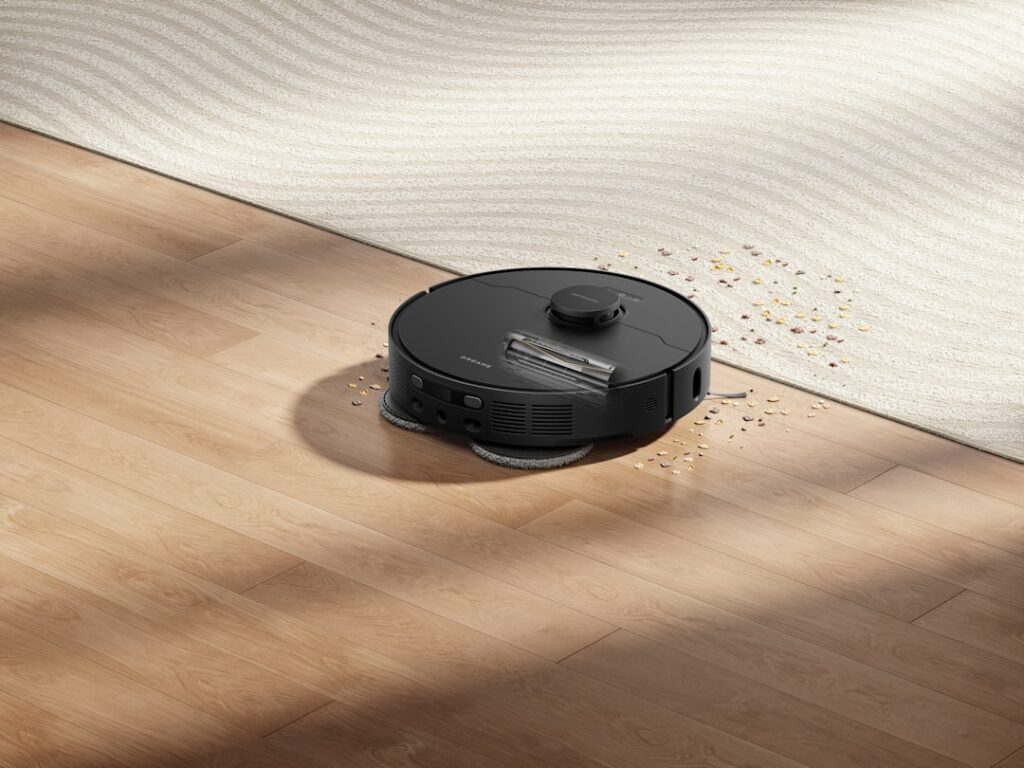
Robot vacuums serve as a maintenance layer between deep-clean sessions. The Roomba j9+ uses dual rubber extractors instead of bristle brushes, which resist hair tangles and maintain consistent contact with carpet fibers. Its PrecisionVision navigation avoids obstacles like shoes and pet bowls, and the auto-empty base holds up to 60 days of debris.
On carpet, the j9+ automatically increases suction by roughly 30 percent — a feature iRobot calls Carpet Boost. It will not replace a full-size upright for deep cleaning, but for daily or every-other-day runs that keep carpet fresh between thorough vacuuming sessions, it is the most effective hands-free option available.
Suction Power & Brush Roll Explained
Suction power and brush-roll agitation work together. Suction creates the airflow that carries dirt into the collection bin, while the brush roll physically dislodges particles from carpet fibers so the airflow can capture them. A vacuum with strong suction but a weak brush roll will clean surfaces well but leave embedded dirt behind. A powerful brush roll with weak suction will loosen dirt but fail to collect it all.
For low-pile carpet (loop, Berber, commercial), moderate suction (200 AW) with a standard motorized brush is sufficient. For medium-pile (cut pile, textured), aim for 230+ AW with a height-adjustable brush head. For high-pile (plush, frieze, shag), you need 250+ AW with multi-channel suction to prevent the nozzle from sealing against the carpet surface.
Why HEPA Filtration Matters
A vacuum without proper filtration acts as a particle redistribution system — it picks up large debris but exhausts fine dust, allergens, and bacteria back into the room. HEPA filtration traps particles as small as 0.3 microns, including dust mite feces (a primary indoor allergen), pollen, mold spores, and pet dander.
However, the filter alone is not enough. A “sealed” HEPA system means the entire airpath — from nozzle to exhaust — is sealed so air cannot bypass the filter through gasket gaps. Both the Dyson and Miele models on this list feature sealed systems. The Shark and Hoover use HEPA media filters, which are effective but may allow minor leakage at seams over time.
If allergies or asthma are a concern in your household, prioritize sealed HEPA. If general cleanliness is your goal, HEPA media filtration is perfectly adequate.
Robot Vacuum Options for Carpet
Beyond the Roomba j9+, several other robot vacuums handle carpet reasonably well. The Roborock S8 MaxV Ultra uses a rubber-and-bristle combo brush and offers strong suction for a robot (up to 6,000 Pa). The Ecovacs Deebot X2 Omni features a square design that improves edge cleaning along carpet borders. Samsung’s Bespoke Jet Bot AI+ uses AI-powered object recognition to navigate cluttered rooms.
All robot vacuums share the same limitation on carpet: they cannot match the sustained suction and aggressive brush agitation of a full-size upright or canister. Think of a robot as your daily maintenance tool and a traditional vacuum as your weekly deep-cleaning tool. Together, they keep carpet floors consistently clean with less total effort. For tips on keeping your carpet in top shape, see our complete carpet cleaning guide.
Vacuum Maintenance Tips
Even the best vacuum for carpet loses performance without regular maintenance. Follow these habits to keep your machine running at full power.
Empty the bin or change the bag before it reaches two-thirds full. Overfilled bins restrict airflow and reduce suction — some models lose up to 40 percent of their effective suction when the bin is completely full.
Clean or replace filters on the manufacturer’s recommended schedule. Washable pre-motor filters should be rinsed monthly and allowed to dry completely (24 hours minimum) before reinstalling. HEPA filters in sealed systems typically need replacement every 12 months.
Inspect the brush roll every two weeks. Cut away hair and thread tangles with scissors, and check that the bristles are not worn flat. A worn brush roll reduces agitation effectiveness, leaving more dirt embedded in carpet fibers.
Check the belt every six months. Stretch belts lose tension over time, causing the brush roll to slow down or stop spinning under load. Geared belts (used in Dyson and many Shark models) maintain consistent speed and rarely need replacement.
If you also vacuum hardwood floors, always switch off the brush roll or swap to a hard-floor nozzle to avoid scratching the finish.
Frequently Asked Questions
What type of vacuum is best for thick carpet?
An upright vacuum with 250+ air watts of suction, a motorized brush roll, and adjustable height settings works best on thick carpet. The Hoover WindTunnel 3 Max and Dyson Ball Animal 3 both excel on high-pile carpet because their multi-channel or self-adjusting heads prevent suction seal — the phenomenon where the nozzle sticks to plush carpet and becomes hard to push.
Is a bagged or bagless vacuum better for carpet?
Both types clean carpet equally well. Bagged vacuums tend to maintain more consistent suction as they fill and offer cleaner disposal (important for allergy sufferers). Bagless vacuums eliminate the recurring cost of bags but require more frequent filter maintenance. Choose based on whether you prefer convenience (bagged) or lower ongoing cost (bagless).
How often should I vacuum carpet?
Vacuum high-traffic carpet areas at least twice per week and low-traffic areas once per week. Homes with pets or allergy sufferers benefit from daily vacuuming in main living spaces. A robot vacuum running daily plus a deep-clean upright session once a week is an effective combination.
Can a robot vacuum replace a regular vacuum on carpet?
Not entirely. Robot vacuums excel at daily surface maintenance — picking up dust, crumbs, and light pet hair — but they lack the suction power and brush agitation needed for deep carpet cleaning. Use a robot for daily upkeep and a full-size vacuum weekly for thorough deep cleaning.
Do I need a vacuum with HEPA filtration?
If anyone in your household has allergies, asthma, or respiratory sensitivities, HEPA filtration is strongly recommended. It captures 99.97 percent of particles 0.3 microns and larger, preventing fine allergens from being exhausted back into your living space. For households without allergy concerns, standard multi-stage filtration is adequate.
What is the best vacuum for pet hair on carpet?
The Dyson Ball Animal 3 is purpose-built for pet hair, with a tangle-free turbine tool and whole-machine HEPA filtration. The Miele C3 Cat & Dog is the premium alternative with even stronger filtration. On a budget, the Shark Navigator Lift-Away handles pet hair well at roughly one-third the price of the Dyson.