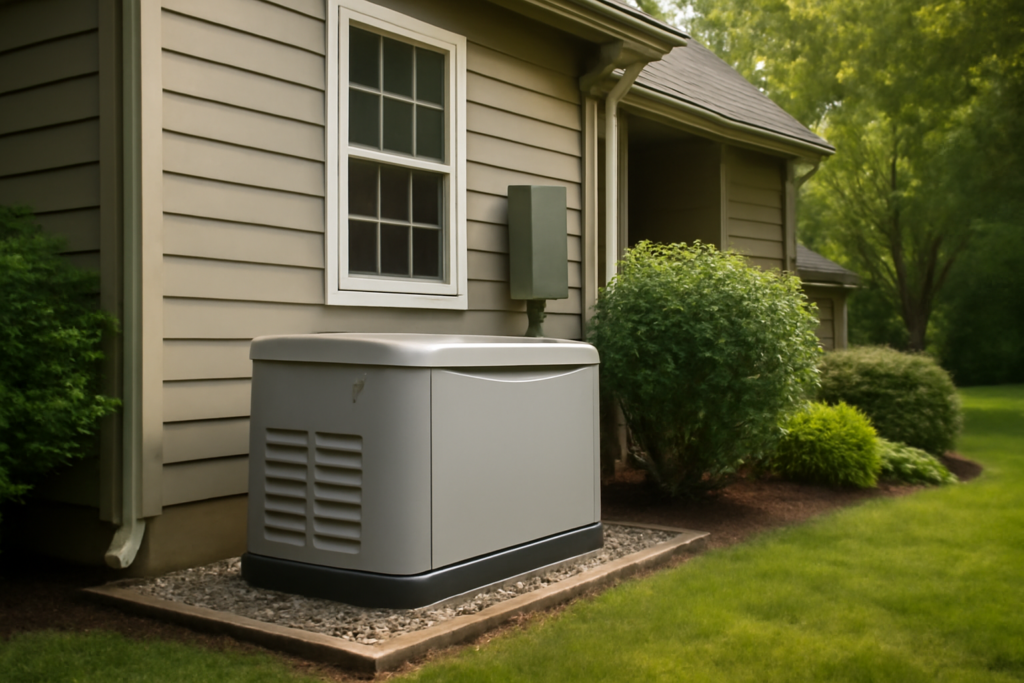
Picking the best whole house generator comes down to three numbers: the kW rating, the fuel it burns, and what you pay a licensed electrician to wire it in. A permanently installed standby unit runs roughly $5,000 to $15,000 installed for most homes, and that spread is real — the generator itself is often only half the bill.
- What You’ll Actually Pay
- Sizing: The One Number That Matters Most
- Top Standby Generator Picks
- Generac Guardian 24 kW (Model 7210) — Best Overall Value
- Kohler 20RCA (20 kW) — Best Build Quality
- Cummins QuietConnect 20 kW (RS20AC) — Best for Long Outages
- Briggs & Stratton / Standby 12-17 kW — Best Budget Entry
- Air-Cooled vs Liquid-Cooled
- Natural Gas vs Propane vs Diesel
- Safety: Do Not Cut Corners Here
- Installation Timeline
- The Automatic Transfer Switch, Explained
- Common Mistakes to Avoid
- Maintenance You Can’t Skip
- The Bottom Line
I’ve set these units next to hundreds of homes. The difference between a good install and a headache almost never comes down to the brand on the enclosure. It comes down to sizing, the transfer switch, and whether the fuel line and pad were done right. Here’s how to get all three correct.
What You’ll Actually Pay
Break the cost into pieces so you know where the money goes:
- Generator unit: $2,000-$6,000 for a 10-18 kW air-cooled model; $8,000-$12,000 for a 20-26 kW liquid-cooled unit.
- Automatic transfer switch (ATS): $400-$1,000 for the hardware. A whole-house 200-amp service switch runs the high end.
- Concrete or composite pad: $200-$800.
- Electrical labor and permits: $1,500-$4,000. This is the biggest variable.
- Gas line / propane hookup: $500-$2,000 depending on run length and whether you need to upsize the meter.
Total for a typical 3-bedroom home on natural gas: about $8,000-$11,000 turnkey. A large all-electric home wanting a 24 kW unit and a 200-amp ATS lands closer to $14,000-$15,000.
Sizing: The One Number That Matters Most
Undersize and you’ll trip the unit every time the AC and well pump kick on together. Oversize and you paid thousands for capacity you’ll never use. A quick field method:
- 10 kW: Essentials only — fridge, furnace blower, sump pump, some lights and outlets. No central AC.
- 14-16 kW: A small home with one central AC (up to about 3 tons) plus essentials.
- 20-22 kW: The sweet spot for most 2,000-3,000 sq ft homes. Runs a 4-5 ton AC, well pump, and a full panel.
- 24-26 kW: Large homes, two AC systems, electric range, or a home with a hot tub and shop.
Remember the difference between running and starting watts. A well pump might draw 1,200 running watts but spike to 3,600 starting. A 5-ton AC compressor pulls maybe 5,500 running but slams the panel with 15,000+ locked-rotor watts at startup. Your generator has to swallow that surge without stalling, which is why “load management” modules that stagger big motors are worth having.
Top Standby Generator Picks
Generac Guardian 24 kW (Model 7210) — Best Overall Value
Generac owns roughly 70% of the residential standby market for a reason: parts, dealers, and service techs are everywhere. The 24 kW Guardian handles most homes on natural gas or propane, includes a 200-amp service-rated transfer switch, and ships with Wi-Fi monitoring standard. Expect $5,500-$6,500 for the unit, $10,000-$12,000 installed. It’s the default recommendation and it earns it.
Kohler 20RCA (20 kW) — Best Build Quality
Kohler runs a heavier-gauge enclosure and a commercial-grade engine that tends to run quieter and last longer under sustained load. The 20RCA is the one I put on a home that loses power for days, not hours. Unit price $5,000-$6,000; installed $10,500-$13,000. Dealer network is thinner than Generac’s, so confirm local service before you buy.
Cummins QuietConnect 20 kW (RS20AC) — Best for Long Outages
Cummins builds diesel gensets for hospitals and data centers, and that pedigree shows in the residential line. The RS20AC is genuinely quiet (around 65 dB at 23 feet) and rated for prime-ish continuous duty better than most air-cooled rivals. Installed $11,000-$14,000.
Briggs & Stratton / Standby 12-17 kW — Best Budget Entry
If you only need to keep the essentials and one AC alive, a 12-17 kW Briggs-platform unit gets you a hardwired standby system for $7,000-$9,000 installed. It’s the value play when a 24 kW is overkill.
Air-Cooled vs Liquid-Cooled
Anything under 22 kW is almost always air-cooled — simpler, cheaper, fine for intermittent outages. At 22 kW and above you cross into liquid-cooled territory, which means a real radiator and coolant, quieter operation, and far longer life under continuous load. If you’re in an area that loses power for days at a stretch, the liquid-cooled premium ($2,000-$3,000) pays for itself in engine longevity.
Natural Gas vs Propane vs Diesel
- Natural gas: Best if you have a municipal line — unlimited runtime, no refueling, no tank. A 22 kW unit burns roughly 300 cubic feet per hour at full load.
- Propane: Cleaner-burning and stores well, but you’re tied to tank capacity. A 500-gallon tank runs a 22 kW generator about 2-3 days at half load.
- Diesel: Rare residentially; best fuel efficiency and cold-start reliability, but noisier and needs fuel rotation.
Safety: Do Not Cut Corners Here
A standby generator produces carbon monoxide and switches live utility-grade current. This is not a DIY hookup.
- Carbon monoxide: The unit must sit outdoors, at least 5 feet from any door, window, or fresh-air intake, with the exhaust pointed away from the house. Install CO detectors on every level anyway. CO is odorless and kills fast.
- Transfer switch is mandatory: Never backfeed through a dryer outlet or a “suicide cord.” A proper ATS isolates your home from the grid so you don’t electrocute a lineman working on your street.
- Permit and inspection: Standby installs require an electrical permit and usually a gas permit. The inspection protects you and keeps your homeowner’s insurance valid.
- Grounding: The unit must be bonded and grounded to code, typically with a dedicated ground rod tied to your service ground.
- Licensed pros only: A licensed electrician for the ATS and panel, a licensed plumber or gas fitter for the fuel line. Full stop.
Installation Timeline
From signed contract to power-on, budget 4-8 weeks. Permitting takes 1-3 weeks in most jurisdictions, the pad cures in a couple days, and the actual set-and-wire is a one-day job for a crew of two. The gas company may need a separate visit to upsize your meter, which is often the longest pole in the tent.
The Automatic Transfer Switch, Explained
People obsess over kW and ignore the ATS, which is the brain of the whole setup. When the utility drops, the switch senses the loss within seconds, signals the generator to start, waits for it to stabilize (roughly 10-30 seconds), then physically flips your home’s load from grid to generator. When utility power returns, it does the reverse and shuts the engine down after a cooldown run. Two flavors matter:
- Whole-house (service-rated) ATS: Sits at your 200-amp service entrance and backs up everything, relying on the generator’s own load management to shed big loads if you overdraw. Simplest for the homeowner.
- Essential-circuit switch: A smaller sub-panel with, say, 8-16 chosen circuits. Cheaper hardware, but you decide up front what stays on. A good match for a smaller generator.
Spend the extra few hundred dollars on a service-rated switch if you’re buying a 22 kW or larger unit — it’s the cleaner install and you won’t be picking circuits.
Common Mistakes to Avoid
- Guessing at size. Have the installer do an actual load calculation, not a napkin estimate. This is the single biggest source of buyer regret.
- Forgetting fuel supply. A natural gas unit is only as good as the line feeding it. A skinny 1/2-inch line to a 24 kW generator will starve it. Confirm the gas company can deliver the volume before you order.
- Placing it wrong. Too close to the house fails inspection and risks CO intrusion; too far runs up conduit and gas-pipe cost. Nail the location during the quote.
- Skipping the maintenance kit. Buy the manufacturer’s oil-and-filter maintenance kit with the unit so you’re not hunting for parts a year in.
Maintenance You Can’t Skip
These units self-exercise weekly for about 5-12 minutes — leave that setting on. Change the oil and filter after the first 25 hours, then annually or every 100-200 run hours. Keep a spare air filter and spark plugs on hand. A yearly dealer service runs $150-$300 and keeps the warranty (typically 5 years) intact. In cold climates, add a battery warmer and a cold-weather kit so the unit cranks reliably at 0°F — a dead start battery is the number-one reason a standby generator fails to fire when you need it.
The Bottom Line
For most homeowners, a 22-24 kW Generac Guardian on natural gas with a 200-amp automatic transfer switch is the best whole house generator you can buy — roughly $10,000-$12,000 installed, with parts and service on every corner. Step up to Kohler or Cummins if you value build quality and quiet over price, or drop to a 14-17 kW unit if you only need the essentials backed up. Whatever you choose, spend on correct sizing and a professional install before you spend on badge prestige.