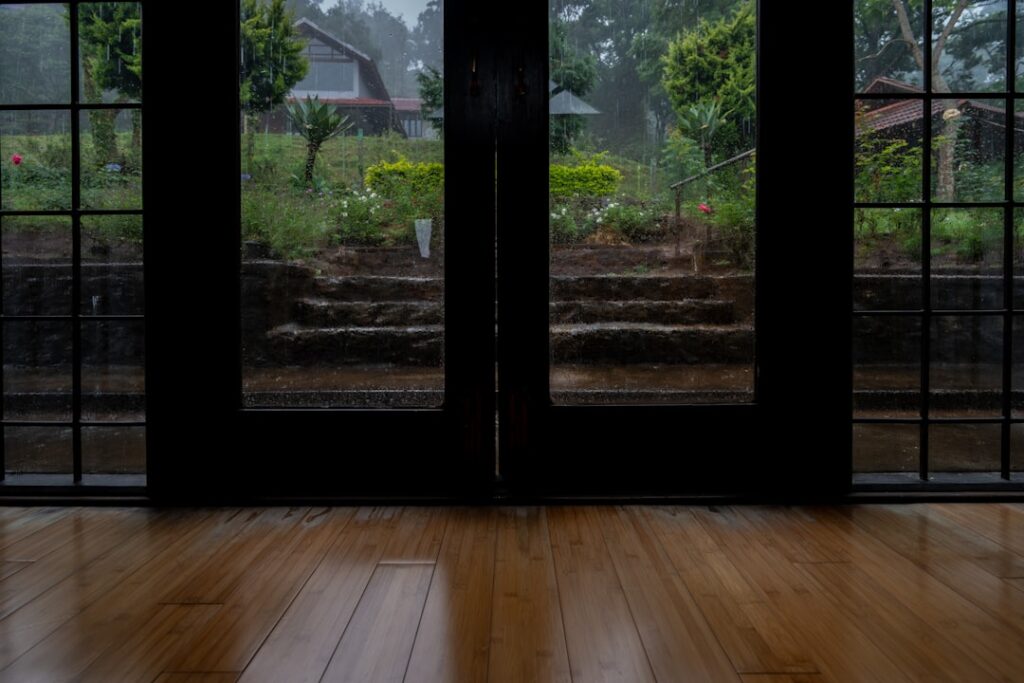
Few upgrades change a room’s whole personality as fast as a set of black French doors. Swap a hollow-core slab or a dated sliding unit for a pair of framed-glass doors in a deep matte black, and suddenly the whole opening reads intentional — architectural instead of builder-grade.
- Interior vs. Exterior: They Are Not the Same Door
- Why Black Works So Well
- Material Choices That Hold Up
- Glass and Grille Patterns
- Swing Direction, Hardware, and Hinges
- Energy, Security, and Weather
- Installation and What It Costs
- Coordinating the Look With Your Room
- Maintenance and Longevity
- Making the Right Call
I’ve hung dozens of these over the years, both the interior swing pairs and the beefy exterior units, and the difference between a set that looks custom and one that looks cheap comes down to a handful of decisions you make before anything gets ordered. Here’s what actually matters.
Interior vs. Exterior: They Are Not the Same Door
The first fork in the road is whether the doors go inside or open to the outside, because the construction is completely different. Interior French doors are lighter — usually 1-3/8 inch thick, single-pane glass, and built to divide space without any weather duty. A typical pair for a 60-inch or 72-inch rough opening runs $400 to $1,200 for the slabs alone.
Exterior black French doors are 1-3/4 inch thick, carry insulated double-pane (sometimes triple-pane) glass, and include weatherstripping, a sill, and often a multi-point lock. Expect $1,500 to $4,000 for a quality pre-hung exterior pair, more if you go to a fiberglass or clad-wood line. Don’t try to use an interior unit on an exterior wall — it’ll warp, leak air, and fail inspection.
Why Black Works So Well
Black frames pull off a visual trick: the thin muntins and stiles recede, so your eye lands on the view or the room beyond rather than the door itself. That’s why steel-look black doors read as high-end — they mimic the slim sightlines of old factory windows. Black also hides fingerprints and scuffs on the frame far better than white, which matters on a door people push open ten times a day.
The catch is heat. On a south- or west-facing exterior door, a black finish can hit 150°F to 170°F in direct summer sun. On wood that’s fine; on a lower-grade steel or vinyl door it can drive warping or finish failure, so buy a product rated by the manufacturer for dark exterior colors.
Material Choices That Hold Up
The frame material drives both looks and longevity:
- Solid wood — the warmest look and easiest to refinish, but needs a protected opening (a porch or overhang) outdoors. Best for interior pairs. $500-$2,000.
- Fiberglass — the sweet spot for exterior use. Won’t warp, holds paint, and factory black finishes are baked-on and durable. $1,200-$3,500 installed.
- Steel — the true “steel-look” divided-light doors, genuinely strong and slim-framed, but premium priced at $3,000-$8,000+ per pair.
- Clad wood — wood interior with aluminum exterior; gorgeous and stable, but the top of the price range.
For most homeowners doing a patio or den opening, a fiberglass French door with a factory black finish gives you 90 percent of the look for half the money of true steel.
Glass and Grille Patterns
The glass layout is where black French doors earn their character. A few common configurations:
- Full lite — one uninterrupted pane per door, maximum light and the cleanest modern look.
- Divided lite — grilles that split the glass into a grid. A 10-lite or 15-lite pattern gives that classic factory-window feel.
- Prairie or top-only — grilles concentrated at the perimeter or top for a subtler nod to traditional styling.
Real divided lites (separate panes) cost more and clean slower than simulated divided lites (SDL), where the grille is bonded to the glass surface. For privacy zones like a home office or bath, spec frosted, reeded, or seeded glass — you keep the light but lose the fishbowl effect. On exterior doors, insist on tempered safety glass; it’s code under the IRC for any glazing in a door.
Swing Direction, Hardware, and Hinges
French doors are a pair of active leaves that meet in the middle, so plan the swing before you order. In a tight hallway, an in-swing that eats floor space may be wrong — consider out-swing exterior doors (also more secure) or reframing for pocket or bi-fold alternatives. One leaf is usually the primary; the second is held by flush bolts top and bottom (called the inactive leaf) until you need the full opening.
Match the hardware finish to the frame or contrast it deliberately. Matte black lever sets disappear into the door; aged brass or brushed nickel pops against black for a two-tone look that reads custom. Budget $80-$300 for a good interior lever set and $200-$600 for an exterior handle set with a deadbolt or multi-point lock. Hinges should be ball-bearing on any door this heavy — standard residential hinges sag over time under a glass-loaded leaf.
Energy, Security, and Weather
On exterior black French doors, three numbers matter. Look for a U-factor around 0.30 or lower for the door assembly, a Solar Heat Gain Coefficient (SHGC) suited to your climate (lower in the hot South, higher up North), and an ENERGY STAR label for your region. Low-E coated double glazing is standard now and worth every dollar in comfort near a big glass opening.
For security, a swinging pair is inherently weaker than a solid door because of the meeting stiles and the amount of glass. Upgrade with a three-point (multi-point) lock that throws bolts into the head and sill, laminated or impact-rated glass in ground-floor openings, and long screws (3 inch) into the framing at the hinges and strike. An out-swing door with non-removable hinge pins is harder to defeat than an in-swing.
Installation and What It Costs
A pre-hung pair drops into a squared, plumb rough opening, gets shimmed at the hinges and strike, fastened, insulated, and flashed (exterior). Interior installs are a solid DIY project for someone comfortable with a level and a drill — budget half a day. Exterior installs involve flashing tape, a sill pan, and weatherproofing that’s easy to get wrong, so most homeowners hire out.
Installed labor typically runs $400-$800 for an interior pair and $700-$1,600 for exterior, on top of the door. If you’re cutting a new opening in an exterior wall, add a header, permits, and possibly structural review — that can push the total project past $6,000. Whenever the opening is load-bearing or the door ties into wiring for a nearby switch or exterior light, bring in the right trades: a framer for the header, and a licensed electrician for any circuit work per NEC.
Coordinating the Look With Your Room
Black French doors are a strong visual anchor, so the rest of the space has to answer them. The cheapest way to make a pair look deliberate is to pull the black into two or three other touchpoints around the room — cabinet hardware, a light fixture, window frames, or the legs of a table. When black shows up in more than one place, the doors read as part of a design rather than a lone dark rectangle.
Wall color also changes the whole feel. Against crisp white or pale greige walls, black doors look sharp and modern. Against a moody deep green or charcoal wall, the same doors read cozy and enveloping. If the opening leads outside, think about what the black frames against — a green backyard or a brick patio makes those slim muntins pop, which is exactly the effect you paid for.
Flooring matters too. A warm wood floor keeps black doors from feeling cold, while a light tile or pale plank creates high contrast that leans contemporary. There’s no wrong answer, but decide the direction before you commit, because repainting a factory-finished fiberglass door later is a real chore.
Maintenance and Longevity
A factory-baked black finish on fiberglass or clad wood needs almost nothing — wipe it down a few times a year with mild soap and water, and avoid abrasive cleaners that dull the sheen. Interior wood doors want a periodic dusting and an occasional wax or polish depending on the finish. Exterior wood in a sun-exposed opening is the high-maintenance option: plan to inspect the finish yearly and refresh it every three to five years, sooner on a south-facing wall where UV and heat are brutal on dark paint.
Keep an eye on the weatherstripping and sill sweep on exterior pairs; those are the first parts to wear and the easiest to replace. Tighten hinge screws once a year — a glass-loaded leaf works them loose over time — and lubricate the lock and hinges with a dry lubricant so nothing binds. Handled this way, a quality black French door pair easily lasts 20 to 30 years.
Making the Right Call
If you want the look on a budget and the opening is interior, a factory-finished black French door pair with simulated divided lites is hard to beat. For an exterior opening, spend the extra on fiberglass or clad wood, insulated Low-E tempered glass, and a multi-point lock — that’s where black French doors go from a pretty upgrade to a genuine, long-term improvement in how your home lives and looks.