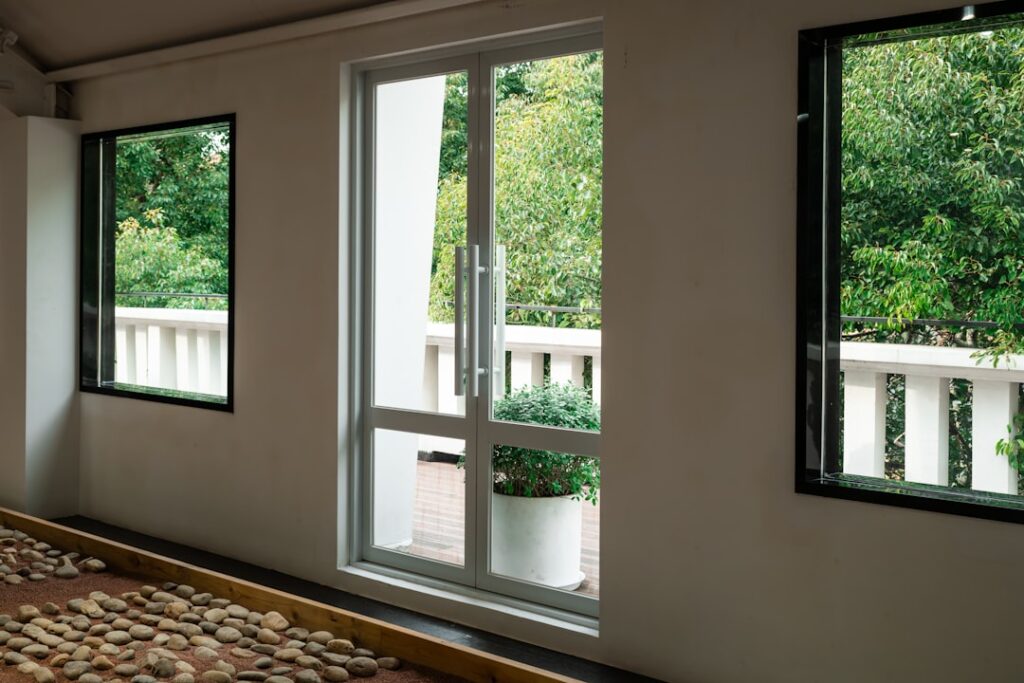
French doors with screens give you the wide, elegant opening of a double door plus the airflow of an open window without inviting every mosquito on the block inside. The catch is that French doors swing, and a swinging door doesn’t pair with a screen as naturally as a slider does. Getting it right comes down to choosing the screen mechanism that matches how your doors move.
- Why French Doors and Screens Don’t Automatically Go Together
- Option 1: Retractable Screens
- Option 2: Sliding Screen Doors
- Option 3: Hinged or Magnetic Screen Doors
- In-Swing vs. Out-Swing and How It Affects Screens
- Measuring for a Screen Kit
- Installation: DIY or Hire Out
- Mesh Choices That Matter
- Maintenance and Longevity
- Bottom Line
- Interior French Doors and Screens
This guide walks through the three screen systems that actually work with French doors, what each costs, and the fit and installation details that trip people up.
Why French Doors and Screens Don’t Automatically Go Together
A sliding patio door has a fixed panel, so a screen can ride in its own track alongside the glass. French doors are different: both panels (or a panel and a fixed side) swing open into the room or out onto the patio. There’s no leftover track for a conventional screen. That’s why you can’t just buy a French door and assume a screen comes with it. The screen is a separate system, and there are three common ways to solve it.
Option 1: Retractable Screens
Retractable screens are the most popular solution for hinged French doors. The mesh rolls into a slim housing mounted on the door jamb, roughly 1.5 to 2 inches wide, and pulls across horizontally like a curtain, latching in the center. When you want the full opening, you let it retract back into its cassette and it disappears.
For a double French door, you install two retractable units that meet and latch in the middle. Quality matters here. Cheap spring-loaded units snap back hard and jam; better units use a speed-reducing brake so the screen glides closed.
- Cost: $150 to $400 per door for a mid-range kit like ODL or Larson; $500 to $900 installed for a professionally fitted double-door system.
- Best for: hinged in-swing or out-swing French doors where you want the screen out of sight when not in use.
- Watch out for: wide openings. Retractable mesh spanning more than about 40 inches per panel can billow and pop out of its track in a breeze.
Option 2: Sliding Screen Doors
Some French door units, especially those built for patios, are designed as “swinging French” panels with a companion sliding screen that runs on an added track. This gives you the look of French doors from inside with the practicality of a slider screen. It’s essentially a hybrid.
These come as a factory system from manufacturers like Andersen (the Frenchwood series) and Pella. Because the screen is engineered to the door, the fit is tight and the mesh is durable. The trade-off is that the screen track sits proud of the threshold, and you commit to the manufacturer’s design up front.
- Cost: built into the door package; a Frenchwood-style hinged patio door with screen runs $2,000 to $4,500 installed depending on size and glass.
- Best for: new construction or full patio-door replacement where you’re buying the door and screen as one unit.
Option 3: Hinged or Magnetic Screen Doors
The budget route is a separate hinged screen door mounted outside the French doors, the same way a screen or storm door mounts on a standard entry. On a double French opening this usually means a single wide screen door or a matching pair. Magnetic walk-through screens, the kind with a center seam that snaps shut behind you, are the cheapest version and work surprisingly well for casual use.
- Cost: $20 to $60 for a magnetic mesh curtain; $150 to $350 for a proper hinged screen door.
- Best for: renters, tight budgets, or doors that open onto a deck where a full-time screen curtain is acceptable.
- Watch out for: magnetic curtains sag and tear within a season or two, and hinged screen doors need enough exterior clearance to swing without hitting railings or furniture.
In-Swing vs. Out-Swing and How It Affects Screens
Which way your French doors open changes your screen options. In-swing doors (opening into the room) leave the exterior face clear, so a retractable or hinged screen mounts cleanly on the outside. Out-swing doors (opening onto the patio) put the door in the same space a hinged exterior screen would occupy, so a retractable screen mounted on the interior jamb usually makes more sense. Confirm your swing direction before you buy any screen kit, because a mismatch means the door and screen collide.
Measuring for a Screen Kit
Retractable kits are sold to fit a range, but you still need accurate numbers. Measure the inside of the door frame (the jamb opening), not the doors themselves:
- Measure the width at the top, middle, and bottom of the opening. Use the smallest number.
- Measure the height on both sides. Use the smallest number.
- Check the jamb depth — retractable housings need 1.5 to 2 inches of flat mounting surface.
- Note whether trim or a threshold intrudes into the opening; it can block the housing.
Order the kit that covers your measurement, then trim the housing and bottom track to your exact size during install. Most kits include a hacksaw-friendly aluminum rail for this.
Installation: DIY or Hire Out
A retractable screen kit is a solid weekend DIY job if you’re comfortable with a level, a drill, and cutting aluminum. Budget two to three hours for a double-door system. The critical steps are getting the housing plumb and the top and bottom tracks perfectly parallel; if they’re off, the screen drags or won’t latch. Pre-drill screw holes in a fiberglass or metal jamb to avoid cracking it.
Factory sliding-screen systems and full patio-door replacements are not DIY. Those involve setting the door in a rough opening, flashing it against water intrusion, and shimming it square, which is a job for an installer unless you’ve hung doors before. A leaking patio door is an expensive mistake.
Mesh Choices That Matter
The screen fabric is easy to ignore and worth a moment:
- Standard fiberglass mesh — cheapest, fine for most homes.
- Pet-resistant mesh — thicker vinyl-coated polyester that shrugs off claws; worth it with a dog or cat that leans on the screen.
- Solar or sun-shading mesh — blocks a chunk of heat gain, useful on a south- or west-facing door.
- Tighter no-see-um mesh — finer weave that stops gnats and sand flies, common near water.
Maintenance and Longevity
Retractable screens live or die by their tracks. Vacuum the bottom track monthly and keep it free of grit; a single pebble can derail the mesh and bend the guide. Wipe the mesh with mild soap and water a couple times a season. Avoid slamming the screen closed, since the retract mechanism is the part most likely to fail. Treated well, a quality retractable screen lasts eight to ten years, and the mesh alone is often replaceable if it tears.
Bottom Line
If you already have French doors, a pair of good retractable screens is almost always the right answer: they keep the clean look of the doors, disappear when you don’t need them, and cost a few hundred dollars. If you’re buying a new patio door, consider a factory hinged-patio system with an integrated sliding screen so the fit is engineered and weathertight. And if you just need bugs out on a budget for one season, a magnetic curtain will do until you commit. Whatever you choose, match the screen to your door’s swing direction and measure the jamb opening carefully, and your French doors with screens will open up the room exactly the way you pictured.
Interior French Doors and Screens
One point of confusion worth clearing up: not every French door faces the outdoors. Interior French doors, used between a living room and a home office, or as a room divider, don’t need a screen at all, since there are no bugs to keep out. If you’re shopping and seeing screen options attached to French doors, that tells you the doors are meant for an exterior or patio opening. Buying exterior-rated French doors with a screen system for an interior application is wasted money and bulk; buy interior French doors instead and skip the screen entirely.
For genuine exterior openings, the screen is doing real work, so spend where it counts: a quality mesh, a smooth-braking retractable mechanism, and a weathertight door package. A cheap screen on a nice French door undermines the whole point, letting in bugs when it billows, tearing in the first season, or sticking in its track. The door and the screen are a system, and the screen is the part you’ll interact with every time you step out, so it’s worth getting the mechanism right the first time.