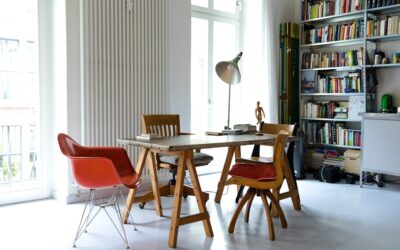
Owners of Craftsman and California bungalows from the 1900 to 1940 era inherit one of two situations — original quarter-sawn white oak or fir strip flooring under decades of paint and carpet, or replacement floors installed badly during the 1970s and 1980s. Choosing bungalow flooring for restoration or new install means balancing period authenticity, modern durability expectations, and the realities of pre-WWII subfloor construction. The wrong product cheapens the architecture; the right one anchors it for the next 50 years. Here is the buying picture.
What Bungalows Originally Had
The Craftsman bungalow’s signature floor was quarter-sawn white oak in 2 1/4 inch strip — chosen for grain pattern (the medullary ray flecks that quarter-sawing produces) and dimensional stability. Douglas fir 3 1/4 inch strip was the West Coast alternative, particularly in California, Oregon, and Washington bungalows. Both species were typically site-finished with shellac or early-generation varnish.
Maple and Southern yellow pine appear in regional variations. Borders and feature strips in walnut or mahogany distinguished higher-end bungalows. Subfloors were 1 by 6 or 1 by 8 pine planks laid diagonal to the joists — different from the plywood subfloors modern installs assume.
Refinishing Original Floors
If you uncover original strip flooring under carpet or vinyl, refinishing usually beats replacement. Solid 3/4 inch oak or fir accepts 4 to 6 full sand-and-refinish cycles over its life. A typical 1920s bungalow floor has been sanded 1 to 3 times in its history — meaning 2 to 5 refinishes remain.
Check for fastener heads sitting above the surface and for boards with cup over 1/8 inch — both cause sander gouging. Patch missing boards with salvaged period oak rather than new mill stock; the grain orientation and growth-ring density of old-growth oak does not match modern second-growth mills.
Plan for $4.50 to $7.50 per square foot for professional sand, stain, and three-coat polyurethane. Site-finished waterborne urethane (Bona Mega ONE, Pallmann Pall-X 96) is the modern default; oil-based polyurethane delivers the warmer amber tone closer to the original shellac finish.
If You Are Replacing the Floor
Period-correct replacement means 2 1/4 inch strip in white oak, red oak, or Douglas fir. Solid 3/4 inch construction matches the original feel and refinish-ability. Expect material costs of $3.25 to $6.75 per square foot for oak strip and $4.50 to $8 per square foot for Douglas fir.
Engineered hardwood in 2 1/4 inch strip is rare but available from specialty mills. Most engineered SKUs jump to 3 1/4 inch and wider, which reads modern in a bungalow context.
Wide-plank engineered (5 inch and wider) is the wrong choice visually. The boards overpower the typical 10 by 12 to 14 by 16 bungalow room dimensions and conflict with the period architecture.
Pros of Period-Correct Restoration
Resale value tracks visible craftsmanship in bungalow markets. Buyers in Berkeley, Pasadena, Portland, Minneapolis, and Chicago bungalow neighborhoods specifically shop for original or period-correct floors. A restored 2 1/4 inch oak strip floor adds documented value over comparable homes with modern wide-plank replacements.
Material is forgiving. Solid 3/4 inch oak strip handles the dimensional swings of older homes without modern humidity control. Houses built before central air conditioning expected humidity to swing from 20 to 70 percent annually — the floor was designed for it.
Visual proportion matches the architecture. Narrow strip flooring works with narrow door openings, lower ceilings, and small-room layouts typical of pre-war bungalow construction.
Cons to Manage
Install labor on 2 1/4 inch strip runs 25 to 40 percent above wide-plank labor for the same square footage. More boards, more fasteners, more end-joint cuts. Budget accordingly.
Source material is harder to find. Most lumber yards stock 3 1/4 inch and wider as their default. Specialty bungalow restoration suppliers (Pioneer Millworks, Carlisle Wide Plank, Wood Floor Company) carry 2 1/4 inch dimension but at premium pricing.
Subfloor prep on original bungalow construction is significant work. Diagonal 1 by 6 plank subfloors deflect more than modern 3/4 inch plywood. Adding a 3/8 inch plywood overlay before nailing strip flooring is often necessary, adding $1.25 to $2.50 per square foot.
Brand Spotlight: Bruce Natural Reflections for Strip
Bruce Hardwood has milled 2 1/4 inch strip for over a century and remains the most accessible prefinished option. The Natural Reflections line in red oak, white oak, and maple lands at $4 to $5.50 per square foot material with a 50-year residential wear warranty on the aluminum oxide finish. The prefinished surface is harder than site-finished urethane but loses the period-authentic look.
For genuine period restoration, site-finished raw 2 1/4 inch quarter-sawn white oak from a specialty mill paired with Bona oil-based polyurethane (Bona DriFast Stain over Bona AmberSeal) delivers the closest match to original 1920s shellac aesthetics. Budget $7 to $11 per square foot material plus $4.50 to $6.50 per square foot for sand-and-finish labor.
Modern Alternatives for Bungalow Owners
Engineered hardwood in 3 inch width with a 3mm sawn-face white oak veneer (Hallmark Organic 567, Mannington Restoration) splits the difference — period-adjacent proportions with slab-friendly install. Material runs $5.75 to $9 per square foot, installed at $9 to $13.
SPC LVP in narrow wood-look plank (5 inch wide) is the budget-driven alternative. Pattern depth and visual quality matters at this dimension — Karndean Korlok at $4.50 to $6.75 per square foot material delivers convincing visuals in narrow plank format.
Both alternatives sacrifice period correctness for modern install ease. Use them in additions, basement conversions, or rental units where authenticity is not the priority.
Installation Notes for Bungalow Subfloors
Test subfloor moisture content with a pin meter before any install — bungalow subfloors over crawl spaces vary widely. Target under 12 percent moisture content; install hardwood boards within 2 percent of subfloor reading.
Acclimate strip flooring in the install room for 14 days minimum at 35 to 55 percent RH. Older bungalows without active humidity control will see the boards equilibrate at different moisture levels than the original 1920s flooring did — plan for slight gapping in winter and minor cupping in humid summers as the floor finds its equilibrium across the first 12 months.
Long-Term Care
Daily dust mop or vacuum with hard-floor attachment. Avoid water-based wet mopping as routine maintenance. For wet cleaning, use Bona Hardwood Floor Cleaner or Pallmann Magic, applied with a microfiber pad. Plan for screen-and-recoat every 8 to 12 years, full sand-and-refinish every 25 to 40 years. Choose the product that matches the architecture and the budget — and a properly chosen bungalow floor outlasts another century of ownership.
Prefer to explore on your own?
See how new flooring looks in your actual room in seconds — free, no signup.
Try the free Floor Studio →