
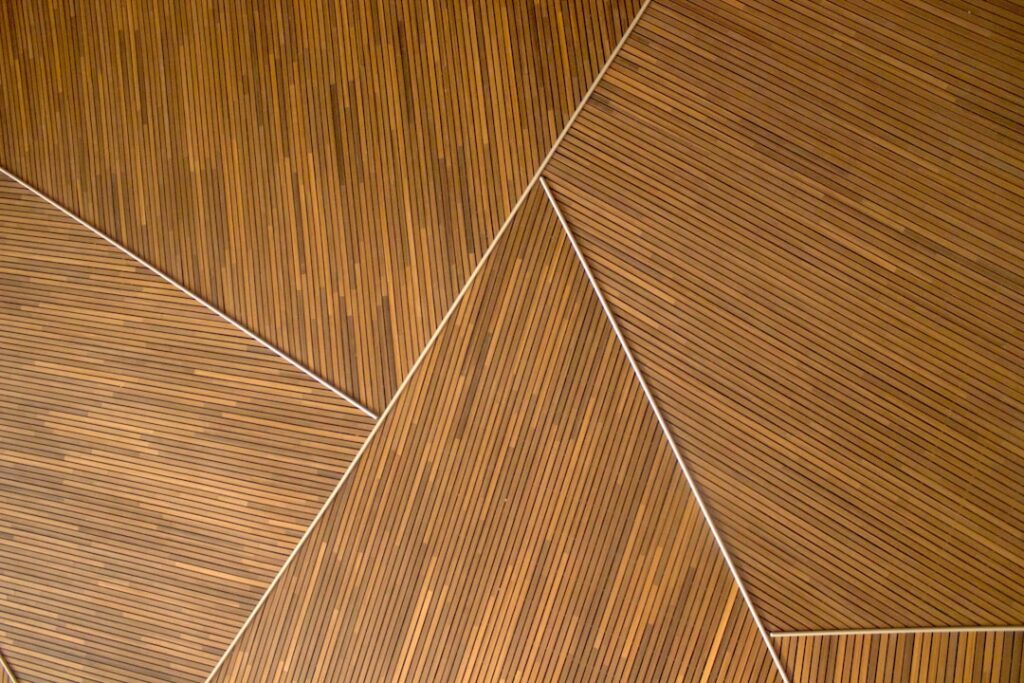
Walk into a 1920s Paris apartment or a turn-of-the-century New York townhouse and the wood floor doing the heavy lifting is almost always parquet. The pattern lasted because it works. Buy parquet flooring today and you are choosing a style that has been continuously fashionable for 400 years, from Louis XIV’s Versailles to modern Brooklyn lofts. The category has also exploded in variety, which means making a smart purchase requires understanding what you are looking at.
Parquet Defined
Parquet flooring is any wood floor laid in geometric patterns rather than parallel planks. Traditional French parquet uses small individual blocks fit into intricate patterns like Versailles panels. Modern parquet most often refers to herringbone or chevron, where rectangular wood pieces interlock at 90 or 45 degree angles to create a directional zig-zag effect.
Three construction types dominate today’s market:
- Solid parquet: Single piece of hardwood, typically 5/8 to 3/4 inch thick. Can be sanded and refinished 5-7 times over its life.
- Engineered parquet: 2-7 mm hardwood veneer over a plywood or HDF core. More dimensionally stable, suitable over radiant heat and concrete slabs.
- Parquet block panels: Pre-assembled tiles, typically 9×9 or 12×12 inch squares, with the pattern already arranged. Easier DIY install.
Pattern Options and What They Cost
Pattern complexity drives price more than any other factor. Same wood species, same finish, two patterns can vary by 50 percent in installed cost. Plan for these ballpark price ranges before tax and underlayment:
- Herringbone: $7-$14 per sq ft material, $11-$22 installed. Most common, widely stocked.
- Chevron: $9-$18 per sq ft material, $14-$28 installed. Cleaner V-shape, ends mitered at 45 degrees.
- Basket weave: $8-$15 per sq ft material. Two-by-two block layout, less directional.
- Versailles panels: $20-$45 per sq ft material, $30-$60 installed. Square panels with complex inlay. Often custom-made.
- Brick or running bond block: $6-$10 per sq ft. Simplest pattern, most affordable.
Species and Finish Considerations
European white oak dominates the parquet market today, prized for its straight grain, light color, and ease of finishing. Domestic red oak is more affordable at $1-$2 less per square foot. Walnut delivers a darker tone but is softer (Janka 1010) and dents more easily. Hard maple is brutal to install (denser than oak, harder on saw blades) but resists scratches better than most species.
Pre-finished parquet ships with factory UV-cured aluminum oxide finishes that last 20+ years. Unfinished parquet requires site sanding and finishing, which adds $3-$5 per sq ft but allows custom stain colors and a perfectly flat finished surface without micro-bevels between pieces. For period-correct restorations, unfinished is the right call. For most renovations, pre-finished saves time and money.
Pros of Parquet Flooring
Visual impact is the headline benefit. Even a modest 200 sq ft entry foyer in herringbone oak becomes a striking architectural feature. The pattern draws the eye and adds perceived value to a home far beyond the dollar cost of the floor itself. Real estate agents in the Northeast routinely cite original parquet as a top selling feature in pre-war buildings.
Durability holds up well. Solid hardwood parquet can be refinished multiple times over a 75 to 100 year life. Engineered parquet with a 4mm+ wear layer can usually be sanded and refinished twice. Compare that to laminate or LVT, which are full-replacement floors at end of life.
Other advantages include:
- Excellent resale value, especially in older homes
- Hides minor wear in patterns better than straight-plank floors
- Available in widths and grades to match historic restorations
- Engineered versions work over radiant heat with stable performance
Cons to Consider Before You Buy
Installation cost is the major obstacle. Even straightforward herringbone requires a skilled installer who can lay each piece individually, maintaining 90-degree precision across the full room. Expect installation alone to run $5 to $14 per sq ft, double or triple the cost of straight-plank installation.
Subfloor preparation is also more demanding. Parquet shows every flatness imperfection. The substrate must be within 1/8 inch over 6 feet. Older homes often need self-leveling underlayment, which adds $1.50-$3 per sq ft.
Smaller rooms can feel overwhelmed by busy patterns. Herringbone in a 9×12 bedroom may read as visual noise rather than elegance. Scale the pattern to the room. Larger blocks (4×16 or 4×20 inch pieces) work better in compact spaces than tiny 2×8 inch ones.
Where to Source Parquet
Big-box retailers carry limited parquet selections, usually engineered herringbone in a few oak finishes. Specialty flooring dealers offer wider selection, custom widths, and unfinished options. European-imported parquet from manufacturers like Boen, Kahrs, Junckers, and Tarkett comes through dedicated importers.
Domestic engineered parquet brands worth knowing include Sawyer Mason (US-made wide plank and herringbone), Stuga, Mirage Hardwood, and DuChateau. Premium ranges from these makers exceed $20 per square foot, but quality control and grading are tighter than budget imports.
For salvage and reclaimed parquet, dealers like Olde Wood Limited and Pioneer Millworks ship historic floors throughout the country. Reclaimed antique parquet from European chateaus and old American mills runs $25-$60 per sq ft but tells a real story.
Buying Tips That Save Money
Order at least 12 percent overage on herringbone and chevron patterns. Mitered cuts produce waste that straight-plank installs do not generate. For Versailles panels, 5 percent is often sufficient because you are buying pre-assembled units sized to your room.
Check the wear layer specification on engineered products. Anything below 2mm cannot be sanded. A 4mm or 6mm top layer allows refinishing later. The price gap between 2mm and 4mm wear layers is usually $1-$2 per sq ft, well worth it over a 20-year horizon.
Ask about acclimation requirements. Solid parquet needs 7-14 days at the installation site to reach moisture equilibrium. Skipping acclimation is the single most common cause of gapping and cupping in parquet floors.
Final Word
Parquet rewards the buyer who pairs the right pattern with the right room and budgets for skilled installation. Engineered herringbone in white oak, factory finished, at $10-$14 per sq ft installed, is the modern sweet spot. It delivers the visual drama of a heritage floor with the stability and convenience of contemporary engineered wood, and it works just about anywhere from a Florida condo to a Minnesota colonial.
Prefer to explore on your own?
See how new flooring looks in your actual room in seconds — free, no signup.
Try the free Floor Studio →

