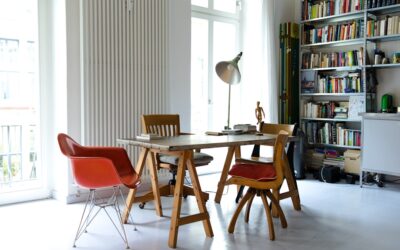
Lift a tired carpet in a 1930s house and there’s a good chance you’ll find a hardwood floor underneath that’s worth far more than the covering hiding it. Authentic 1930s flooring reflects an era caught between hand craftsmanship and early mass production, when oak strip floors, geometric parquet, terrazzo, and the first generation of resilient floor coverings all competed for space in the home. Understanding what was originally laid helps you decide whether to restore the real thing or recreate the look with modern materials.
The interwar period had a distinct flooring vocabulary. Houses of this age were built before fitted carpet became standard, so the floor itself was meant to be seen, polished, and shown off. That’s why so many survive in good shape under later coverings.
Oak Strip and Block Flooring
Narrow oak strip flooring, typically 2 to 2.5 inches wide, was the everyday hardwood of the 1930s home. Laid over joists or on battens, these floors were finished with wax or early varnishes and developed a warm honey patina over decades. They were built from solid timber, which is why they sand and refinish beautifully even ninety years on.
Where budgets stretched further, oak block (a form of parquet using small solid blocks bedded in bitumen) appeared in hallways and reception rooms. If you find a block floor that’s lifting, the bitumen has usually failed; re-laying blocks with modern flexible adhesive restores them without losing the period character.
Parquet and Geometric Patterns
Parquet was the showpiece floor of the era. Herringbone and basketweave patterns in oak, walnut, and occasionally exotic species like mahogany defined the better houses of the decade. The blocks were small and the patterns intricate, designed to catch light differently across the room.
Restoring original parquet is one of the most rewarding flooring projects you can take on. The wear layer on solid blocks is generous, so even a scuffed, paint-spattered floor often hides a flawless surface a few millimeters down. Have it professionally sanded with the grain direction in mind, since the alternating block orientation can tear out if handled carelessly.
Early Linoleum
Genuine linoleum, made from linseed oil, cork dust, wood flour, and jute backing, was hugely popular in 1930s kitchens, bathrooms, and hallways. Don’t confuse it with modern vinyl; real lino is a natural, biodegradable material that was often laid in bold patterns or marbled effects.
Surviving original linoleum is rare and worth preserving where it exists. If you want the look today, true linoleum is still manufactured and comes in period-appropriate colors and patterns, offering an authentic, eco-friendly alternative to vinyl that ages gracefully rather than peeling.
Hexagonal and Octagonal Floor Tiles
Bathrooms and entrance halls of the 1930s frequently used small ceramic mosaic floor tiles, most famously the white hexagon and the black-and-white octagon-with-dot patterns. These tiny tiles were hard-wearing, easy to clean, and gave bathrooms the crisp, hygienic look the era prized.
- Hex tiles: Often plain white or cream, sometimes with a contrasting border running around the room.
- Octagon and dot: White octagons separated by small black square “dots,” a signature interwar bathroom look.
- Encaustic borders: Patterned, colored clay tiles used to frame hallways and porches.
Both patterns are still made today, so a damaged section can usually be patched or a whole floor recreated convincingly.
Terrazzo
In grander 1930s homes, public buildings, and entrance porches, terrazzo brought a touch of glamour. This composite of marble or stone chips set in cement and ground smooth produced a seamless, speckled surface that suited the clean lines of Art Deco interiors.
Original terrazzo is extraordinarily durable, and a dull, scratched floor can be reground and resealed to look like new. It’s cold and hard underfoot, so it suited halls and bathrooms rather than living spaces, but where it survives it’s a genuine period asset.
Quarry Tiles and Solid Floors
Beyond the decorative ceramics, many 1930s homes had practical quarry tiles in kitchens, sculleries, and back hallways. These unglazed, fired-clay tiles in warm reds, browns, and buffs were tough, slip-resistant when dry, and able to take the heavy daily use of a working kitchen. Laid directly onto a solid base, they often survive beneath later vinyl or carpet, sometimes hidden for decades.
If you uncover original quarry tiles, resist the urge to seal them with a modern impervious coating, since many were laid over a base that needs to breathe; trapping moisture can cause salts to bloom and tiles to lift. A simple linseed-oil or breathable finish keeps them looking rich while respecting how the floor was built. Reclaimed quarry tiles are also widely available, so a damaged floor can be patched with genuine period material rather than a modern lookalike.
Restoring Versus Recreating
If you have original 1930s flooring in salvageable condition, restoration almost always beats replacement on both authenticity and value. Solid timber and ceramic tile from this era were made to outlast their owners.
- Restore when the original material survives across most of the room and damage is surface-level or localized.
- Recreate when the floor is gone entirely, choosing solid oak strip, real linoleum, or reproduction hex tile to match the period.
- Avoid wide-plank engineered boards or high-gloss laminate, which read as modern and clash with the era’s proportions.
Bringing a Period Floor Back to Life
Start every 1930s flooring project with careful detective work. Lift a discreet corner of carpet, check under built-in furniture, and look at thresholds for clues about what’s underneath. A floor that looks ruined under decades of grime, paint, and old adhesive frequently turns out to be a sound, beautiful surface that just needs sanding and refinishing.
When you do refinish, choose finishes sympathetic to the age. Hardwax oils and traditional waxes give a softer, more authentic sheen than thick polyurethane, and they’re easier to spot-repair down the line. Done thoughtfully, a restored 1930s floor becomes the quiet centerpiece of the whole house, and one that no new material can truly imitate.
Keep period proportions in mind throughout. Interwar rooms tended to be smaller and more defined than today’s open-plan spaces, and the flooring was scaled accordingly: narrow oak strips, small mosaic tiles, and modestly sized parquet blocks all suit the era. If you’re piecing in repairs or extending a floor into a converted space, matching that scale matters as much as matching the material, because an oversized modern plank in a 1930s room reads as a mistake even when the wood species is correct. Salvage yards and reclamation specialists are your best friends here, often stocking genuine period boards, blocks, and tiles that blend seamlessly with what survives.
Prefer to explore on your own?
See how new flooring looks in your actual room in seconds — free, no signup.
Try the free Floor Studio →