
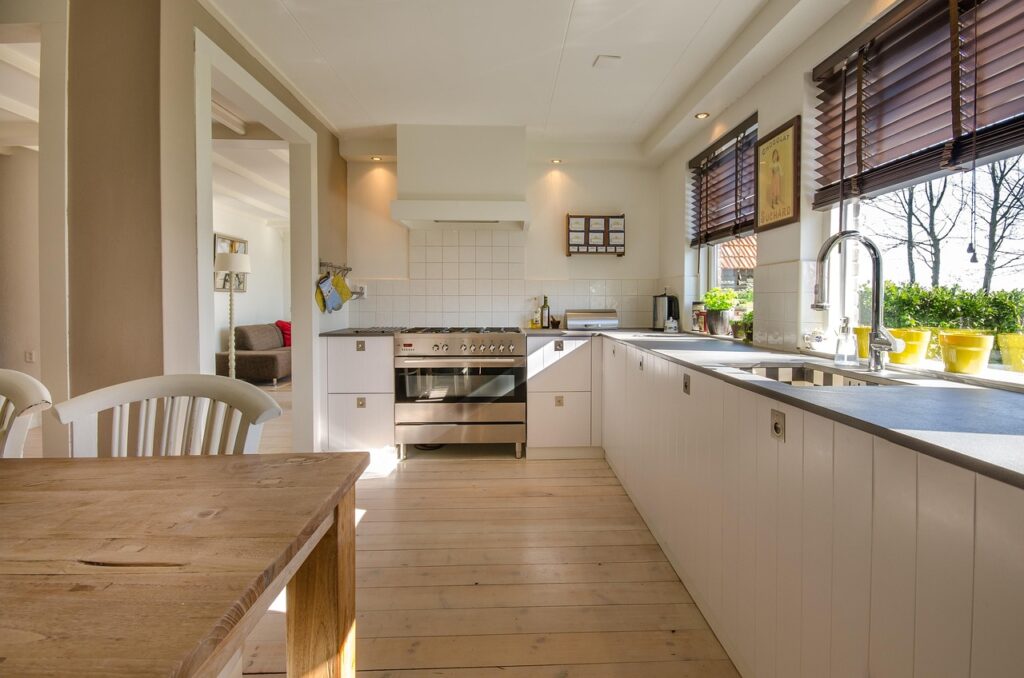
The Depression era kitchen is having a moment in renovations, partly because vintage style has cycled back into fashion and partly because original 1930s homes have hit the age where major remodels are due. A true 1930s kitchen looks nothing like the white-and-marble showrooms of today; it was painted in cheerful pastels, fitted with chrome and Bakelite hardware, and built around the new electric refrigerator and porcelain enamel range. Reproducing the look authentically means understanding what was actually in those rooms, not the Hollywood version.
The Era in Context
Kitchens of the era were transitional. The pre-WWI pantry-and-cook-stove arrangement was giving way to the modern fitted kitchen with built-in cabinets and electric appliances, but the all-white sanitation aesthetic of the 1920s was already softening. Magazines like Better Homes and Gardens promoted color, efficiency, and the new “step-saving kitchen” layouts pioneered by Lillian Gilbreth.
The Hoosier cabinet — a freestanding piece with built-in flour bins, sifters, and work surface — was on its way out, replaced by built-in cabinets along the wall. Tile and linoleum floors replaced the wood plank kitchens of earlier decades.
Authentic Color Palette
Pastel green, pale yellow, soft blue, and creamy white dominated period kitchen color schemes. Specific historic colors included:
- Jadite green: A pale milky green popularized by Anchor Hocking glassware.
- Buttercup yellow: Cheerful and warm, often paired with white.
- Robin’s egg blue: A touch greener than modern light blue.
- Mamie pink: A pale dusty pink that became more dominant in the late 30s and 40s.
- Cream and ivory: Background colors for cabinets and walls.
For paint, Sherwin-Williams Habitat (a soft jadeite green) and Benjamin Moore Buttercup Yellow are close modern equivalents. Avoid bright primary colors — those came later in the 50s.
Cabinet Style and Construction
Cabinets of the period were typically painted wood with simple shaker or flat-panel doors. Cabinet runs were shorter than today, often with open shelves above and below the counter run. Glass-front upper cabinets and built-in china displays were common in middle-class kitchens.
Hardware was chrome, nickel, or Bakelite — not brass or oil-rubbed bronze, which are mid-century or later. Look for round chrome knobs, simple bin pulls, and Hoosier-style latches. Reproduction sources like House of Antique Hardware and Liz’s Antique Hardware carry accurate styles starting around $8 per knob.
Countertops of the Era
Linoleum was the most common counter material in working-class and middle-class kitchens — yes, the same material used on floors. Wood butcher block, white marble, soapstone, and tile were used in higher-end installations.
For a modern kitchen aiming for authenticity, butcher block ($30 to $80 per sq ft installed) and tile ($15 to $35 per sq ft installed) read most period-correct. White marble works but reads more 1920s-formal. Skip granite and quartz entirely — they will date the kitchen forward to the 1990s.
Flooring Choices
Black and white checkerboard linoleum is the iconic floor of the era, but it was actually less common than solid colored or marbled linoleum in soft greens, beiges, and reds. Hexagonal ceramic tile in white with black accent tiles also appeared in higher-end homes.
For modern installations, true linoleum from Forbo Marmoleum (around $5 per sq ft) lasts 30+ years and is more authentic than vinyl. Hexagonal porcelain tile from Daltile or Florida Tile gives the period look with modern durability at $4 to $10 per sq ft.
Sinks and Faucets
Cast iron with porcelain enamel was the universal sink material — usually wall-mounted with integrated drainboards on one or both sides, or a single farmhouse-style apron front. Faucets were chrome with separate hot and cold cross handles, often with a swing spout that reached into either basin.
Kohler still makes period-correct cast iron sinks in the Bannon and Hawthorne lines, $400 to $900. For faucets, Strom Plumbing’s reproduction line and Sign of the Crab both make accurate two-handle bridge faucets in the $250 to $600 range.
Appliances: Period Look with Modern Function
The 1930s kitchen’s signature appliance was the Monitor Top refrigerator with the round compressor on top, and the porcelain enamel gas range on cabriole legs. Recreating either requires either a restored vintage piece or a modern reproduction.
Big Chill, Smeg, and Northstar all make refrigerators in retro pastels with rounded corners starting at $2,500. For ranges, the Aga Legacy 36-inch and the Heartland Classic offer enameled period looks with modern burners and controls. Expect $4,000 to $8,000 for a quality range.
Lighting and Finishing Touches
Schoolhouse-style milk glass pendants and frosted glass flush mounts were the standard ceiling fixtures. Chrome wall sconces flanked the sink in higher-end kitchens. Bare-bulb sockets in pantries and breakfast nooks were common.
Schoolhouse Electric and Rejuvenation both reproduce accurate fixtures starting around $200 per pendant. For details that complete the look, add a vintage Bakelite kitchen scale, a chrome breadbox, and Jadite or Pyrex mixing bowls.
Common Mistakes in Recreations
Subway tile is the most commonly misused element. Real 1930s subway was 3×6 inches with thin white grout, not the trendy 4×12 horizontal layout with dark grout that dominates 2010s-2020s remodels. The latter looks 2018, not 1938.
Avoid stainless steel anywhere — it would not show up in residential kitchens until the 1950s. Avoid LED strip lighting under cabinets. Avoid waterfall counter edges, mitered slabs, or any built-in trash pull-outs. All read modern instantly.
Marrying Period Style with Modern Function
The successful 1930s kitchen restoration uses period-correct visible elements with hidden modern function. Soft-close drawer slides inside vintage-style drawers. A modern dishwasher concealed behind a paneled door. Induction cooking under a porcelain enamel hood. The eye reads 1935; the hands feel 2026.


