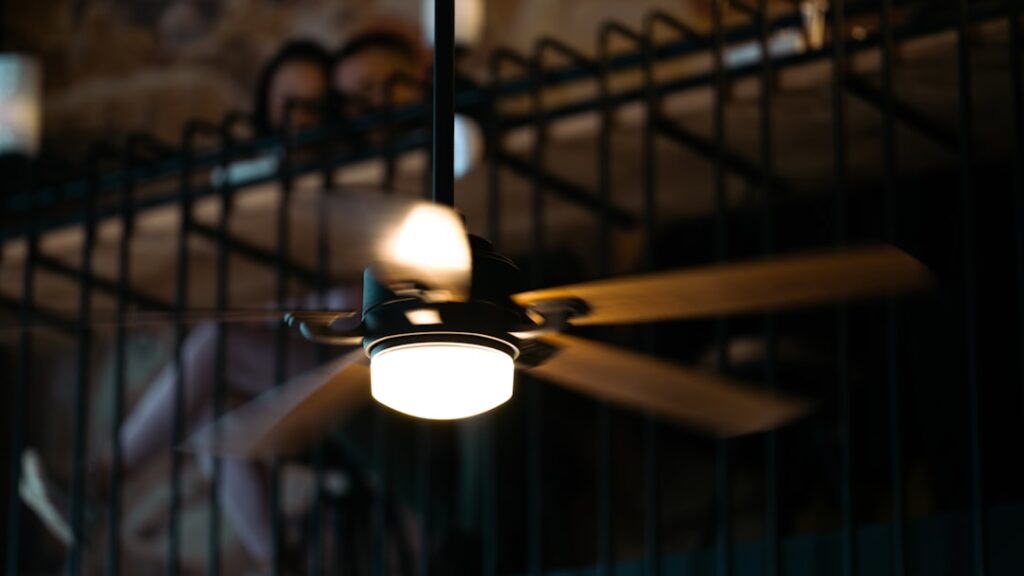
The wire cage started as pure function — factory fans ran at eye level and the guard kept knuckles out of the blades — and a century later it’s one of the strongest style statements in residential lighting. A caged ceiling fan wraps the blades, the light, or both inside an open metal enclosure, trading a little airflow for a lot of character: industrial, farmhouse, steampunk, or coastal depending on the finish and glass. Here’s where the look works, what the cage actually costs you in performance, and which models deliver.
- Anatomy of the Look
- Where the Style Lands: Four Directions
- The Airflow Honesty Section
- Sizing, Height, and Safety
- Bulbs, Light Output, and the Edison Trap
- Models and Money
- Installation Notes Specific to Cage Fans
- Styling Around the Cage
- Cage Fans Outdoors, in Garages, and Over Workbenches
- Verdict: Commit Where It Counts
Anatomy of the Look
Cage fans split into two builds that get lumped together in listings. Fully enclosed fans put blades and light inside one drum or globe cage — the most dramatic silhouette, usually compact at 14 to 27 inches across, spinning smaller blades faster to compensate. Cage-light fans are conventional 44-to-60-inch fans whose light kit sits inside a cage, keeping full-size blades and normal airflow while borrowing the industrial vocabulary. The distinction matters because the two perform completely differently: one is a statement piece with modest air movement, the other is a normal fan in costume.
Where the Style Lands: Four Directions
Finish and detailing steer the same cage toward very different rooms. Matte black cages with Edison-filament LED bulbs read industrial loft — right over kitchen islands, home bars, and offices with any brick or concrete in view. Oil-rubbed bronze or galvanized cages with wood-tone blades tilt farmhouse, pairing naturally with shiplap and open shelving; if your house leans that way broadly, our farmhouse ceiling fan guide covers the wider category. Brass and copper cages with globe glass go vintage-nautical, at home in dens and reading corners. And slim nickel drum cages with frosted diffusers skew transitional, sliding into rooms that aren’t otherwise themed at all — the safest choice if you love the cage but not a full aesthetic commitment.
The Airflow Honesty Section
Read the CFM line before falling for the silhouette. Full-size fans move 4,000 to 6,000 CFM; compact enclosed cage fans commonly deliver 1,500 to 3,000 because blade span, not motor effort, moves air. That makes fully caged models right for small and supplemental spaces — 10×10 offices, entries, walk-in closets, kitchens with existing ventilation — and wrong as the sole air-mover in a 300-square-foot living room. Cage-light fans with standard spans dodge the problem entirely. Two more practical notes: cages collect dust on every wire and want a monthly swipe with a duster (a vacuum brush attachment does it in two minutes), and open-frame designs are noisier at top speed than shrouded modern fans, a hum most owners file under character.
Sizing, Height, and Safety
Standard rules apply with one twist. Match span to room: under 100 square feet suits the 14-to-27-inch enclosed compacts; 100 to 225 square feet wants 44 to 52 inches, which means a cage-light fan. Keep blades at least 7 feet off the floor — but here the cage earns its original keep, because enclosed models are the one category safe to mount lower in tight spaces like stair landings, lofts, and low-slung bunk rooms where an open blade at 6 feet 8 inches is a genuine hazard. Sloped ceilings need a downrod and a cage profile that clears the pitch; check the fan’s maximum slope rating, since drum cages are wider at the top than standard motor housings.
Bulbs, Light Output, and the Edison Trap
Most cage fans are designed to show off their bulbs through open wire, which makes bulb choice half the fixture’s look. Vintage-style LED filament bulbs give the amber glow at 4 to 7 watts — but note the lumen math: three 350-lumen amber Edisons total barely 1,000 lumens, mood lighting rather than task lighting. If the fan must actually light the room, choose a model with higher-output 2700K filament LEDs or a frosted inner diffuser, and confirm sockets are standard E26 so replacements stay cheap. Dimmable filament LEDs on a compatible control give you both looks: bright for cleaning day, low amber for evenings.
Models and Money
Entry cage fans ($120–$200) come from Amazon-native brands like Parrot Uncle and Ohniyou — style-forward, decent for bedrooms and offices, with the usual budget caveats on remote receivers and parts support. The $200–$400 mid-band is the sweet spot: Hunter’s industrial-styled models and Quorum’s Windmill-adjacent cage designs add real warranties, better motors, and damp-rated options for porches. Above $400, Savoy House, Hinkley, and Fanimation build cage fans as lighting-showroom pieces with heavy-gauge cages, DC motors, and designer finishes. Across tiers, prioritize a sealed or replaceable light source, a remote from a brand with a parts channel, and — for enclosed compacts — a published CFM you’ve actually read.
Installation Notes Specific to Cage Fans
Hanging a cage fan is standard fan work with a few wrinkles. Weight first: enclosed compacts run a manageable 15 to 20 pounds, but the rule is unchanged — a fan-rated ceiling box, never a plastic light box, regardless of how petite the fixture looks. Assembly order is the real difference: on drum-cage models the blades install inside the enclosure, then the cage panels close around them, a fiddlier sequence than a standard fan that adds a good 30 minutes and rewards laying out every cage screw before starting. Check panel alignment as you close the cage; a slightly racked cage rattles at speed and is maddening to diagnose afterward. Flush-mount versions suit 8-foot ceilings, while anything higher wants the downrod length that puts the cage bottom near 8 feet — and porch installations need the damp rating verified on the box, not assumed from the industrial look.
Styling Around the Cage
A cage fan is a strong ingredient, and rooms handle it best when the finish echoes at least twice elsewhere — matte black cage picking up cabinet pulls and a floor lamp base, bronze cage answering doorknobs and picture frames. Pair it with one or two smaller cage or filament fixtures (a sconce pair, a pendant over the counter) rather than a room full of them; industrial reads best at about 20 percent dosage. Contrast keeps it crisp: black cages pop against white or pale ceilings and disappear against dark ones, which is a choice, not a flaw. The one genuine conflict to avoid is a decorative chandelier in the same sightline — two ceiling statements in one visual field argue, and in open plans the cage fan should either repeat or stand alone.
Cage Fans Outdoors, in Garages, and Over Workbenches
The style’s factory roots make it a natural fit for hardworking spaces, with ratings as the gatekeeper. Covered porches and three-season rooms need a UL damp rating — plenty of bronze and galvanized-finish cage models carry it — while anything catching blown rain needs wet-rated, a shorter list worth searching deliberately. Garages are the sweet spot: a caged fan over a workbench or home-gym corner delivers air where box fans clutter the floor, the cage shrugs off the occasional lumber bump that would crack a standard fan’s glass, and the lower mounting the enclosure permits suits garage ceilings that often sit at 8 feet with door tracks stealing clearance. Two practical specs for these installs: choose sealed or easily wiped finishes (galvanized and powder-coat over intricate antique detailing, which collects workshop dust in every crevice), and favor models with standard E26 sockets so bright 1,600-lumen daylight LEDs can turn the fan into the task light the space probably lacks.
Verdict: Commit Where It Counts
A caged ceiling fan is a style purchase that carries real functional trade-offs, and the winning move is matching the build to the job: enclosed compacts for small rooms, low clearances, and statement corners; cage-light full-span fans anywhere you need genuine airflow with the industrial look. Pick the finish for your home’s existing direction, spend on filament LEDs worth displaying, and dust the wires monthly. Done right, it’s the fixture guests comment on — which is exactly what a hundred-year-old safety guard turned design icon should do.