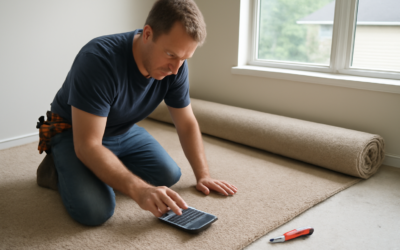
The average household replaces carpet every 8 to 12 years, but most owners wait too long and accept matted, stained floors as normal. A planned carpet change is one of the highest-value updates in a home — a $3,500 expense that lifts resale value by $5,000 to $9,000 and instantly upgrades how the space feels. The trick is doing it well, on the right timing, with the right product. Rushing the decision or chasing the lowest price almost always produces a floor that looks tired by year three.
- When to Plan a Carpet Change
- What a Full Replacement Costs in 2026
- Choosing the Right Fiber
- Pad Selection Is Underrated
- Prep Work That Saves Money
- Subfloor Issues to Address First
- Installation Day Logistics
- Three Mistakes That Wreck a Carpet Change
- Warranties and What They Actually Cover
- The Smart Carpet Change Plan
When to Plan a Carpet Change
Three signs say it is time. Visible matting in walking lanes that does not bounce back after vacuuming means the fibers have lost their twist permanently — no cleaning will fix it. Persistent odor that survives professional steam cleaning indicates pad saturation, usually from pet accidents that wicked through the backing. Visible color shift between under-furniture areas and traffic paths shows uneven UV degradation that gets worse, never better.
Best time to schedule a carpet change is January through March or July through August. Demand is lower, installer crews are available within 7 to 14 days, and many retailers run promotional pricing 10 to 20 percent below their fall pricing.
What a Full Replacement Costs in 2026
A complete carpet change for an average 1,800-square-foot home runs $3,200 to $7,800 all-in:
- Materials (carpet + pad): $2,400 to $5,400.
- Tear-out and disposal: $300 to $700.
- Installation labor: $1,000 to $2,200.
- Transitions, stairs, and extras: $200 to $600.
Bedrooms-only changes (typically 800 square feet) run $1,400 to $3,400. Stairs always cost more per foot — figure $7 to $15 per stair tread separately because of the wrap-and-tack labor.
Choosing the Right Fiber
The fiber decision drives 70 percent of how long the new carpet looks fresh. The four real-world choices in order of value:
Triexta (PTT): Mohawk SmartStrand and similar lines. Inherently stain-resistant without coatings that wear off, soft underfoot, runs $3.50 to $6.50 per square foot. Best overall choice for families with kids and pets.
Nylon 6,6: The traditional gold standard. Stain Master, Anso, and Tactesse brands run $4 to $8 per foot. Most resilient under heavy traffic. Slightly less soft than triexta.
PET polyester: Soft, vivid colors, $2 to $4 per foot. Good for adult bedrooms but mats faster in heavy-traffic rooms. Look for 6+ TPI twist to extend life.
Wool: $8 to $15 per foot. Premium look and feel, naturally flame-resistant. Demands more maintenance and avoids basements.
Pad Selection Is Underrated
Buyers spend hours choosing carpet color and seconds choosing pad — backwards. The pad determines how the floor feels, how long the carpet lasts, and how well it muffles sound. For most rooms, a 7/16-inch, 8-pound rebond pad is correct. Step up to a 1/2-inch, 8-pound pad in living rooms with home theaters. Skip memory foam pads (they trap moisture and void some warranties) and the cheap 5-pound pad sometimes thrown in for free — it crushes within 18 months.
Moisture-barrier pad (a thin film bonded to the top) costs $0.20 more per square foot and prevents pet accidents from soaking into the subfloor. Worth every penny in homes with dogs.
Prep Work That Saves Money
Three prep tasks the homeowner can do reduce the carpet change cost by $200 to $500. First, empty rooms completely before the install crew arrives — most contractors charge $40 to $90 per heavy item if they have to move furniture. Second, remove existing carpet and pad yourself: pull the carpet at a corner, fold sections over, and roll for disposal. Bagging the pad in 4-foot squares fits municipal trash limits in most cities.
Third, vacuum the exposed subfloor and check tack strip condition. Replace any rotted or rusted strips at $0.30 per linear foot from any home center. The crew will charge $1 to $2 per foot for the same job.
Subfloor Issues to Address First
Once the old carpet is up, inspect the subfloor before ordering new. Look for: water staining (pull a section of pad to expose plywood), squeaky areas (drive 2-1/2 inch deck screws into joists below to silence), and uneven seams over 3/16 inch (sand or fill with leveler). Plywood with delaminated layers needs replacement at $1.10 to $2.50 per square foot.
Hardwood under existing carpet is a common find in homes built before 1980. If the wood is salvageable, refinishing runs $4 to $7 per square foot — often cheaper than a quality carpet change and adds significant resale value.
Installation Day Logistics
A 1,800-square-foot whole-home carpet change takes 6 to 9 hours with a 3-person crew. Expect the install to follow this sequence: tear out old, prep tack strip, lay pad, roll out carpet, stretch with power stretcher, trim and tuck, install transitions, vacuum, walk-through. The power-stretcher step is non-negotiable — knee-kick installs leave carpet that ripples within 12 months.
Plan to be out of the house during the install. Off-gassing from new carpet and pad is real but mild — open windows for 24 to 48 hours after the crew leaves to clear residual VOCs.
Three Mistakes That Wreck a Carpet Change
First, choosing carpet by color alone. Take large samples (12 by 18 inches minimum) home and view them at multiple times of day. Showroom lighting is brighter and warmer than most homes. Second, picking a high pile in a high-traffic room. Frieze, cable, or short loops handle traffic better than long shag in living rooms. Third, skipping the moisture-barrier pad in pet households. The $200 added cost prevents $1,500 in subfloor replacement later.
Warranties and What They Actually Cover
Carpet warranties run 5 to 25 years and cover specific defects: manufacturing flaws, abrasive wear, and stain resistance. They do not cover crushing in traffic lanes, fading from sunlight, or pet damage. The warranty also requires professional cleaning every 12 to 18 months with receipts retained — most claims fail because the homeowner cannot produce records.
The Smart Carpet Change Plan
Pull three quotes from independent retailers, normalize on identical product specs, schedule for January or July, prep the rooms yourself, and choose triexta or nylon with an 8-pound rebond pad. That formula produces a floor that still looks fresh at year 8, lifts resale value, and rarely produces a callback issue. The homeowners who treat a carpet change as a 10-year investment rather than a quick refresh consistently end up happiest.