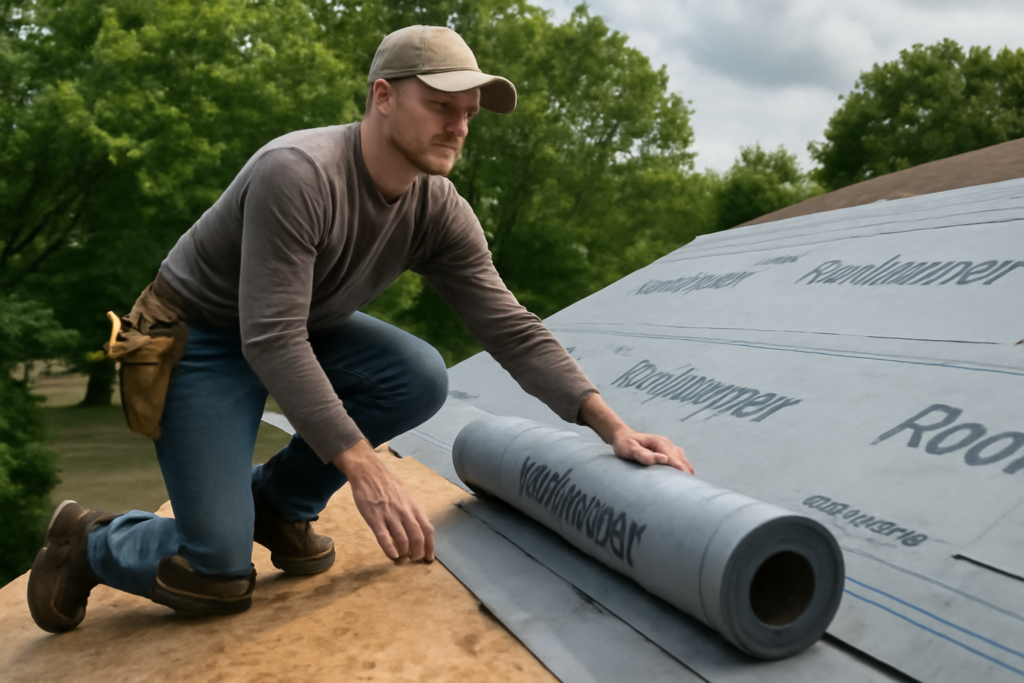
Roofing felt had a hundred-year run, and products like this one are the reason it is ending. CertainTeed RoofRunner synthetic underlayment is the shingle giant’s polymer replacement for #15 and #30 felt — a woven polypropylene sheet that weighs a fraction of asphalt paper, refuses to tear off the roll, and does not turn into a slip-and-slide the moment morning dew hits it. Underlayment is the layer nobody sees after install day, which is exactly why it deserves scrutiny before the shingles bury it for 30 years. Here is how RoofRunner performs where it counts: on the deck, under foot, and in the warranty fine print.
What RoofRunner Is
RoofRunner is a multi-layer synthetic: a woven polypropylene scrim for tear strength, coated top and bottom, with a slip-resistant textured walking surface. CertainTeed positions it as the standard-duty synthetic in its lineup, beneath the premium DiamondDeck, and rates it for use under asphalt shingles as well as most sloped roofing systems where a water-shedding — not waterproofing — underlayment is specified.
The roll math tells the replacement story. A typical RoofRunner roll runs 48 inches wide by 250 feet long, covering 10 squares (1,000 square feet) while weighing in the neighborhood of 30 pounds. Covering the same area with #30 felt takes five rolls at roughly 60 pounds each — call it 300 pounds of asphalt paper versus one 30-pound synthetic roll. That is not a marketing statistic; it is the difference between one ladder trip and five, and between a crew that is fresh at 2 p.m. and one that is not. Street price runs about $85 to $120 per roll, or roughly $9 to $12 per square, against $20 to $25 per square for #30 felt.
On-Deck Performance: Where Synthetics Earn It
Lay felt on a hot day and it wrinkles; lay it before rain and it buckles into ridges that telegraph through shingles. RoofRunner lies flat and stays flat — polypropylene does not absorb water, so morning dew and a surprise shower do not swell or wrinkle it, and the deck you papered Friday is the deck you shingle Monday. Tear resistance changes crew behavior too: felt rips at every boot pivot and blows apart in gusts, while the woven scrim shrugs off foot traffic and holds at fasteners in wind that would shred paper into confetti.
Traction is the spec that keeps roofers loyal once they switch. The textured surface grips footwear wet or dry noticeably better than saturated felt, and on a 8/12 pitch that grip is a safety system, not a comfort feature. Cold-weather behavior follows the same pattern — felt gets brittle and cracks below freezing, while the synthetic stays flexible for the shoulder-season installs that make up half of real roofing schedules.
Exposure Window and Dry-In Duty
Every re-roof carries a gap between tear-off and final covering, and the underlayment holds the fort. RoofRunner is rated for UV exposure measured in weeks — CertainTeed’s published window is 60 days — versus felt’s practical limit of days before it dries, cracks, and curls. For a homeowner whose roofing project hits a material delay or a week of storms, that window is the difference between a protected deck and an emergency tarp bill.
Respect what “water-shedding” means, though. Synthetic underlayment sheds rain that gets past shingles; it is not an ice barrier and not a sealed membrane. Eaves in snow country still require a self-adhered ice-and-water shield per code — typically from the edge to at least 24 inches inside the warm wall — and valleys, penetrations, and low-slope transitions keep their dedicated membranes. RoofRunner covers the field of the roof above those zones. On slopes below 4/12, follow CertainTeed’s low-slope instructions or step up to a fully adhered product.
Installation Rules and Fastening
Synthetics install fast, but the details differ from felt in ways that matter at inspection time:
- Fasteners: plastic cap nails or cap staples, not smooth roofing nails alone — caps prevent tear-through and seal better; expect roughly 200 to 400 caps per square depending on exposure timeline and wind zone
- Laps: horizontal laps around 4 inches and end laps 6 inches, following the printed lap lines; increase laps on lower slopes per the instructions
- Orientation: printed side up, courses run parallel to the eave, starting at the bottom so water sheds over — never behind — each lap
- Deck: dry, clean structural sheathing; synthetics are vapor-impermeable, so attic ventilation must be right because the roof assembly will not breathe through this layer
That vapor note deserves emphasis. Felt passes some moisture; woven synthetics essentially do not. On a house with marginal attic ventilation, the underlayment swap can surface a condensation problem that felt was quietly masking — fix the ventilation, not the underlayment choice.
Warranty Math and the System Game
CertainTeed, like GAF and Owens Corning, plays the system card: using the brand’s underlayment alongside its shingles and accessories counts toward enhanced warranty tiers such as SureStart PLUS coverage levels, which extend labor and material protection well past the base warranty when installed by credentialed contractors. For a homeowner already buying Landmark shingles, speccing RoofRunner instead of a generic synthetic can upgrade warranty coverage for close to zero net cost — one of the few free lunches in roofing. Ask your contractor to quote the roof as a registered system and show the warranty tier in writing; the paperwork takes them minutes.
Against the Competition
The synthetic field is crowded, and honest positioning helps. Against commodity synthetics in the $50-per-roll tier, RoofRunner offers heavier scrim, better walkability, and a brand that will still exist when a warranty claim ages — worth the modest premium on any roof someone will walk during install. Against premium synthetics like DiamondDeck, Titanium UDL30, or GAF FeltBuster’s upmarket siblings, RoofRunner gives up some thickness and slip-tech but costs meaningfully less, and under standard asphalt shingles the extra spend rarely buys visible benefit. Against felt, the comparison is over: synthetics win on weight, safety, exposure, and flatness, and felt’s only surviving arguments are ultra-low material cost and certain historic-restoration specs. For the typical 25-square re-roof, the entire underlayment upgrade from #30 felt to RoofRunner costs less than $150 in materials.
Homeowner Checklist: Getting It Specified Right
Most homeowners never choose their underlayment — it arrives as a line item in a roofing quote, sometimes as a vague “synthetic felt” that could mean anything from RoofRunner to a $45 mystery roll. Take three minutes to pin it down. Ask the contractor to name the exact product and show it on the material order; verify the ice-and-water shield zones separately, since some bids quietly substitute synthetic field sheet where sealed membrane belongs; and confirm cap fasteners rather than staples if your area sees real wind, because the fastener choice determines whether the dry-in survives a storm mid-project.
Watch the install for two details that predict quality. Courses should run straight along the printed lap lines with no fishmouths — wrinkles at laps channel water sideways — and every penetration cut should be dressed so the underlayment sheds around it, not into it. A crew that is sloppy with the layer you can still see will not get more careful with the layers you cannot. Good synthetics make good work easier, but they do not make careless work waterproof.
Verdict: The Sensible Default Under Shingles
CertainTeed RoofRunner synthetic underlayment is not the most exotic sheet in the category, and that is its virtue. It nails the fundamentals — light rolls, flat lays, real traction, a 60-day exposure cushion, and warranty synergy with the most-installed shingle lines in America — at a price that undercuts the boutique synthetics without the sketchiness of the bargain imports. Pair it with proper ice-and-water shield at the eaves and honest attic ventilation, fasten it with caps on the printed lines, and it will do the underlayment’s true job: be quietly perfect for decades, and be forgotten. That is a strong recommendation dressed as a modest one.