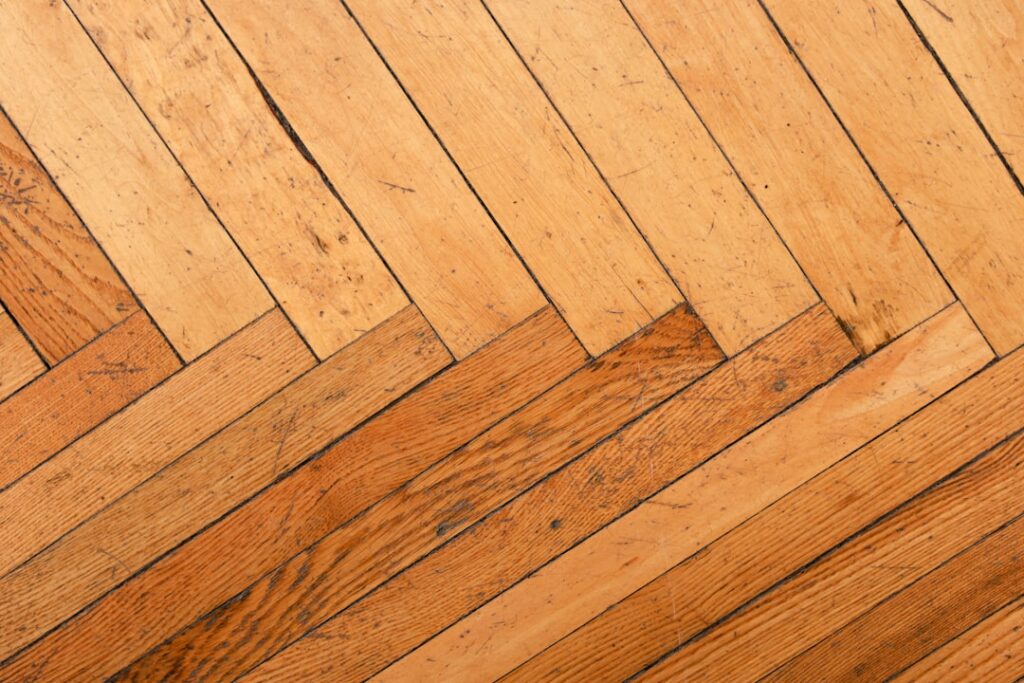
Designer herringbone floors at $25 per square foot installed dominate Pinterest, but most homeowners need an option that fits a $3,000 budget for a 400-square-foot room. Cheap herringbone flooring exists — laminate at $1.79 per square foot, peel-and-stick LVT at $2.50, and budget engineered oak at $4.50 — and some of it performs surprisingly well. The trick is knowing which corners are safe to cut and which compromises will haunt you in 18 months when click joints separate or the printed wear layer ghosts visible repeats.
Where Cheap Works and Where It Fails
The herringbone pattern adds visual richness regardless of material cost. From 5 feet away, $3 LVP and $18 engineered oak look similar. The differences emerge at close range, under raking light, and over time as wear accumulates. Budget products fail predictably:
- Thin wear layers (under 0.3 mm): Scratch through to the printed pattern within 2-4 years.
- Cheap click joints: Separate under seasonal humidity swings and create visible gaps.
- Limited print repeats: Same plank graphic appears every 6-12 boards, creating a noticeable pattern from across the room.
- Off-gassing: Imports without testing certification can release VOCs for 6-18 months after install.
Budget Material Comparison
Laminate herringbone runs $1.50-3.50 per square foot at retail. Floor & Decor, Lumber Liquidators (LL Flooring), and Home Depot all carry private-label options. Pergo Outlast+ Herringbone at $2.79 includes a 25-year warranty and AC4 commercial-rated wear layer — strong value at this price.
SPC and LVP herringbone runs $2.50-5.50 per square foot at retail. Lifeproof, Tranquility (LL Flooring), and Mohawk’s RevWood collection are common picks. Specify minimum 0.4 mm wear layer or higher; thinner wears through fast.
Budget engineered oak herringbone starts around $3.50-5.50 per square foot for 8-10 mm planks with a 1-2 mm wear layer. Floor & Decor’s AquaGuard Engineered Hardwood and Bauwerk Outlet European oak both deliver real wood at near-laminate prices.
Pros of Going Cheap
- Cost savings: A 400 sq ft room finishes at $1,200-2,500 in budget herringbone vs $7,000-10,000 in premium engineered oak.
- DIY-friendly: Click-lock laminate and SPC install at 100-150 sq ft per day for a confident DIYer.
- Waterproof options: SPC and LVP shrug off kitchen and bathroom moisture that solid wood cannot.
- Easy replacement: When a section gets damaged, click planks lift and swap without specialty tools.
- Fast install: Most budget herringbone has factory bevels and pre-aligned tongue-and-groove edges that speed pattern layout.
Cons That Surface Over Time
Print repeats become visible the longer you live with a budget floor. High-end engineered oak uses 30+ unique plank graphics per box; budget LVP often uses 6-12 repeats. Stand at room edge and scan the floor — if you see the same knot pattern three times in 20 square feet, the repeat count is too low.
Edge integrity at cheap herringbone joints matters because the pattern multiplies the linear feet of joinery by 2-3x compared to straight-laid plank. A cheap click profile that fails 1 in 200 joints causes visible gaps every 50 square feet across a herringbone field.
Returns are harder than buyers expect. Big-box and online sellers limit return windows to 30-90 days, but some pattern issues only appear after 60-90 days of natural light exposure.
Brands That Punch Above Their Price
- Pergo Outlast+ Herringbone Laminate: $2.79 per sq ft, AquaBlock waterproof technology, 25-year warranty.
- Lifeproof Sterling Oak Herringbone: $3.49 per sq ft (Home Depot), 0.32 mm wear layer, click install.
- Floor & Decor AquaGuard Herringbone: $3.99-4.99 per sq ft, real engineered wood with waterproof core.
- Build Direct Vanier Herringbone: $3.50-4.50 per sq ft online, 12 mm laminate with wide planks.
- Bauwerk Outlet European Oak Chevron: Mill seconds at $4.50-6 per sq ft when in stock, real wood at near-laminate prices.
Where to Spend the Saved Money
If you save $4,000 on flooring, redirect it to elements that affect long-term satisfaction:
- Quality underlayment ($300-500): 3 mm cork or 2 mm cross-linked polyethylene smooths subfloor minor unevenness and reduces echo.
- Self-leveling compound ($400-700 if needed): Cures subfloor variation that would otherwise stress click joints.
- Professional install ($800-1,800): A skilled installer makes cheap material look better than DIY install of premium product.
- Real wood transitions ($150-300): Solid oak T-mold and reducers look 10x better than budget vinyl trims.
- Felt floor protectors and area rugs: Extend wear layer life by 2-3x in main paths.
Installation Tips for Budget Material
Sort planks across multiple boxes before laying. Color batch and print repeat variations show less when you draw planks from 4-5 boxes simultaneously. Run perpendicular to the longest wall to maximize visual room length, and start the pattern from the room centerline to avoid asymmetric end cuts.
Use a tapping block and pull bar designed for the plank profile — generic tools damage the click joint and void warranty. A $25 dedicated kit pays back on the first row.
Cost Breakdown for a 400 Sq Ft Room
- Mid-tier laminate herringbone at $2.79 per sq ft: $1,116
- Underlay (3 mm cork): $250
- Self-levelling compound (partial): $300
- Professional install at $3 per sq ft: $1,200
- Trim and transitions: $200
- Total: roughly $3,066
Lifespan Realistic Expectations
Mid-tier laminate herringbone with a quality install delivers 12-18 years of attractive service in residential conditions. Budget LVP gets 10-15 years if the wear layer is 0.4 mm or thicker. Budget engineered oak (0.5 mm wear layer) gets 15-20 years. None of these match premium $20+ engineered oak’s 30+ year lifespan, but for a third of the price, cheap herringbone flooring is genuinely good value.
Prefer to explore on your own?
See how new flooring looks in your actual room in seconds — free, no signup.
Try the free Floor Studio →