Vinegar has earned a reputation as a miracle cleaner, but on flooring the truth is more nuanced. Cleaning floors with vinegar is genuinely effective on some surfaces and quietly destructive on others. Use it on the wrong floor and you will dull the finish, etch the stone, or void your manufacturer warranty in a single mopping session.
Why Vinegar Cleans So Well
White distilled vinegar is roughly 5 percent acetic acid in water. That mild acid dissolves alkaline soils — soap scum, hard water deposits, and many food spills — without leaving a sticky residue. It is also cheap, around $3 per gallon, and free of fragrances or dyes that bother people with sensitivities.
The cleaning power comes from chemistry, not abrasion. That means it will not scratch or discolor surfaces that can handle mild acid, but it will react with anything calcium-based.
Floors That Tolerate Vinegar Well
A few flooring types are genuinely vinegar-friendly when used in the correct dilution.
- Ceramic and porcelain tile with sealed grout. The vinegar cuts soap film and brightens the grout lines.
- Vinyl plank, sheet vinyl, and linoleum. The wear layer resists mild acid and rinses clean without streaks.
- Sealed concrete with an epoxy or polyurethane top coat.
- Glazed brick floors and pavers that have been sealed within the last 5 years.
For these floors, the standard ratio is 1/2 cup of white vinegar per gallon of warm water. Stronger mixes leave a faint acidic film that attracts dust within days.
Floors You Should Never Clean with Vinegar
Three categories will be damaged by acetic acid no matter how diluted.
- Hardwood floors. The acid breaks down the polyurethane finish over time, leading to dull patches and accelerated wear at high-traffic areas. Manufacturers like Bona, Bruce, and Mohawk specifically warn against vinegar in their care guides.
- Natural stone. Marble, travertine, limestone, and slate are calcium-based. Vinegar etches the surface on contact, leaving dull rings that no polishing can remove without professional restoration.
- Unsealed grout. The acid eats into the cement matrix, weakening it and creating crumbling lines that catch dirt.
If you have already used vinegar on these surfaces a few times, the damage may not be visible yet but it is happening at a microscopic level.
The Right Vinegar to Mop Ratio
Use white distilled vinegar, not apple cider, balsamic, or red wine vinegar — those contain sugars and pigments that leave residue. Mix 1/2 cup vinegar to one gallon of warm water for routine cleaning. For sticky messes on vinyl, bump it to 1 cup per gallon and rinse with plain water afterward.
Adding a few drops of mild dish soap such as Dawn helps emulsify grease, but skip essential oils unless you want to spend an hour buffing out streaks. Never combine vinegar with hydrogen peroxide or bleach — the first creates a corrosive peracetic acid and the second releases chlorine gas.
Step by Step Mopping Method
Cleaning floors with vinegar takes more than dunking a string mop and slapping it down. Follow a sequence that minimizes water sitting on the surface.
- Sweep or vacuum first. Mopping over grit drags it across the floor and creates fine scratches.
- Mix the vinegar solution in a clean bucket. A second rinse bucket of plain water doubles your efficiency.
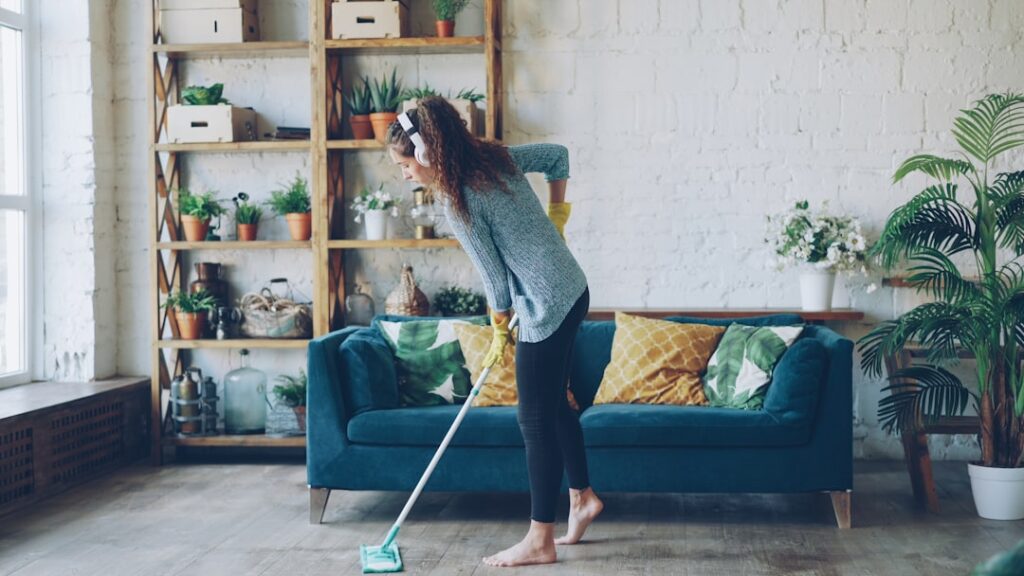
- Use a microfiber flat mop, not a sponge mop. Microfiber holds the right amount of moisture and lifts soil rather than smearing it.
- Wring the mop until it is damp, never dripping. Standing water is the enemy of every floor type.
- Mop in figure-eight patterns, working from the far corner toward the door.
- Rinse with the plain water bucket if the floor feels tacky after drying.
- Open windows or run a fan to speed drying — wet floors collect dust faster than dry ones.
Tips That Make Vinegar Cleaning Better
Heat the water to roughly 110 degrees F. Warm vinegar solution dissolves soils faster than cold. Replace the solution as soon as it looks gray — dirty vinegar water just redistributes grime.
For hard water spots, spray full-strength vinegar directly on the spot, let it dwell 5 minutes, then wipe. For pet urine on tile, mix 1 cup vinegar, 1 cup warm water, and 1 tablespoon baking soda in a spray bottle, but use it within 10 minutes — the fizzing reaction is what cleans, not the leftover liquid.
When to Choose a Commercial Cleaner Instead
Vinegar is great for general maintenance but it is not a degreaser, a disinfectant, or a wood-safe cleaner. For greasy kitchen tile, a product like Zep Heavy-Duty Floor Cleaner cuts grime that vinegar leaves behind.
For hardwood, use a pH-neutral cleaner such as Bona Hardwood Floor Cleaner, around $15 per quart. For natural stone, a product like Granite Gold Floor Cleaner is engineered to lift soils without etching.
FAQ
Will vinegar disinfect my floors?
Vinegar reduces some bacteria but does not meet EPA disinfectant standards. For genuine disinfection, use a product registered for that claim and follow the dwell time on the label.
Can I use vinegar on luxury vinyl plank flooring?
Yes, in the standard 1/2 cup per gallon ratio. Avoid stronger concentrations and never let the floor stay wet for more than a few minutes.
Does vinegar make floors smell bad?
The smell fades within 30 to 60 minutes as the acetic acid evaporates. If it lingers, you used too much or did not rinse properly.
Why does my floor look streaky after using vinegar?
Streaks usually mean too much vinegar, dirty water, or a sponge mop that left puddles. Switch to a microfiber flat mop and dilute the solution further.
Can I use vinegar on engineered hardwood?
No. Engineered hardwood has the same surface finish as solid hardwood and reacts the same way to acid. Use a manufacturer-approved cleaner instead.
Prefer to explore on your own?
See how new flooring looks in your actual room in seconds — free, no signup.
Try the free Floor Studio →