
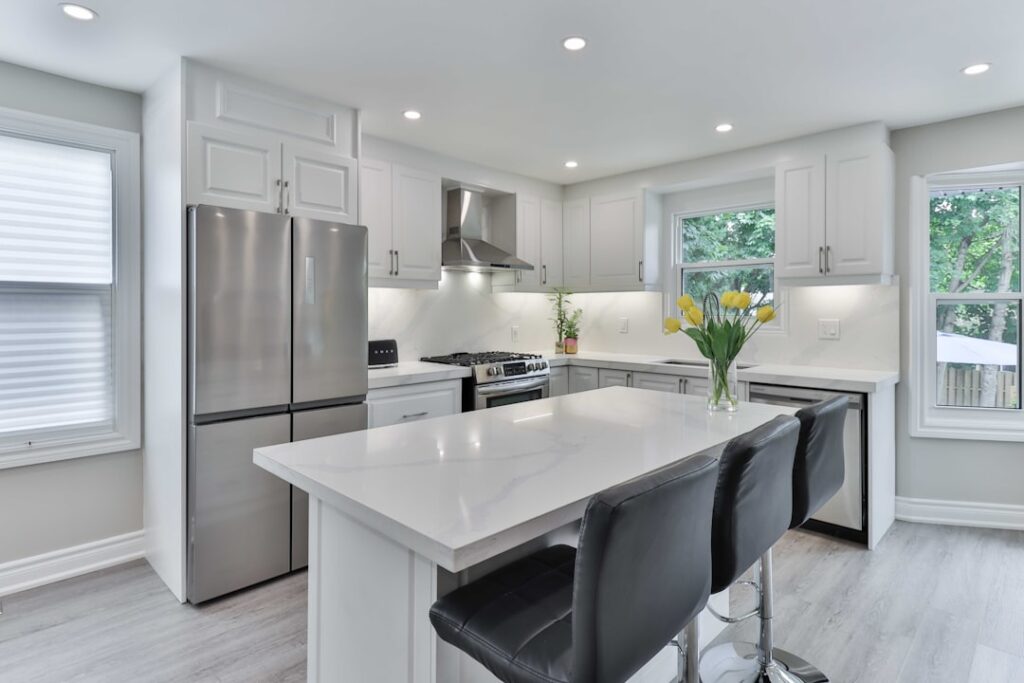
Salt air corrodes brass hardware in under two years and warps unsealed cabinet doors faster than any inland environment. Coastal kitchens are not just a design style — they are a set of material choices that have to survive 70 to 90 percent ambient humidity, intense UV, and frequent open-window airflow. The look is calm, light-flooded, and breezy; the engineering underneath has to be tough. This guide covers cabinetry, countertops, flooring, hardware, and the color palettes that read coastal without sliding into theme-park nautical.
Define the Style Before You Buy Anything
Three sub-styles dominate coastal kitchens, and they shop very differently:
- Hamptons coastal: White Shaker cabinets, marble or quartz counters, blue island, polished nickel hardware. Polished and tailored.
- Beach cottage: Painted plank cabinets in soft white or pale blue, butcher block counter accents, bead-board backsplash, woven pendant lights.
- Modern coastal: Flat-panel rift white oak cabinets, white quartz, matte black or brushed brass, dramatic windows, almost monochrome.
Pick one direction and let it drive every material decision. Mixing two leads to a kitchen that looks indecisive in photos.
Cabinetry: Material Matters More Than Style
Solid wood cabinets in oak, maple, or cherry move with humidity and crack the painted finish along door panels. For coastal homes, look at:
- MDF cabinet doors with a conversion-varnish factory finish — dimensionally stable, holds paint cleanly.
- Marine-grade plywood box construction with a polyurethane sealer on all six sides, including inside the cabinet.
- Thermofoil doors for budget builds — cheap to replace and indifferent to moisture.
Whatever you choose, vent the soffit and run an exhaust hood that moves at least 400 CFM. Trapped cooking moisture is what swells doors, not the salt air alone.
Countertops Built for the Climate
Quartz is the workhorse of modern coastal kitchens. Brands like Cambria Brittanicca and Silestone Eternal Calacatta Gold mimic marble veining without the etching problems real marble has in a coastal humidity cycle. Expect $70 to $110 per square foot installed.
If you want real stone, choose quartzite — Taj Mahal or White Macaubas — which is harder than marble and more resistant to the citrus and vinegar that coastal cooking favors. Granite still works in cottage-style kitchens; honed soapstone is gorgeous in modern coastal but needs monthly mineral oil.
Flooring That Survives Sand and Spills
Hardwood is risky within a quarter mile of the ocean. Sand grits down the finish, and humidity cycles cup engineered planks unless they were installed with a strict moisture protocol. Better choices for coastal kitchens:
- Luxury vinyl plank in a wide white oak look — completely waterproof, $3 to $6 per square foot installed.
- Porcelain tile in a wood-look plank, 8 by 48 inches — handles sand abrasion and wet feet from the beach.
- Engineered hardwood with a 4 mm or thicker wear layer, only if your subfloor is well below grade and humidity stays under 60 percent.
Skip carpet entirely in any coastal kitchen-adjacent area. Salt and moisture compound carpet wear and create a permanent musty smell.
Hardware and Fixtures: Saltwater Resistance
Standard zinc-plated hardware corrodes in months on a Gulf or Atlantic property. Specify solid brass with a marine-grade lacquer, polished nickel, or 316 stainless steel. Avoid oil-rubbed bronze near the ocean — the finish is wax-coated and salt strips it. For faucets, Kohler Artifacts and Delta Trinsic both offer Lifeshine PVD finishes warranted against pitting.
The Coastal Color Palette
Successful coastal kitchens use a tight palette: one warm white on cabinets, one soft blue or sage green as an accent, and natural wood or rope tones to anchor it. A few that work consistently:
- Benjamin Moore White Dove (OC-17) on cabinets — warm enough to read coastal, not bone white.
- Sherwin-Williams Sea Salt (SW 6204) on walls — a desaturated sage that reads green-gray in different light.
- Farrow & Ball Stiffkey Blue (No. 281) on a kitchen island — saturated navy that grounds the room.
Avoid pure white walls. They go cold and clinical when paired with white cabinets.
Lighting and Windows
The whole point of a coastal kitchen is the light. Maximize window square footage — a 36-inch by 48-inch sink window is a minimum, and adding a second window over the prep counter or banquette pays off every morning. For artificial lighting, layer pendants over the island ($150 to $400 each from Schoolhouse or Visual Comfort), recessed cans for general illumination, and under-cabinet LED strips at 2700K to keep the warmth.
Backsplash Choices
Subway tile in a glossy white is the safest pick and looks right in every coastal sub-style. For more interest, zellige tile reads handcrafted and Mediterranean coastal — Cle Tile and Zia Tile both ship to the US for $20 to $30 per square foot. Beadboard backsplash works in cottage kitchens but requires a marine-grade primer and two coats of trim enamel to survive.
Frequently Asked Questions
What is the most important investment in a coastal kitchen?
The exhaust hood and ventilation. A 400 to 600 CFM hood vented to the exterior keeps cooking moisture from compounding the ambient humidity. Without it, no finish lasts.
Can I use real marble in a coastal kitchen?
You can, but seal it twice a year and accept that lemons and tomatoes will etch the surface. For a calmer life, pick a marble-look quartz instead.
What hardware finish lasts longest near the beach?
Polished nickel and 316 stainless steel are the most durable. Brass with a baked-on lacquer comes second. Skip plated zinc and oil-rubbed bronze.
How wide should the kitchen island be?
For coastal kitchens that often double as entertaining space, plan a minimum of 42 inches wide and 6 to 8 feet long. Leave 42 to 48 inches of aisle on the working side and 36 inches on the seating side.


