
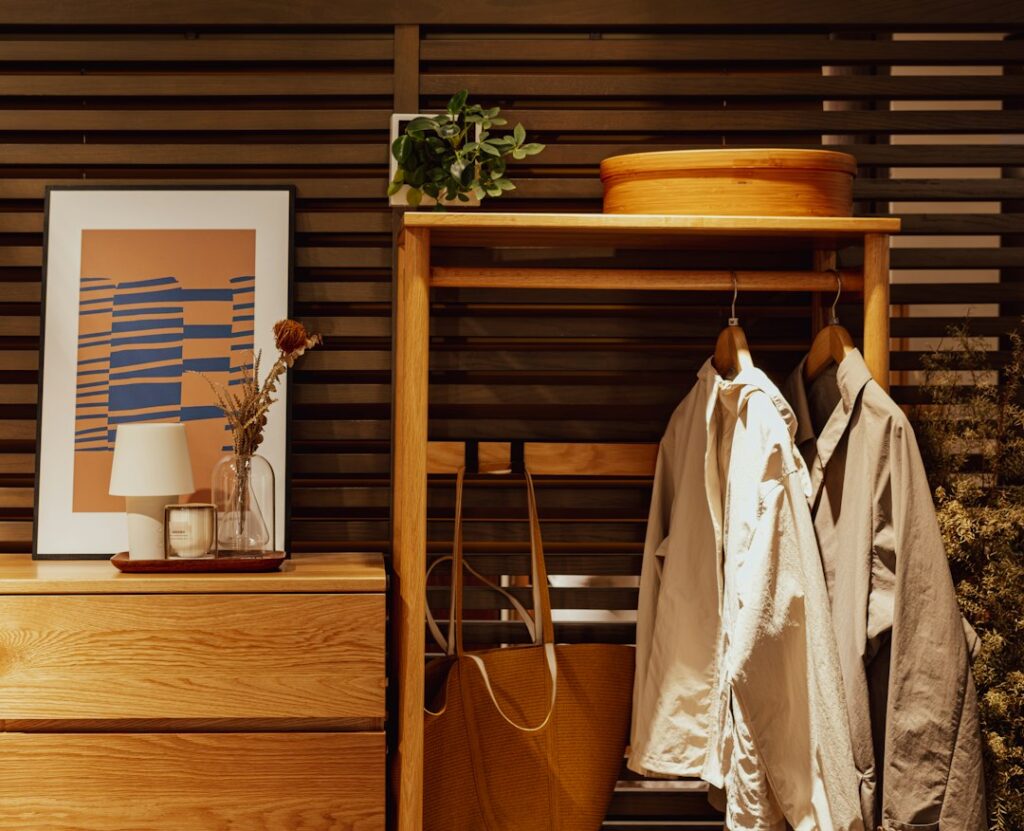
A row of hooks alone turns into a pile of jackets with hats and gloves stuffed on top. A coat rack with shelf fixes that by giving small items a landing spot above the coats, so the whole entry stays usable in a footprint only 6 to 10 inches deep. The catch is weight. A fully loaded rail with winter coats, a backpack and a wet umbrella can easily carry 50 pounds or more, so how you mount it matters as much as how it looks.
You have two paths. Buy a ready-made wall mounted coat rack with shelf, or build a simple one from a board, a shelf plank and a set of hooks or pegs. Both work well when the rail is screwed into wall studs or into anchors rated for the load. We cover styles, sizing, a basic DIY build, mounting and the mistakes that cause racks to sag or pull out of the wall.
- Choosing a Coat Rack With Shelf: Styles That Work
- Sizing and Placement
- Tools and Materials for a DIY Build
- How to Build a Wall Shelf With Hooks
- Mounting Safely: Studs, Anchors and Weight Limits
- Freestanding Racks and Tip-Over Risk
- Troubleshooting Common Problems
- Cost to Build vs Buy
- When to Call a Pro
- Frequently Asked Questions
Choosing a Coat Rack With Shelf: Styles That Work
Most entryway shelf with hooks designs fall into a few families. Each suits a different amount of gear and a different look.
Shaker peg rail with shelf
A flat backboard with turned wooden coat pegs and a shallow shelf on top. Wooden coat pegs with shelf rails have a clean, traditional look and grip coats well without snagging fabric. They pair well with farmhouse or cottage interiors.
Floating shelf with hooks
A solid shelf mounted on hidden brackets with metal hooks screwed into its underside or front edge. A floating shelf with hooks looks minimal, but the hidden bracket must be rated for the combined load, since coats pull down and outward at the same time.
Bracketed hook rack with shelf
A backboard with visible brackets supporting the shelf and a row of cast or bent metal hooks. This is the sturdiest style and the easiest to find as a heavy duty wall mounted coat rack with shelf. Black shelf with hooks and white shelf with hooks finishes are common, and rustic wood shelf with hooks versions use stained or reclaimed boards.
Hanging shelf with hooks
Some units hang from a cleat or over a door. They are fine for light loads in rentals, but they are not a good choice for heavy winter gear.
Sizing and Placement
- Length: plan about 6 to 8 inches of rail per hook. A family of four usually needs 5 to 8 hooks, so 36 to 48 inches is a common length.
- Shelf depth: 6 to 10 inches holds hats, gloves and small baskets without becoming a head hazard.
- Height for adults: hooks around 60 to 66 inches off the floor, with the shelf a few inches above.
- Height for kids: a second lower rail around 36 to 48 inches lets children hang their own things. Use rounded hooks or pegs at this height.
- Clearance: leave at least 36 inches of walkway in front of the rail when coats are hanging, and keep hooks clear of door swings.
Tools and Materials for a DIY Build
- 1×6 or 1×8 board for the backboard (hardwood or clear pine)
- 1×8 or 1×10 board for the shelf
- Coat hooks or wooden pegs (plan one per 6 to 8 inches)
- Wood glue and 1 1/4 inch screws or pocket screws
- Two or three shelf brackets, or a French cleat
- 2 1/2 to 3 inch structural wood screws for stud mounting
- Stud finder, level, tape measure, drill/driver, sandpaper, finish or paint
How to Build a Wall Shelf With Hooks
- Cut the boards. Cut the backboard and shelf to the same length. Ease the edges with sandpaper.
- Attach the shelf. Glue and screw the shelf to the top edge of the backboard from behind, or use pocket screws on the underside. Add small brackets underneath for extra support.
- Lay out the hooks. Mark hook positions evenly along the backboard, keeping the end hooks 3 to 4 inches from the ends.
- Finish the wood. Paint or stain and seal before installing hooks. A durable clear coat resists scuffs from zippers and bags.
- Install hooks or pegs. Pre-drill and screw metal hooks in place, or drill holes for pegs and glue them in at a slight upward angle.
- Mark the studs. Use a stud finder to locate studs, typically 16 inches apart, and transfer the marks to the backboard.
- Mount it. Have a helper hold the rail level, pre-drill through the backboard, and drive structural screws into at least two studs. For longer rails, hit every stud the board crosses.
A French cleat is a good alternative mounting method. Screw one beveled strip to the studs and attach the matching strip to the back of the rail. The rail drops onto the cleat and the weight pulls it tighter to the wall.
Mounting Safely: Studs, Anchors and Weight Limits
The most common failure with any hook rack with shelf is pull-out. Coats hang from the front of the hooks, which levers the top of the rail away from the wall. Plastic expansion anchors in drywall can loosen and fall out under that repeated pull.
- Studs first. Screws driven at least 1 1/2 inches into wood framing give the most dependable hold.
- Rated anchors when studs don’t line up. Use heavy-duty toggle bolts or metal self-drilling anchors rated for more than the expected load, and check the package rating for shear and pull-out in drywall. Treat the rating as a maximum, not a target.
- Masonry walls. Use masonry sleeve anchors or screws with a hammer drill and the correct bit.
- Know the limit. Follow the manufacturer’s stated weight capacity for a purchased unit, and do not let kids swing or climb on the rail.
- Check for hidden hazards. Before drilling, scan for wires and pipes. Avoid drilling directly above or below outlets and switches, where cables usually run vertically.
Freestanding Racks and Tip-Over Risk
If you cannot drill into the wall, a freestanding coat hanger with shelf or a hall tree offers a similar function. These units get top-heavy once coats are loaded on one side, and a child pulling on a hook can bring the whole piece down. Choose a wide, weighted base, load the heaviest items on the lowest hooks, and secure tall units to the wall with an anti-tip strap or bracket screwed into a stud. Place them away from doors that could swing into them.
Troubleshooting Common Problems
- Rail pulls away at the top: it is probably mounted on anchors only. Remount into studs or add a French cleat.
- Shelf sags in the middle: use a thicker board or add a center bracket. Spans over 32 inches in softwood usually need support.
- Hooks spin or loosen: screws stripped the pine. Move the hook slightly and re-drill, or use a longer screw with glue in the hole.
- Wall paint scuffs: add felt bumpers to the bottom corners of the backboard, or choose a taller backboard that protects the wall.
Cost to Build vs Buy
A DIY entryway wall shelf typically costs $30 to $100 in lumber, hooks and finish, depending on wood species and hook quality. Ready-made units range from about $30 for simple painted boards to $200 or more for solid hardwood or heavy-duty mudroom shelf with hooks designs. A handyman installation usually takes under an hour, and many charge a minimum service fee. When the entry is really a mudroom, pairing the rail with a bench and boot tray below creates a complete drop zone.
When to Call a Pro
Hire a handyman or carpenter if your walls are plaster, masonry or tile, if you can’t locate studs, or if you want a long built-in rail spanning multiple studs with a bench below. If a stud finder shows wiring where you need to mount, or if you want to add lighting above the rail, have a licensed electrician handle any electrical work.
Frequently Asked Questions
How high should a coat rack with shelf be mounted?
For adults, place the hooks around 60 to 66 inches off the floor with the shelf just above. Add a lower rail at 36 to 48 inches for children.
Can I hang a coat rack on drywall without studs?
You can use heavy-duty toggle bolts or metal anchors rated above your expected load, but screwing into at least two studs is more reliable for heavy winter coats and bags.
How much weight can a wall mounted coat rack hold?
It depends on the mounting and the unit’s rating. Rails screwed into studs with structural screws can hold considerably more than those on drywall anchors. Always follow the stated capacity.
How many hooks do I need on an entryway shelf with hooks?
Plan about two hooks per person plus one or two extras for bags and leashes. Space them roughly 6 to 8 inches apart.
Are freestanding coat racks safe with kids?
They can tip if loaded unevenly or pulled on. Choose a wide base, load heavy items low, and anchor tall units to a wall stud with an anti-tip strap.


